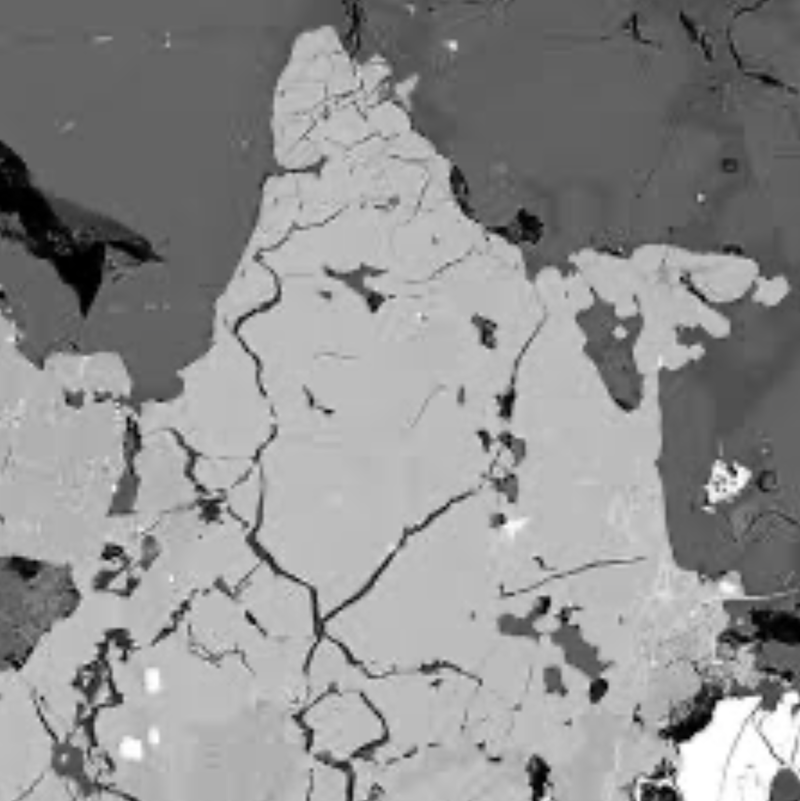
- Teghaza 001 is a meteorite that came from Mars. Prospectors found it in the Sahara Desert in 2022.
- Analysis of this rock suggests Mars began to lose its water very early in its history.
- Plus, it reveals Mars had a crust similar to granite, which is surprising given the planet lacks plate tectonics.
Teghaza 001, the oldest known Mars meteorite
Many pieces of Martian material have been ejected from the red planet and reached Earth as meteorites. And one of the more recently discovered Martian meteorites might be the oldest yet.
That’s what a team of scientists, led by the California Institute of Technology (Caltech), said on July 16, 2026. Prospectors found the meteorite – named Teghaza 001 – in the Sahara Desert in September 2022. And researchers have identified the piece of Mars’ crust as being over 4.1 billion years old.
The meteorite hints that the planet was already losing its water at that early stage in its life. Plus, it points to a granite-like crust on ancient Mars. That’s surprising, as the formation of granite on Earth is associated with tectonic activity … and Mars lacks plate tectonics.
The not-yet peer-reviewed paper is available as a preprint on the ESS Open Archive (April 14, 2026). Additional papers are also expected.
This meteorite, called Teghaza 001, “will revolutionize the way that we think about early Mars.”Learn more: https://scim.ag/4yDBSYK
— Science Magazine (@science.org) 2026-07-21T22:40:01.528162083Z
A view into Mars’ past
Paper co-author Lee Saper is a geochemist at NASA’s Jet Propulsion Laboratory (JPL). He gave a talk at the Goldschmidt geochemistry conference in Montreal, Canada, on July 14. He said that the meteorite:
… will revolutionize the way that we think about early Mars.
And he’s likely right.
Teghaza 001 is only the second known Martian meteorite from the Martian crust in the earliest period of the planet’s history. The other one is Allan Hills 84001. So now, scientists have two meteorites to work with instead of just one. Lydia Hallis, a planetary scientist at the University of Glasgow, said:
We’ve doubled our old meteorites. There will be a lot of people, including me, who want to get a piece of this.
So what does the meteorite show?
Tegzaza is rich in both zircons and silicon. Zircon minerals contain tiny amounts of uranium. The uranium decays into lead over time. Since it decays at a known rate, scientists can use it to determine the age of the meteorite.
If the zircon minerals melt or are exposed to fluids, though, then their “clocks” are reset to zero. This means that the meteorite might be even older than 4.1 billion years. Christopher Herd, a geologist at the University of Alberta, said:
There’s more of a story to this rock than most other Martian meteorites.
Mars meteorite hints at granite-like crust on ancient Mars
But there was another surprise in the meteorite: it contained a lot of silicon. This hinted at granite-like rocks on ancient Mars. As Eva Scheller, a planetary scientist at Stanford University, noted:
It’s very strange; we don’t expect that.
Scientists never expected Mars to have much granite since it lacks plate tectonics (the division of a planet’s upper crust into multiple different pieces, or plates). On Earth, granite forms from cooling magma. And most of that magma is generated by the movement of tectonic plates. Meanwhile, most of Mars’ crust is composed of solid basalt.
But it’s starting to look like Mars did once have at least some granite, or granite-like rock. Impacts from meteorites have exposed some deposits. And last year, the Perseverance rover discovered a rock outcrop, called Plankeholmane, that looks a lot like granite on Earth. It contained quartz, a key component of granite.
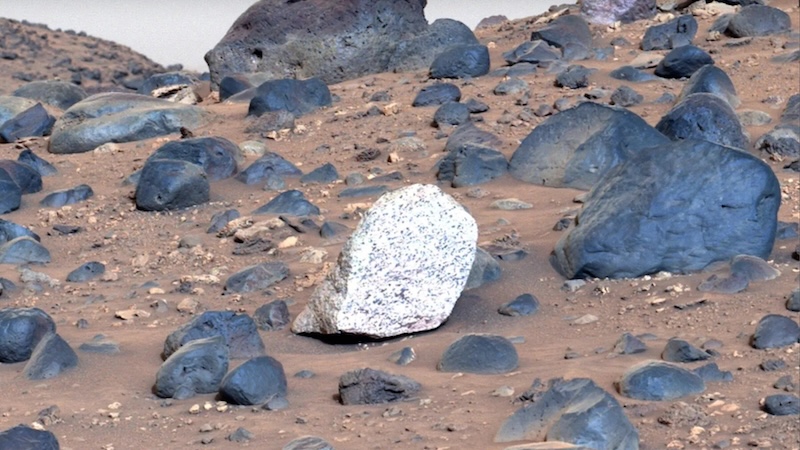
And last year, the rover found an odd speckled white rock called Atoko Point that also appeared quite granite-like. It contained pyroxene and feldspar. Feldspar is also a component of granite on Earth.
How was Mars able to produce such deposits without plate tectonics? Scientists don’t know yet. This evidence also points to complex magma systems on early Mars, as does this other recent study.

When Mars dried up
The meteorite also provides valuable clues about past water on Mars. Both it and the Allan Hills meteorite show that Mars had more water early in its history. But they also indicate that Mars began to lose its water early on, as the planet’s magnetic field disappeared and the atmosphere thinned and became much colder. Considering that these meteorites are at least 4.1 billion years old, and Mars – like Earth – formed some 4.5 billion years ago, this loss of water seems to have come in the planet’s infancy.
The clues come from the ratios of hydrogen in the meteorites. When Mars began to lose its water, the higher ratio of hydrogen – the primary component of water – to deuterium dropped. Super said:
This is the product of rapid hydrogen loss from the juvenile Martian atmosphere.
The new analysis of Teghaza 001 has provided new clues about Mars’ ancient past. And it also raises new questions. It will be interesting to see what else it and similar Mars meteorites reveal!
Bottom line: A new analysis of the the oldest known Mars meteorite, Teghaza 001, reveals evidence for a granite-like crust and the start of the loss of water on early Mars.
Like what you read?
Subscribe and receive daily news delivered to your inbox.
More from
Paul Scott Anderson


Weirdest cloud on Mars formed via ‘exotic physics’

Did formaldehyde on ancient Mars help kickstart life?
Black holes could have planets, new simulations suggest
Is this an alien radio signal from a super-Earth exoplanet?