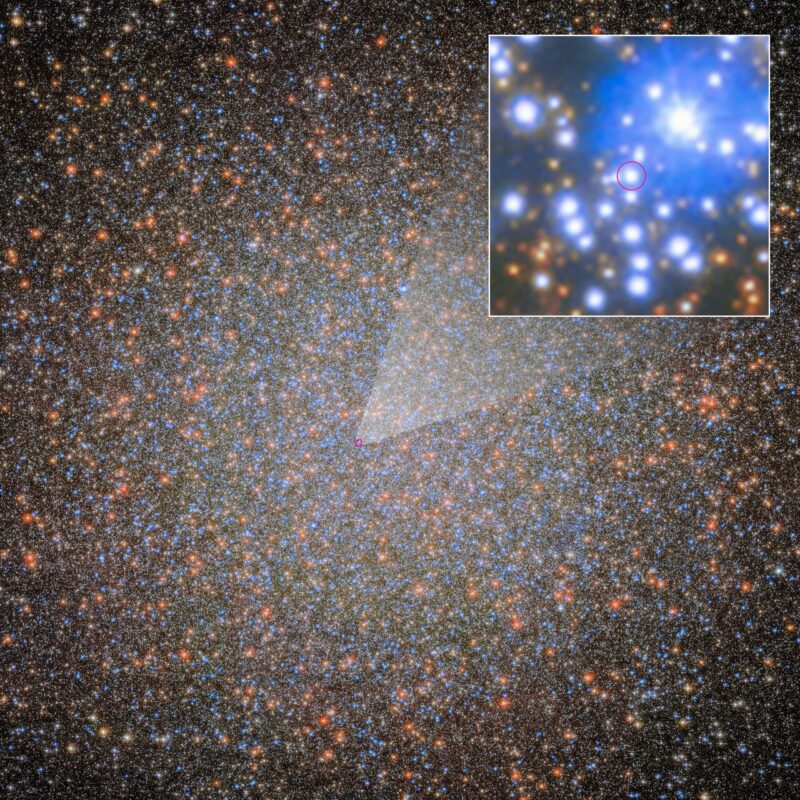
10,000 black holes are missing from this star cluster
Astronomers know of three different categories of black holes. There are the supermassive black holes, which are the beasts that lurk at the centers of galaxies. There are stellar-mass black holes, which form after huge stars die. And then there are intermediate-mass black holes that fill the gap between those two.
Astronomers think the Omega Centauri globular cluster – a huge collection of 10 million stars that orbits our Milky Way galaxy – should be home to some 10,000 stellar-mass black holes. But they’d never found any stellar-mass black holes in the cluster … until now.
On July 13, 2026, ESA said observations with the Hubble and Webb space telescopes have revealed evidence for a stellar-mass black hole in the massive star cluster. The data from these two telescopes allowed astronomers to track a star orbiting a companion for more than 20 years in the cluster. And the star’s invisible dance partner is so heavy that astronomers concluded it must be a black hole. They’ve named the newly found black hole oMEGACat BH-2.
The researchers published their peer-reviewed paper in The Astrophysical Journal Letters on July 13, 2026.
Finding a stellar-mass black hole
Astronomers had searched for stellar-mass black holes in the globular cluster before. Their previous methods of detection included looking for emissions from material falling into the black hole and something called the radial velocity method. This method looks at how fast stars are moving toward or away from us. It can reveal the presence of nearby objects. But these methods never turned up a black hole in Omega Centauri.
Enter astrometry. This is a method where astronomers measure precise locations and movements of stars over time. More than 20 years of data allowed astronomers to get a collection of the precise movements and wiggles of stars in Omega Centauri. And one star revealed it not only had a companion, but the companion was more massive than any star.
Astronomers calculated the companion was too heavy to be something like a neutron star (the dense core of a dead star). But at the same time, it was a bit lighter than they were expecting for a black hole. Co-author Anil Seth of the University of Utah said:
While we already knew that the star was 0.78 solar masses, we can now calculate the black hole’s mass, which is 4.46 solar masses and therefore too heavy to be a neutron star. However, its mass is actually much lower than would be expected in a metal-poor environment like Omega Centauri. This is surprising and exciting. We now know that a metal-poor star should be able to form a black hole like this, and we need to figure out how that happens.
More insights into the black hole
The astronomers learned that the visible star orbits the black hole – oMEGACat BH-2 – once every 94 years. That’s the longest-known period for a star and its black hole.
But the star and black hole don’t appear to be original dance partners. The astronomers said the binary pair likely found each other in the crowded environment of the cluster.
And they won’t remain together forever. Calculations show the star and black hole will stay a pair for less than a billion years before other stars in the cluster tear them apart. It’s not easy being on a packed dance floor.
Insight into gravitational waves
This black hole and its stellar companion could give astronomers insight into gravitational waves. Gravitational waves are ripples in spacetime. They’re triggered by explosive events in the universe, such as exploding stars or black hole mergers. And the formation of black holes and their influence on companions, like oMEGACat BH-2 and its star, could provide insight into the physics of these events. Seth said:
It’s important to understand black hole populations in globular clusters, because there’s uncertainty about their physics and formation. More specifically, understanding the process of forming black holes and then dynamically forming binaries is vital, because it affects our ability to interpret and understand gravitational wave events. Environments like Omega Centauri are the primary places where we think binaries are merging and creating these waves.
Not the only black hole in Omega Centauri
While this is the first detection of a stellar-mass black hole in Omega Centauri, astronomers believe they’ve already identified an intermediate-mass black hole in the cluster. In 2024, a team of astronomers detected seven fast-moving stars in the innermost region of Omega Centauri. In fact, they’re moving so fast they should escape the cluster. So their existence and speed suggests a massive object – an intermediate black hole – is pulling on them. Read more about the intermediate-mass black hole in Omega Centauri here.
This video from the Max Planck Institute for Astronomy shows the 7 fast stars in the globular cluster Omega Centauri that should not be there. They provide evidence for a long-predicted intermediate-mass black hole. And now astronomers said they’ve also detected a stellar-mass black hole in Omega Centauri, which is 17,700 light-years away.
Bottom line: Astronomers think the Omega Centauri globular cluster should be home to 10,000 black holes of a stellar-mass size. But they’ve never found one … until now.
Source: A Long Period Stellar-mass Black Hole Binary in Omega Centauri
Like what you read?
Subscribe and receive daily news delivered to your inbox.
More from
Kelly Kizer Whitt


Why does anything exist? New theory emerges

Visible planets and night sky guide for October
Euclid was mapping the universe. Then it found a comet
Auriga the Charioteer and bright Capella on October evenings