ESA originally published this article on April 21, 2026. Edits by EarthSky.
Euclid Space Warps: Help spot galaxies bending spacetime!
With the launch of Space Warps, a new citizen science project, you can now join in the search to find galaxies that are bending the very fabric of the universe.
Hosted on the Zooniverse platform, this project sees members of the public search through never-before-seen images captured by the Euclid space telescope to find rare and elusive strong gravitational lenses. The project aims to shine a light on dark matter in galaxies and provide clues about mysterious dark energy.

Gravity warps spacetime
Warps in spacetime do not only show up in science fiction movies like Interstellar. In real life, we can see the warping effect that gravity has on spacetime in the form of gravitational lensing.
The enormous gravity of a massive object – such as a galaxy or cluster of galaxies – distorts the shape of spacetime and can bend the light rays coming from a distant galaxy behind. By warping spacetime, the foreground galaxy acts like a magnifying glass.
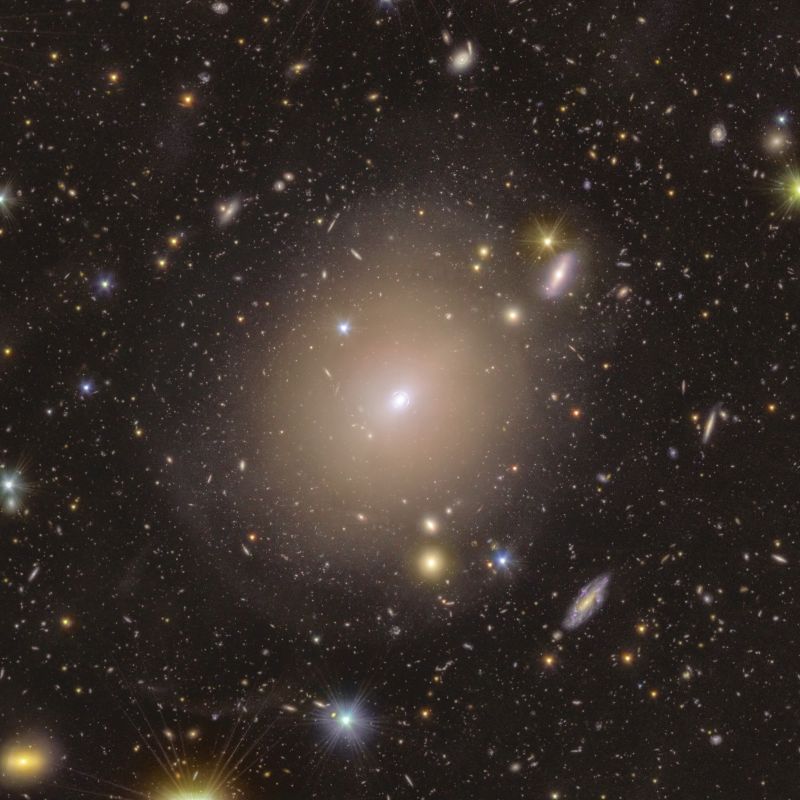
Light from the background object that would be obscured doesn’t travel in a straight line anymore. Instead, it curves around the intervening mass. That often produces multiple images, stretched arcs, or even a complete ring known as an “Einstein ring,” like the one recently discovered by Euclid.
ESA’s Euclid telescope launched in July 2023 and is revolutionizing the studies of strong gravitational lensing by providing very sensitive imaging over large swaths of the sky. This is exactly what is needed to identify rare gravitational lenses.
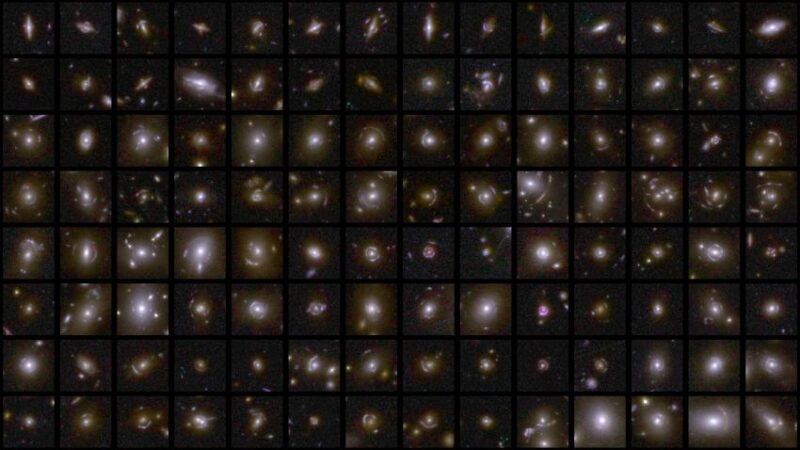
In March 2025, 500 galaxy-galaxy strong lenses were found nestled in just the first 0.04% of Euclid data, most of them previously unknown. This pioneering catalog was created thanks to the combined effort from citizen scientists, artificial intelligence and researchers.
Spot gravitational lenses with Space Warps
As Euclid continues its survey, sending around 100 gigabytes of data back to Earth every day, ESA and the Euclid Consortium once again need help from citizen scientists to identify strong gravitational lenses in a large data set.
For this, the Space Warps team has launched a citizen science project based on new Euclid images, which will be part of the future Euclid Data Release 1. This data is not public yet. So by participating in this new citizen science project, you can get an early glimpse of Euclid’s new images.
For this project, you will be inspecting new high quality imaging data from Euclid in which many previously unknown strong lenses are hiding. About 300,000 images pre-selected by AI algorithms will be shown, fine-tuned with the results from the initial citizen-science Euclid strong lens search.
These are the highest-ranked candidates from a whopping 72 million galaxies from Data Release 1 that were classified by the AI algorithms. Scientists expect that this exquisite high-quality data will reveal more than 10,000 new lenses.

What we can learn from strong lenses
The Euclid mission explores how the universe has expanded and how its structure has changed through cosmic history. It does so using mainly two methods: weak gravitational lensing and a phenomenon known as baryonic acoustic oscillations. From this, scientists can learn more about the role of gravity and the nature of dark matter and dark energy.
Strong gravitational lenses can also provide insights into these central questions. For example, strong lensing features can “weigh” individual galaxies and clusters of galaxies. This reveals the total matter (whether dark or light) and traces the distribution of dark matter.
By studying strong lenses across cosmic time, scientists can trace the expansion of the universe and its apparent acceleration. This will provide additional insight into the role of dark energy.
Aprajita Verma, Space Warps’ co-founder and project lead at the University of Oxford in the U.K., said:
We’ve already seen the success of combining AI with visual inspection by citizen volunteers and scientists on Space Warps, efficiently finding hundreds of high-probability lens candidates in an initial small Euclid search in 2024.
In this brand-new Data Release 1 data, 30 times larger than the initial search and together with our improved AI algorithms, we are expecting to find more than 10,000 high quality lens candidates. This is more than four times the number of lenses than we have been able to find since the first gravitational lens was discovered nearly 50 years ago.
We can’t wait to see what we will find within this unprecedented dataset. Join us on Space Warps to take part in this exciting search!
Bottom line: New citizen science project Space Warps lets you study new Euclid space telescope data to find galaxies bending the fabric of the universe.
Read more: New Euclid images reveal hidden gravitational lenses
Like what you read?
Subscribe and receive daily news delivered to your inbox.
More from
EarthSky Voices


Would a Yellowstone supervolcano eruption end humanity now?

Neptune discovered on this date 180 years ago
Earth images from space: 13 incredible photos of our planet
International Observe the Moon Night 2026 is tonight