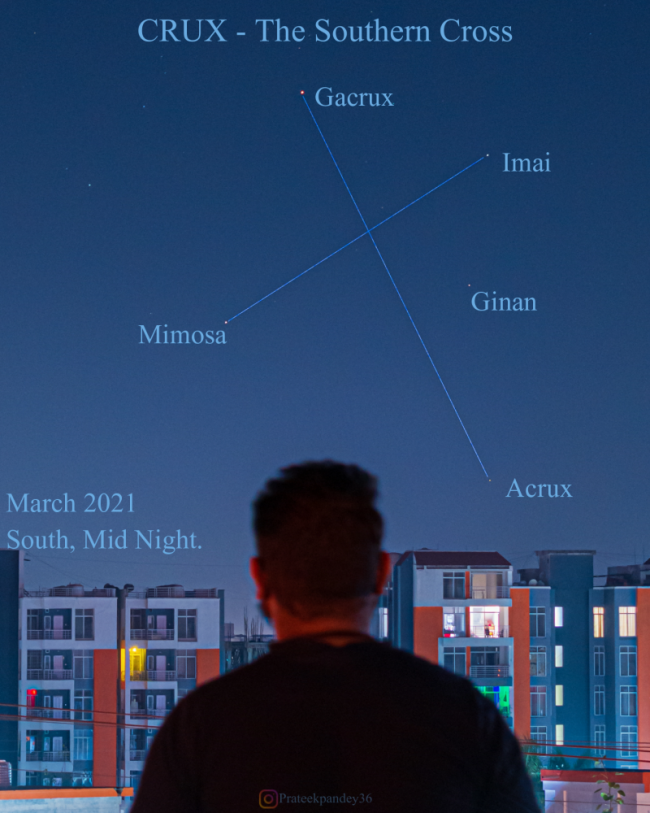
The Southern Cross is your guide to due south
Did you know you can use the constellation Crux, the famous Southern Cross, to find the south celestial pole and the direction due south? That is, you can if you are south of the equator, and can see both Crux and the sky’s south pole.
Even for us in the Northern Hemisphere, the Southern Cross is legendary. We’ve all heard of it. It appears on both the Australian and New Zealand national flags.
And you might already know that the south celestial pole is the point in the sky directly above Earth’s southern axis. It’s the point around which the entire southern sky appears to turn.
Here are three different methods for finding the south celestial pole, using the Southern Cross. Once you find it, you can draw a line downward from celestial south to find the earthly direction due south.
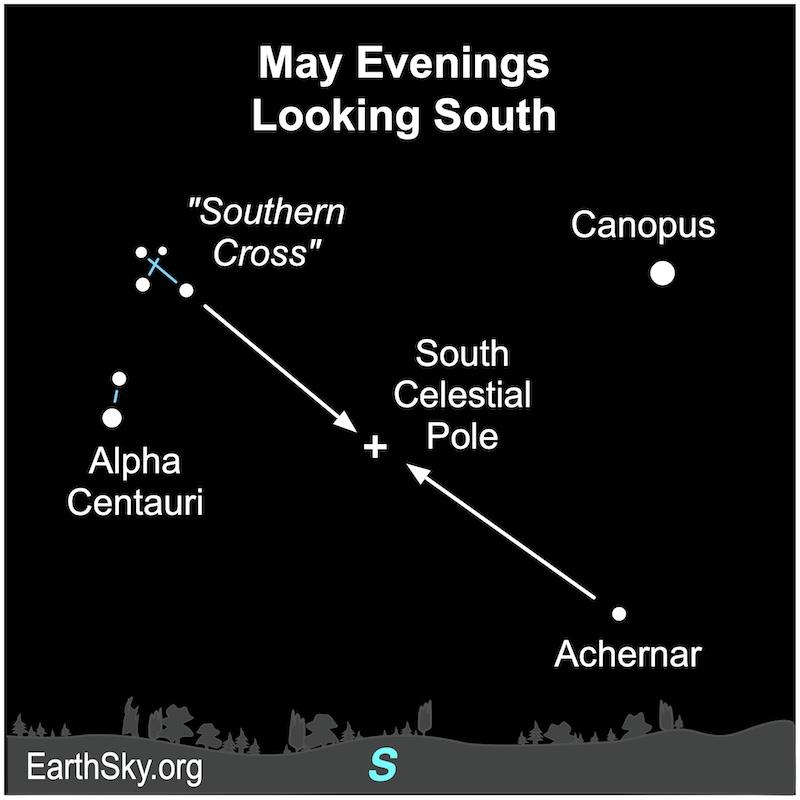
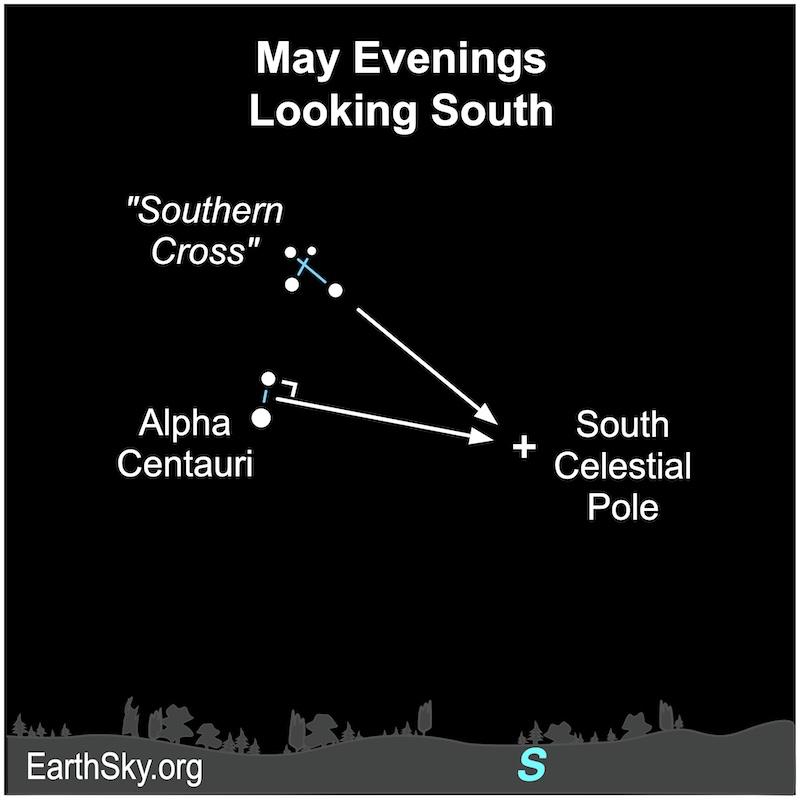
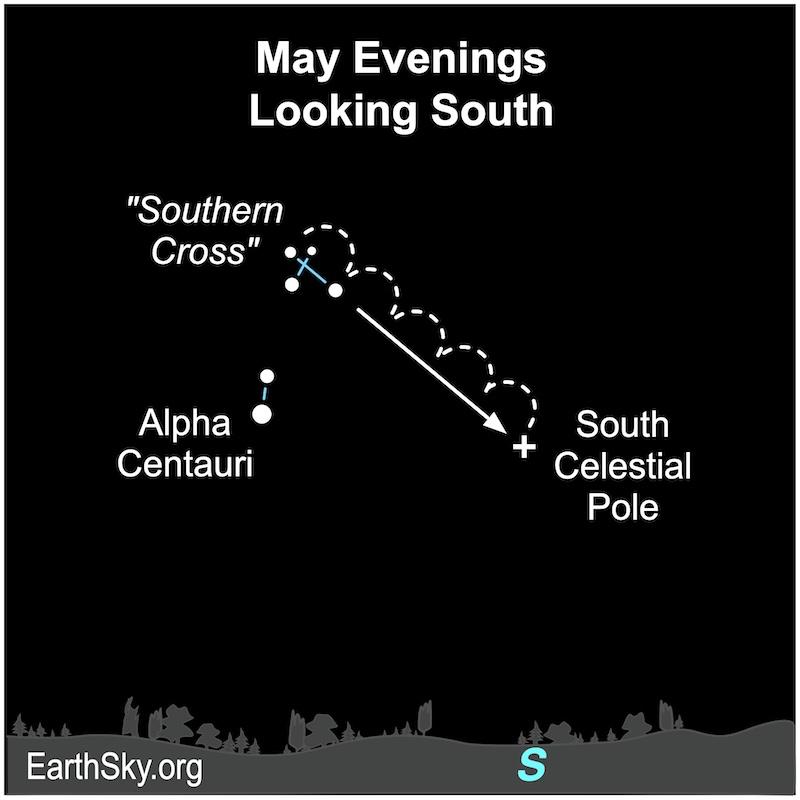
Prefer video?
Prefer to get your information via video? Here’s a video showing how to use the Southern Cross to find the south celestial pole and due south (assuming you are in the Southern Hemisphere).
Why do we need 3 methods?
In the Northern Hemisphere, there’s a moderately bright star – which modern astronomers call Polaris or the North Star – marking the north celestial pole. It’s not exactly on the sky’s north pole. It’s approximately 0.5 degrees from that pole. But close enough! If you watch throughout the night from the Northern Hemisphere, you’ll definitely notice that Polaris, the North Star, stays fixed in the northern sky. Meanwhile, the whole northern sky full of stars (or at least the part you can see from your latitude) wheels around it.
The stars that circle the pole never rise or set. They’re called circumpolar stars.
And that’s why there are lots of Northern Hemisphere stories about people finding their way when lost, by using Polaris as a guide to true north.
But the Southern Hemisphere doesn’t have a similarly bright star marking its pole. So we provide three ways to find it!
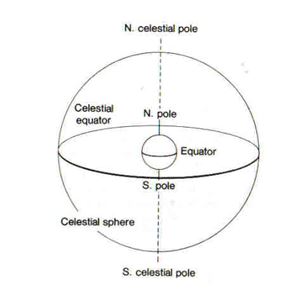
The height of the south celestial pole depends on your latitude
Here’s what’s true for both earthly hemispheres. The height of your celestial pole depends on your latitude.
So if you are at the North or South Pole of Earth – in wintertime, when it’s dark out – and you look straight up, you’ll be looking toward the celestial pole of your sky. If you’re in the Northern Hemisphere, you’ll see Polaris there. At that moment, the sky’s pole will make an angle of 90 degrees with your horizon.
But if you then travel toward Earth’s equator, the height of the pole in your sky will begin to shift. If you move 10 degrees toward the equator, the pole will likewise shift by 10 degrees. Now instead of being 90 degrees from your horizon, the pole of your sky will be 80 degrees up. Travel 20 degrees toward the equator from the pole, and the pole of your sky will be 70 degrees up … and so on.
So from 35 degrees N. or S. latitude, for example, you will find the celestial pole at a height in your sky equal to 90 degrees minus 35 degrees; in other words, you’ll find it in the north, or south, 55 degrees above your horizon.
And if you were at the equator, you could not see either the north or south celestial pole.

The Southern Cross isn’t the only way
The Southern Cross isn’t the only route to finding celestial south and the direction due south. There are several others way to find south. If you’re interested, try this Wikipedia page. The illustration below, which I found on Wikimedia Commons, shows how to use the Large and Small Magellanic Clouds to find celestial south.
Happy gazing, southern (and northern) friends!
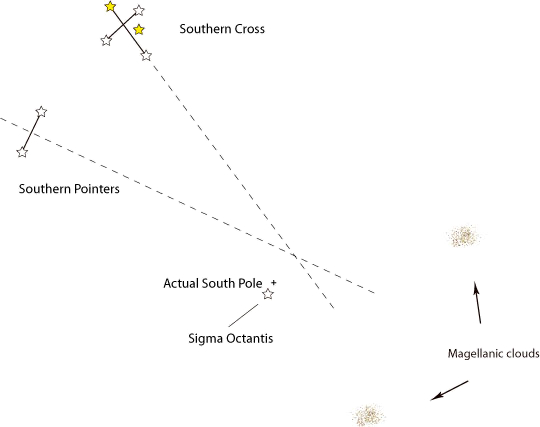
Bottom line: There’s no bright star marking due south from the Southern Hemisphere. But the Southern Cross points the way.
Read more: How to see the Southern Cross from the Northern Hemisphere
Like what you read?
Subscribe and receive daily news delivered to your inbox.
More from
Editors of EarthSky


Venus brightest in the evening sky this week

See Venus in the daytime: Here are 3 tips
Crepuscular rays are sunrays in twilight skies
What is retrograde motion? And why is the moon moving backwards?