



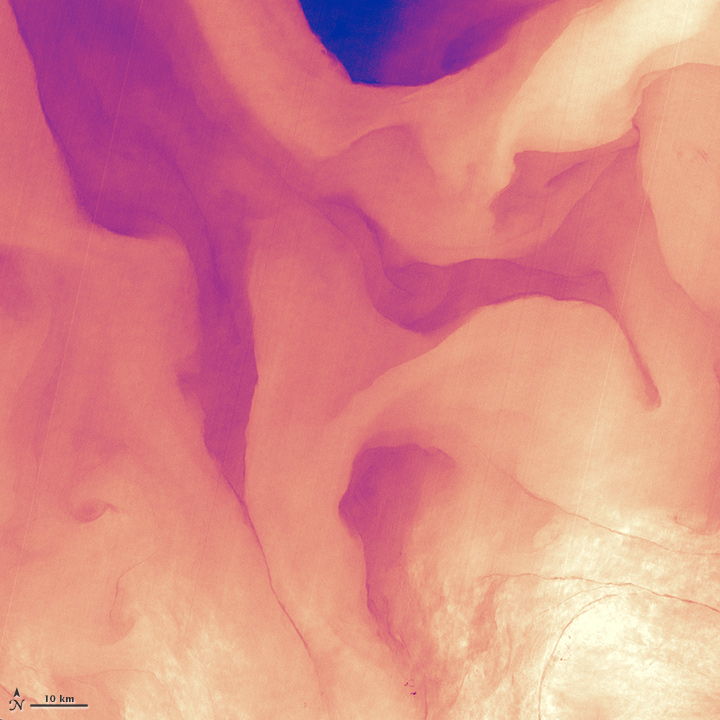
The image shows a small portion of the Gulf Stream in the infrared. The Gulf Stream is like a warm river in the ocean, but, as the image above shows, it’s not uniformly warm. Instead, water temperatures in the Gulf Stream range from 64° to 70.25° Fahrenheit (18° to 21.25° Celsius). The image – which is from an infrared sensor on the Landsat 8 satellite – shows cooler temperatures in purple and the warmest nearly white.
The bright area in the lower right of the image above is likely caused by sunglint, NASA says. It’s probably the reflection of sunlight directly back from the sea surface at Landsat 8’s infrared sensor.
The Gulf Stream carries warm water from the Gulf of Mexico along the U.S. east coast, then across the Atlantic, and finally as far as Ireland and Great Britain.
The image above is centered at 33.06° North latitude, 73.86° West longitude, about 500 kilometers (300 miles) east of Charleston, South Carolina.
Like what you read?
Subscribe and receive daily news delivered to your inbox.
More from
Deborah Byrd


Visible planets and night sky guide for October

Hera mission hits the brakes to arrive at asteroid
Flashing star in autumn? Here are 3 candidates
Stargazing tips! 10 great tips for beginning astronomers



