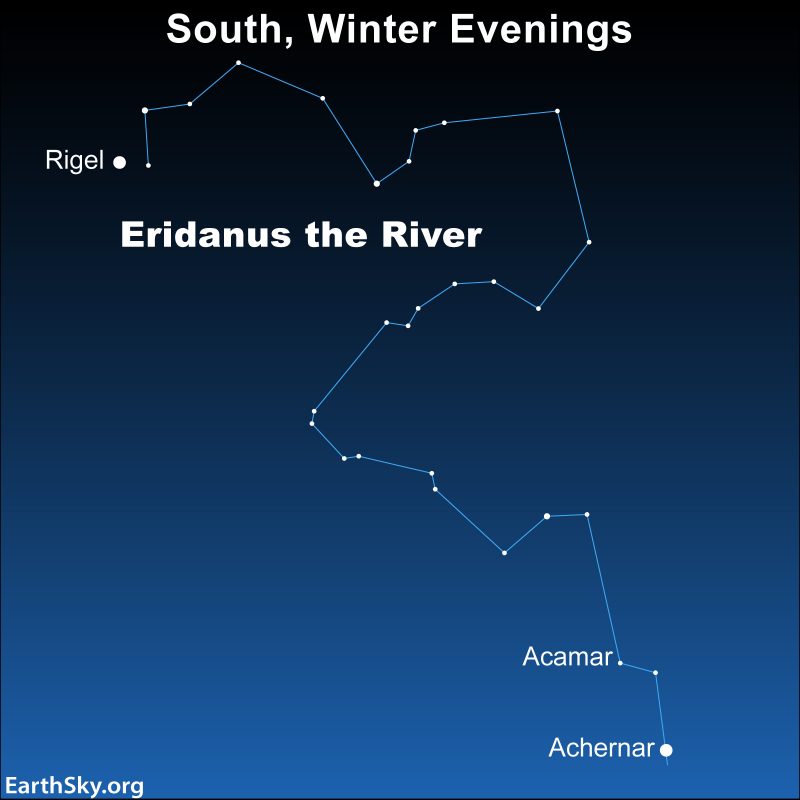
Eridanus the River
You’ll need a dark sky to see Eridanus the River. You won’t see this constellation from the city, or even the suburbs. The River begins near the star Rigel in the constellation Orion the Hunter and wells up in a great loop before ambling back down toward the southern horizon.
Eridanus is one of the longest and faintest constellations. But it’s very noticeable in a dark sky. It was one of the 48 constellations listed by the second century astronomer Ptolemy. The International Astronomical Union (IAU) included it on its list of 88 official modern constellations. Eridanus is the sixth largest of the modern constellations. It’s the one that extends farthest in the sky from north to south.
Why to search for such a faint constellation? Only because it’s beautiful. And seeing Eridanus – understanding its association with a river in the minds of the early stargazers – can give you a kinship with those stargazers from centuries ago.
2024 lunar calendars on sale now. Makes a great gift! Check it out here.
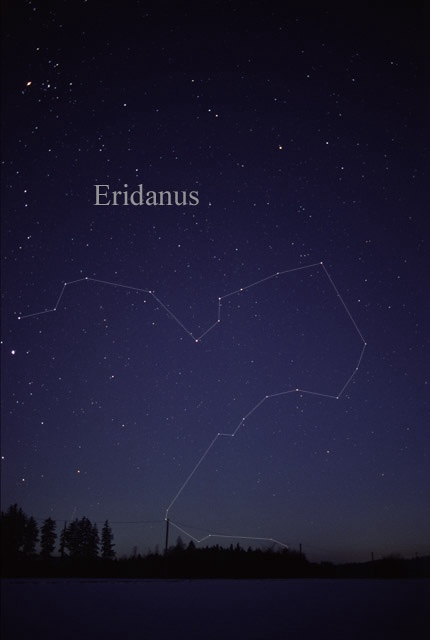
How to find Eridanus
From the Northern Hemisphere, look southward for Eridanus on northern winter evenings, say, in the month of January. At this time of year, the noticeable constellation Orion the Hunter is making its great arc across the southern sky. Orion is the key to seeing Eridanus. The River begins at Orion’s bright star Rigel. It then swells up in its mighty loop, before meandering back southward. From most of the U.S., the River disappears before its end below the southern horizon. But if you live at a very southerly latitude in the Northern Hemisphere, you can see a special sight: the bright star that represents the end of the River. This star is Achernar.
From the Southern Hemisphere, Orion is still helpful as a guide to seeing Eridanus. About two hours after sunset in January, part of the River will pass straight overhead. Those in the Southern Hemisphere can easily trace the entire River from near Rigel in Orion through the zenith to its bright star Achernar. Achernar lies at the end of the River not far from the Small Magellanic Cloud in Tucana the Toucan.

The River in skylore
Over the years, this long, winding constellation has represented the Nile in Egypt, Euphrates in western Asia, or the River Po in Italy. Eridanus also holds the nickname of the River of Orion, or River of Ocean. In Homer‘s day in ancient Greece, people thought that the River of Ocean encircled a flat Earth.
The mythology of Eridanus ties it to Phaethon. Phaethon was the son of Helios, the god of the sun. When he tried to fly his father’s chariot, he was unable to control the horses. The chariot veered wildly in different directions, scorching both Earth and heaven. Zeus struck the wayward Phaethon dead with a lightning bolt, and Phaethon fell into the River Erdianus. The constellation was sometimes the path Phaethon drove; other times, it was the path of souls.
Bottom line: Can you find the long, meandering river of stars called Eridanus in your sky? Be sure to look from a dark location.
Like what you read?
Subscribe and receive daily news delivered to your inbox.
More from
Deborah Byrd


Visible planets and night sky guide for September

Great Square of Pegasus gallops into the autumn sky
Yes, there’s an aurora season, and it’s here
2026 September equinox: All you need to know