




The latest sunsets after the summer solstice
For the Northern Hemisphere: Your latest sunsets – and latest evening twilights – are happening around now. They always come in late June and early July. Meanwhile, the Northern Hemisphere’s longest day falls on the June solstice.
For 40 degrees north latitude (Philadelphia, Pennsylvania; Beijing; Turkey; Japan and Spain), the latest sunsets are centered around June 27. The year’s latest sunsets always come after the summer solstice. But the exact date of the latest sunset depends on your latitude. Farther north, the latest sunsets happen on dates centered around June 25.
Farther south, the latest sunsets are centered on dates in early July.
For the Southern Hemisphere: Your latest sunrises of the year happen in late June and early July.
For the Northern or Southern Hemispheres: Latest sunsets go hand-in-hand with your latest twilights. The latest twilights of the year for 40 degrees north also happen in late June and early July. See more about twilight below.
To find out the sunrise and sunset times for a given day, visit Sunrise Sunset Calendars.

Why the latest sunsets come after the summer solstice
The latest sunsets come after the summer solstice because the day is more than 24 hours long at this time of the year.
For several weeks, around the June solstice, the day (as measured by successive returns of the midday sun) is nearly 1/4 minute longer than 24 hours. Hence, the midday sun (solar noon) comes later by the clock in late June than it does on the June solstice. Therefore, the sunrise and sunset times also come later by the clock, as the table below helps to explain.

Clock time and sun time
If the Earth’s axis stood upright as our world circled the sun, and if the Earth also stayed the same distance from the sun all year long, then clock time and sun time would always agree.
However, the Earth’s axis is tilted 23.44 degrees away from vertical, and our distance from the sun varies by about 3 million miles (5 million km) throughout the year. At and around the equinoxes, solar days are shorter than 24 hours, yet at the solstices, solar days are longer than 24 hours.
That’s why the latest sunsets always come around June 27 at mid-northern latitudes every year.
At mid-northern latitudes, the later clock time for solar noon one week after the summer solstice is more substantial than the change in daylight hours. Given that the daylight hours on June 27 are almost the same as they are on the June 20-21 solstice, the later clock time for the June 27 solar noon gives us slightly later sunrise and sunset times, as well.
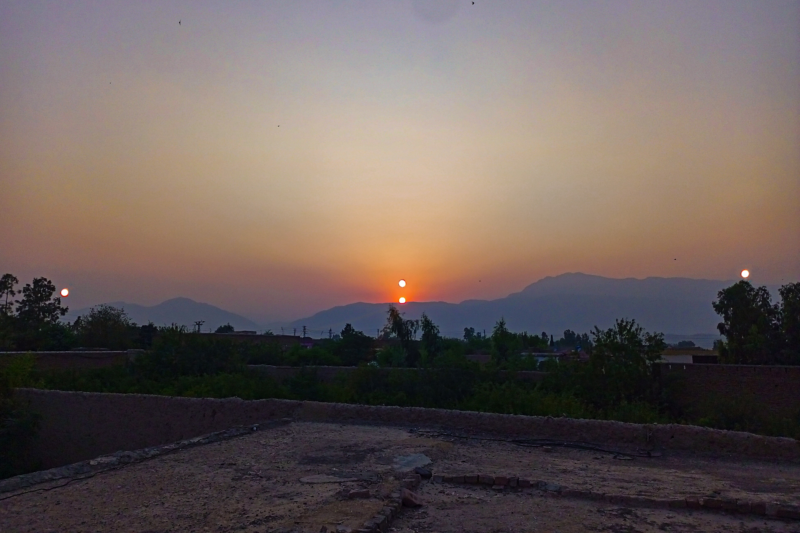
A word about twilight
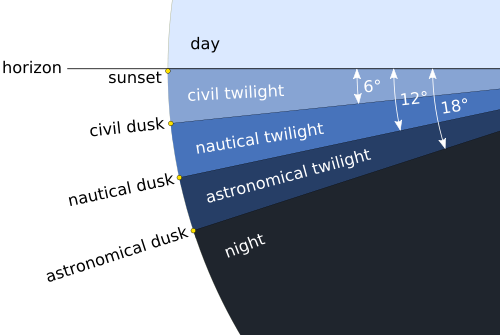
There are three kinds of twilight:
Civil twilight starts at sundown and ends when the sun is 6 degrees below the horizon.
Nautical twilight occurs when the sun is 6 to 12 degrees below the horizon.
Astronomical twilight happens when the sun is 12 to 18 degrees below the horizon.
North of 50 degrees north latitude, there’s no true night in the month of June. In June, that far north, the sun never gets far enough below the horizon for true night to occur. So from 50 degrees north latitude – to the Arctic Circle (66.5 degrees north latitude) – you’ll find midnight twilight at this time of the year.
And, above the Arctic Circle to the North Pole (90 degrees north latitude), this time of the year is the time of the midnight sun.
Read more: What exactly is twilight?
Bottom line: Why don’t the latest sunsets come on the longest day (the solstice)? In a nutshell, it’s a discrepancy between the sun and the clock. Thus, for mid-northern latitudes, the latest sunsets always come in late June.
Enjoying EarthSky so far? Sign up for our free daily newsletter
Like what you read?
Subscribe and receive daily news delivered to your inbox.
More from
Bruce McClure


Cassiopeia and Perseus on October evenings

Meet Aquarius the Water Bearer and its stars
Check out the Double Cluster in Perseus on October evenings
Find the Andromeda Galaxy using Cassiopeia



