Why do we have eclipses?
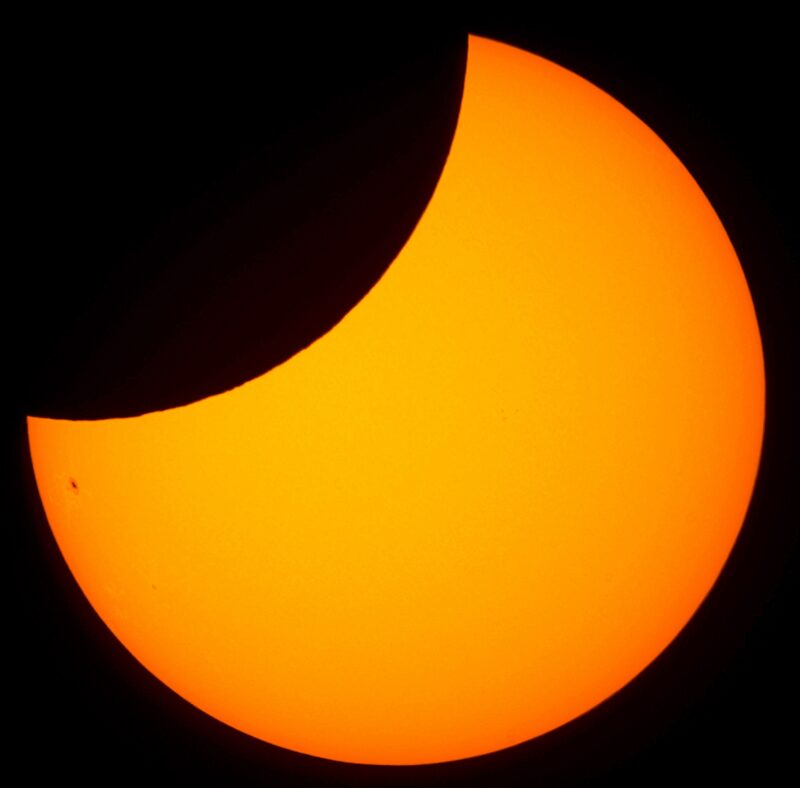
A solar eclipse happens at new moon, when the moon passes between the sun and Earth. A lunar eclipse happens at full moon, when the Earth, sun and moon align in space, with Earth between the sun and moon. During a lunar eclipse, Earth’s shadow falls on the full moon, darkening the moon’s face and – at mid-eclipse – sometimes turning it a coppery red. We typically have between four and seven eclipses – some partial, some total, some lunar and some solar – every year. But why aren’t there eclipses at every full and new moon?
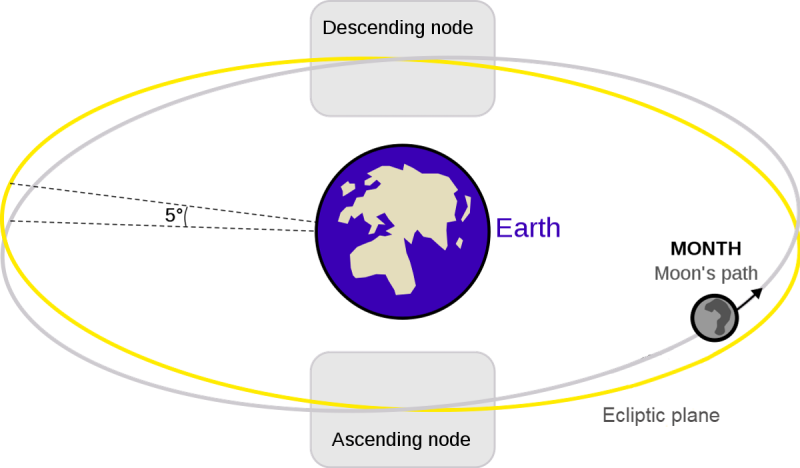
The moon takes about a month to orbit around the Earth. If the moon orbited in the same plane as the ecliptic – Earth’s orbital plane – we would have a minimum of two eclipses every month. There’d be an eclipse of the moon at every full moon. And, approximately two weeks later there’d be an eclipse of the sun at new moon for a total of at least 24 eclipses every year.
But that doesn’t happen, and the reason is that the moon’s orbit around Earth is inclined to Earth’s orbit around the sun by about 5 degrees. Twice a month the moon intersects the ecliptic – Earth’s orbital plane – at points called nodes. And if the moon is going from south to north in its orbit, it’s an ascending node. If the moon is going from north to south, it’s a descending node.
If the full moon or new moon sweeps appreciably close to one of these nodes, then an eclipse is inevitable.
An eclipse does not come alone
Solar and lunar eclipses always come in pairs, with one following the other in a period of one fortnight (approximately two weeks).
For example, there’s an ascending node annular solar eclipse on February 17, 2026, followed two weeks later by the descending total lunar eclipse on March 3, 2026.
Then exactly six lunar months (six full moons) later there’s a descending total solar eclipse on August 12, 2026. Followed two weeks later by an ascending partial lunar eclipse on August 27-28, 2026.
And then exactly six lunar months (six full moons) later there’s an ascending node annular solar eclipse on February 6, 2027, followed two weeks later by the descending penumbral lunar eclipse on February 20, 2027.
Eclipse seasons
More often than not, two eclipses – one solar and one lunar – occur in one eclipse season. Eclipse seasons last approximately 34 to 35 days. Sometimes, when the initial eclipse happens sufficiently early in the eclipse season, there can be three eclipses in one eclipse season (two solar and one lunar, or two lunar and one solar). This last happened in July-August 2020 (lunar/solar/lunar), and will next happen in June-July 2029 (solar/lunar/solar).
Read more: How often are there 3 eclipses in a month?
This year, in 2026, the middle of the eclipse season falls on February 27 and August 22. At the middle of an eclipse season, which recurs in periods of about 173 days, the lunar nodes are in exact alignment with the Earth and sun.
The video below explains why a pair of eclipses happens when the new moon and full moon align with the lunar nodes.
There might be some unfamiliar words in this video, including ecliptic and node. The ecliptic is the plane of Earth’s orbit around the sun. And the moon’s orbit is inclined to the plane of the ecliptic. The nodes are the two points where the moon’s orbit and the ecliptic intersect.
Moon phases shift along the zodiac every month
Relative to the moon’s nodes, the moon’s phases recur about 30 degrees farther eastward (counterclockwise) along the zodiac each month. So the next pair of eclipses won’t be forthcoming for nearly another six calendar months (6 x 30 degrees = 180 degrees). The first pair of eclipses in 2025 were on March 13-14 (total lunar eclipse) and March 29 (partial solar eclipse). Following the September 7 total lunar eclipse and September 21 partial solar eclipse, the next set of eclipses are an annular solar eclipse on February 17, 2026, and a total lunar eclipse on March 3, 2026.
Node passages of the moon: 2001 to 2100
Phases of the moon: 2001 to 2100
The following new moon and full moon happen nearly 30 degrees farther eastward as measured by the constellations of the zodiac in about 29.5 days. But the moon returns to its node a good two days earlier than that, or in about 27.2 days.
How often is there an eclipse?
Even though the moon’s orbit is inclined to that of Earth – and even though there’s not an eclipse with every new and full moon – there are more eclipses than you might think. All are marvelous to behold. They’re a reminder that we live on a planet and a chance to experience falling in line with great worlds in space!
There will be 224 solar eclipses in the 21st century. And there will be 228 lunar eclipses in the 21st century.
Bottom line: If the Earth and moon orbited on the same plane around the sun, we’d have a total solar eclipse – and a total lunar eclipse – every month. But we don’t, because the moon’s orbit is inclined to Earth’s orbit by about 5 degrees. In 2026, there are four eclipses: two solar and two lunar.
Like what you read?
Subscribe and receive daily news delivered to your inbox.
More from
Editors of EarthSky


Celebrate World Oceans Day today, June 8, 2026

June birthstone: Pearl, moonstone or alexandrite