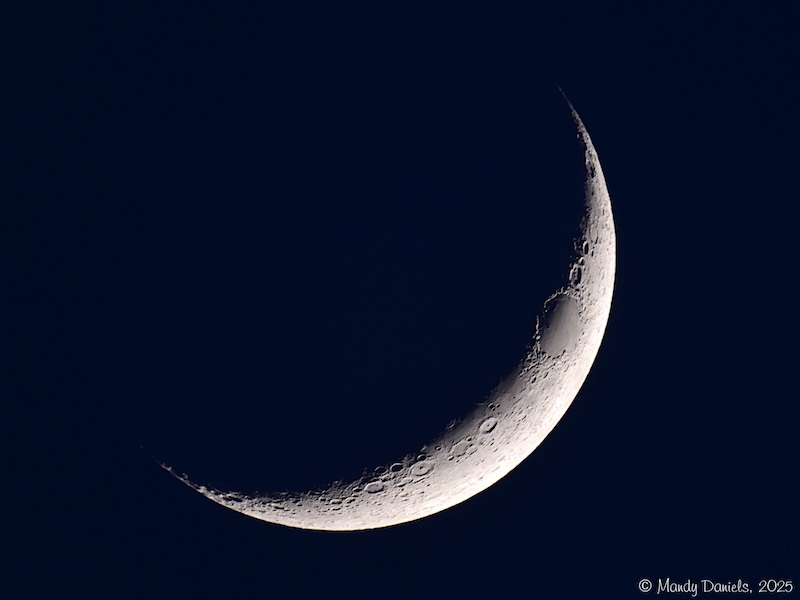
See the waxing crescent moon after new moon
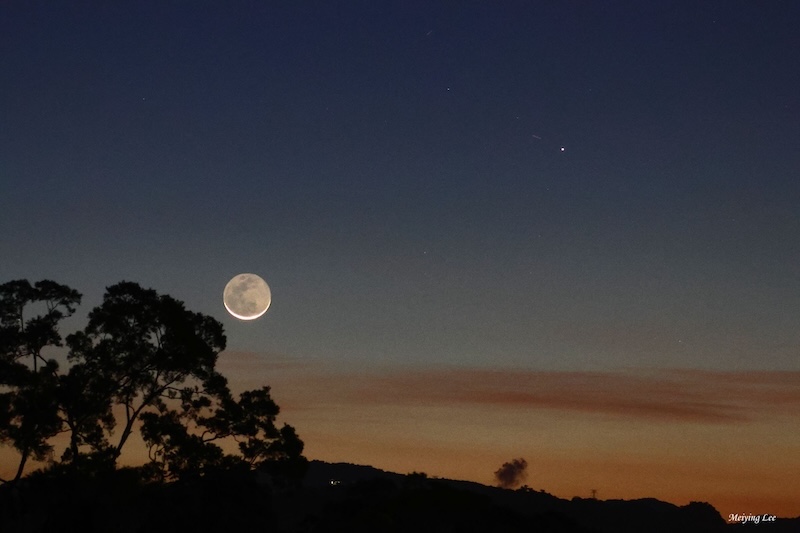
In the day or so after every new moon, a slim smile of a moon – a waxing crescent – appears in the west shortly after sunset. Some people think a moon visible in the west after sunset is a rising moon. It’s not; it’s a setting moon. As Earth spins under the sky, all sky objects rise in the east and set in the west. A waxing crescent moon – visible in the western sky – quickly follows the sun below the western horizon.
Also, a waxing crescent moon has nothing to do with Earth’s shadow on the moon. Earth’s shadow can fall on the moon only at full moon, when the moon and sun are opposite each other – on either side of Earth – in space. When Earth’s shadow falls on the moon, we have a lunar eclipse.
That’s not the case on a waxing crescent moon. Such a moon lies not opposite the sun, but, on the contrary, on nearly the same line of sight to the sun, as seen from Earth. There is a shadow on a crescent moon, but it’s the moon’s own shadow. You know how night on Earth happens on the part of Earth submerged in Earth’s own shadow? The same is true on the moon. When you stand looking at a waxing crescent moon, you’re seeing a thin fraction of the moon’s day side, or illuminated side, and a larger fraction of the moon’s night side, the side of the moon submerged in the moon’s own shadow.
Earthshine on the waxing crescent moon
You might also see a pale glow on that night portion of the moon, when the moon is a crescent. That glow is called earthshine. It’s caused by the fact that – when we see a crescent moon in Earth’s sky – any moon people looking back at our world would see a nearly full Earth. Just as a full moon can illuminate an earthly landscape, so a full or nearly full Earth can illuminate the lunar landscape. And that’s what you’re seeing when you see earthshine. Read more about earthshine.
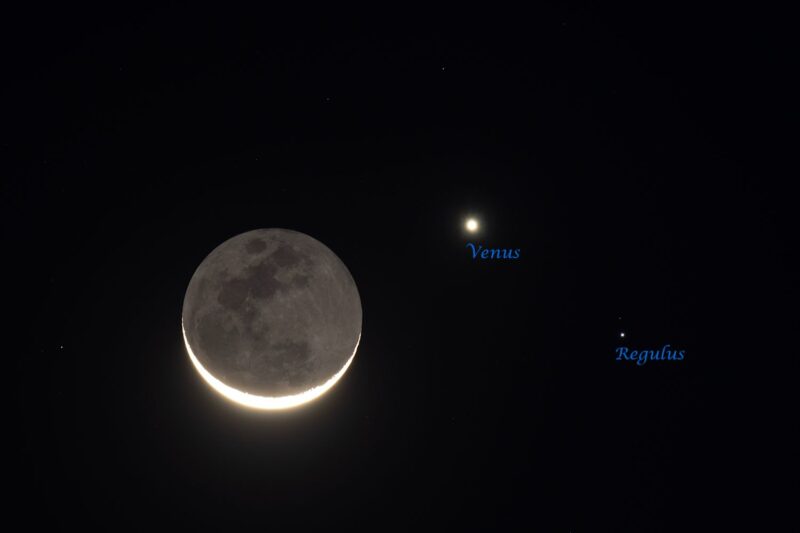

Because the waxing crescent moon is nearly on a line with Earth and the sun, its illuminated hemisphere – or day side – is facing mostly away from us. We see only a slender fraction of the day side: a crescent moon. Each evening, because the moon is moving eastward in orbit around Earth, the moon appears farther from the sunset glare. It is moving farther from the Earth-sun line in space. Each evening, as the moon’s orbital motion carries it away from the Earth-sun line, we see more of the moon’s day side. Thus the crescent in the west after sunset appears to wax, or grow fatter each evening.
More about moon phases
As the moon orbits Earth, it changes phase in an orderly way. Follow the links below to understand the phases of the moon.
New moon
Waxing crescent moon
First quarter moon
Waxing gibbous moon
Full moon
Waning gibbous moon
Last quarter moon
Waning crescent moon
Bottom line: A waxing crescent moon shines in the west after sunset. It quickly follows the sun below the western horizon.
Read more: 4 keys to understanding moon phases
Like what you read?
Subscribe and receive daily news delivered to your inbox.
More from
Deborah Byrd


NASA’s Perseverance rover on Mars sets off-world driving record

Visible planets and night sky guide for October
Hera mission hits the brakes to arrive at asteroid
Flashing star in autumn? Here are 3 candidates