



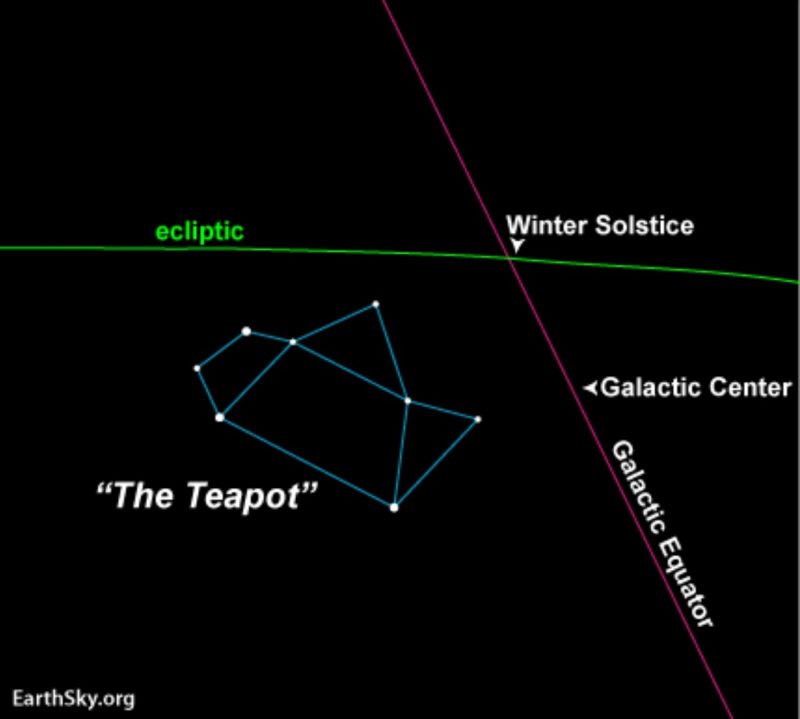
Come to know the Teapot of Sagittarius
Our Milky Way galaxy is a vast collection of hundreds of billions of stars. We’re not in the galaxy’s center, but instead about 2/3 of the way out from center, in one of the Milky Way’s spiral arms. And on August evenings, under a dark sky, all of us on Earth can gaze toward the galaxy’s center.
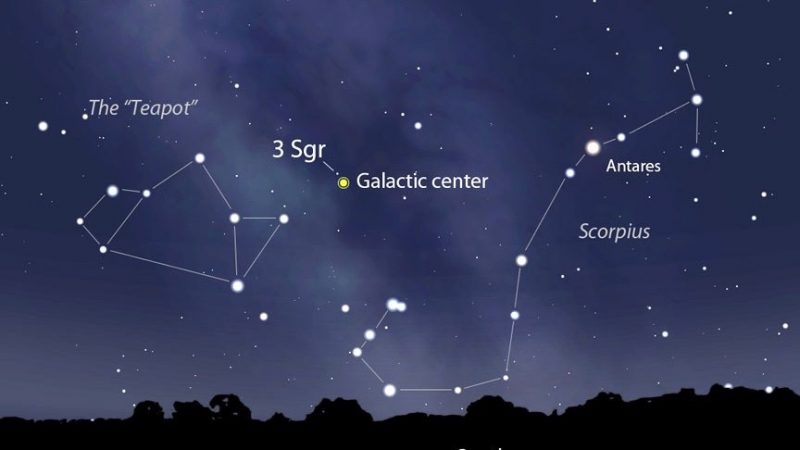
The band of the Milky Way gets broader and brighter in the direction of the center. And in that direction, you’ll find a famous asterism called the Teapot, in the constellation Sagittarius.
The Teapot’s pattern is distinctive. It’s easy to see it as an earthly teapot. You’ll find it southward on August evenings from the Northern Hemisphere, and overhead from the Southern Hemisphere.
Even if your sky isn’t dark, once you find the Teapot, you can use it to guide your mind’s eye to the star-rich center of our galaxy. A supermassive black hole lies at the galaxy’s heart, with some 4 million times the mass of our sun. It’s called Sagittarius A* (Sagittarius A-Star).
How to spot the Teapot
You’ll want a fairly dark sky to find the Teapot. A suburban sky will likely work, if you’re not standing under a streetlight. You can see the Teapot even if you can’t see the starry band of the Milky Way.
If you’re in the Northern Hemisphere, look southward on August evenings a couple of hours after sunset. If you’re in the Southern Hemisphere, look overhead.
The Teapot and Sagittarius are best viewed during the evening hours from about July to September.
Want a more exact location for Sagittarius? Try Stellarium, which will let you set a date and time from your exact location on the globe.
The Teapot looks like its name
The constellation Sagittarius is supposed to be a centaur, a mythical half man/half horse creature, carrying a bow and arrow. But good luck spotting the centaur in these stars!
On the other hand, the Teapot – unlike many star patterns – looks just like its namesake. That’s because the Teapot appears to have a handle, spout and lid, as any earthly teapot would. And just be sure to head to a dark sky for your best views of this Milky Way region.
Once you’ve found the Teapot, assuming you have a dark sky, you can see “steam” billowing out of the spout. Gaze into the midst of this “steam” – actually billions of stars – and you’ll be gazing toward the center of our Milky Way galaxy.
The Teapot is highest in the evening sky in August
Because the sun passes in front of Sagittarius from about December 18 to January 20, the Teapot isn’t visible then. However, about half a year later – on July 1 – the Teapot climbs to its highest point for the night around midnight (1 a.m. daylight saving time or DST), when it appears due south as seen from the Northern Hemisphere or due north as seen from the Southern Hemisphere. In August, the Teapot – and the Milky Way’s center – reach their highest points for the night during the evening hours.
By the way, another noteworthy point lies in the direction of the Teapot in space. It’s the point at which the sun shines on the December solstice around December 21 each year.
The center of our Milky Way
The center of our galaxy is some 26,000 light-years away. We can’t see directly into it, because this region is shrouded by dust and gas clouds. But studies by astronomers have shown that, when we look in this direction, we’re looking toward the supermassive black hole located at our galaxy’s heart. This black hole has some 4 million times our sun’s mass. It’s known as Sagittarius A*.
Now sweep the area around the Teapot with binoculars or a telescope. You’ll see many faint fuzzy objects pop into view. They’re star clusters and nebulae (gas clouds) located in the disk of our galaxy, in the direction of the galaxy’s center.
So, find the Teapot on a dark night – when the moon is out of the way – and enjoy all it has to offer.
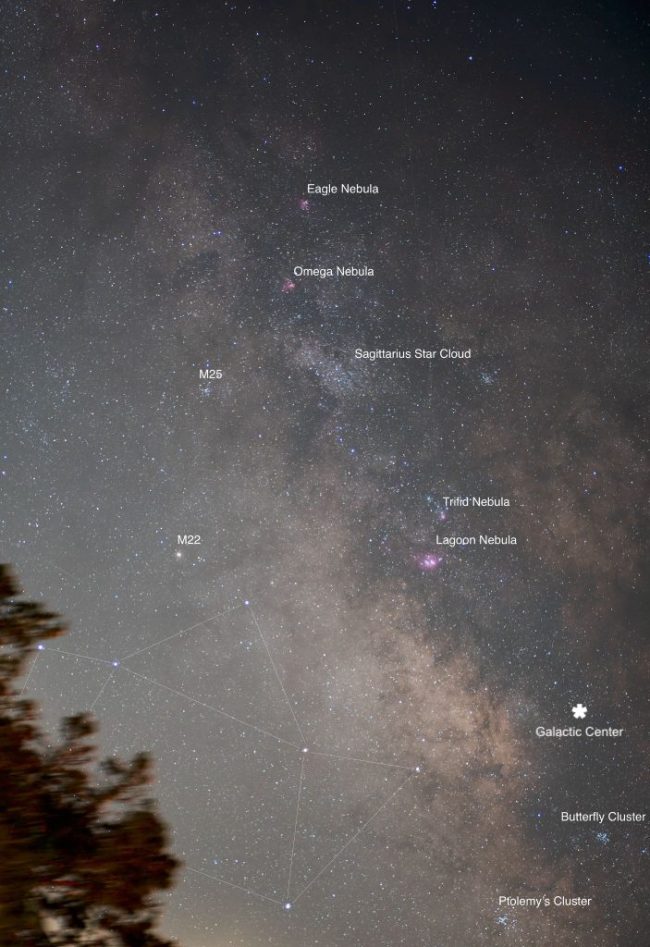
Bottom line: As you gaze toward the famous Teapot asterism in the constellation Sagittarius, you’re looking toward the center of our Milky Way galaxy.
Read more: Milky Way’s black hole emits rapid-fire flickers and flares
Like what you read?
Subscribe and receive daily news delivered to your inbox.
More from
Bruce McClure


Meet Aquarius the Water Bearer and its stars

Check out the Double Cluster in Perseus on October evenings
Find the Andromeda Galaxy using Cassiopeia
Alpha Cephei, or Alderamin, is a fast-spinning star



