EarthSky // Tonight // Favorite Star Patterns By Bruce McClure Jun 29, 2009

Big and Little Dippers: Noticeable in northern sky

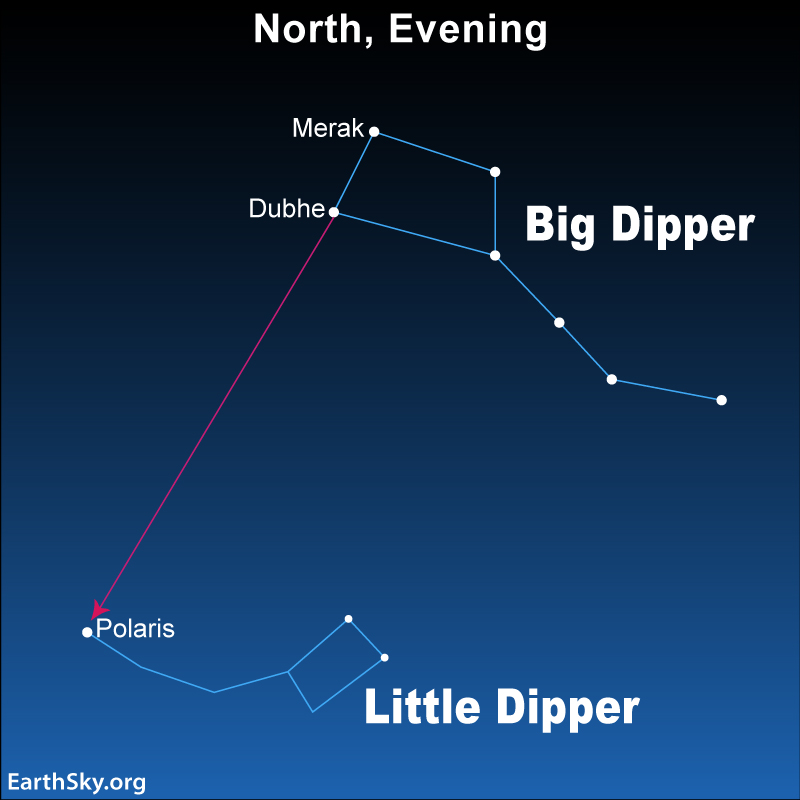
The Big and Little Dippers appear in the northern sky, near Polaris, the North Star.

How to find them

A fixture of the northern sky, the Big and Little Dippers swing around Polaris, the North Star like riders on a Ferris wheel. They go full circle around the North Star once a day – or once every 23 hours and 56 minutes. If you live at temperate latitudes in the northern hemisphere, simply look northward and chances are that you’ll see the Big Dipper in your nighttime sky. It looks just like its namesake and is so wonderfully easy to see that Chet Raymo, in his charming book 365 Starry Nights, suggests that our species is genetically predisposed to recognizing the Big Dipper.

Once you’ve found the Big Dipper, it’s only a skip, hop and jump to Polaris and the Little Dipper. Drawing a line through the pointer stars Dubhe and Merak always takes you to Polaris, the North Star. In turn, Polaris marks the end of the Little Dipper Handle. Like the Big Dipper, the Little Dipper has 7 stars. But the 4 stars in between Polaris and the outer bowl stars – Kochab and Pherkad – are rather dim. You need a dark country sky to see all 7.

Depending upon the season of the year, the Big and Little Dippers can be found high in the northern sky or low in the northern sky. Remember spring up and fall down. On spring and summer evenings, the Big and Little Dippers shine highest in the sky. On autumn and winter evenings, the Big and Little Dippers lurk closest to the horizon.

Given an unobstructed horizon, latitudes at and north of Little Rock, Arkansas (35 degrees north) can expect to see the Big Dipper at any hour of the night for all days of the year. As for the Little Dipper, it is circumpolar – always above the horizon – as far south as the tropic of Cancer (23.5 degrees north latitude).

History and Myth

The Big Dipper is really an asterism – a star pattern that is NOT a constellatrion. The Big Dipper is a clipped version of the constellation Ursa Major the Big Bear, these Big Dipper stars outlining the Bear’s tail and hindquarters. In the star lore of the Micmacs in Canada, the Big Dipper is also associated with a bear but with a different twist. The Micmacs see the Big Dipper bowl as Celestial Bear, and the 3 stars of the handle as hunters chasing the Bear.

The starry sky serves as a calendar and a story book, as is beautifully illustrated by the Micmac tale of Celestial Bear. In autumn, the hunters finally catch up with the Bear, and it’s said that the blood from the Bear colors the autmn landscape. In another version of the story, Celestial bear hits its nose when coming down to Earth, with its bloody nose giving color to autumn leaves. When Celestial Bear is seen right on the northern horizon on late fall and early winter evenings, it’s a sure sign that the hibernation season is upon us.

The Little Dipper is also an asterism, these stars belonging to the constellation Ursa Minor the Little Bear. In ancient times, the Little Dipper formed the wings of the constellation Draco the Dragon. But when the seafaring Phoenicians met with the Greek astronomer Thales around 600 B.C., they showed him how to use the Little Dipper stars to navigate. Thereby, Thales clipped Draco’s wings, to create a new constellation that gave Greek sailors a new way to steer by the stars. In Thales’s day, the stars Kochab and Pherkad (rather than Polaris) marked the approximate direction of the north celestial pole – the point in the sky that is directly above the Earth’s North Pole. To this day, Kochab and Pherkad are still known as the Guardians of the Pole.

Science

Astronomers know that the stars are not truly fixed on a great big stellar sphere. The star patterns that we see today will slowly but surely drift apart over the long course of time. But even 25,000 years from now, the Big Dipper pattern will look nearly the same as its does today. Astronomers have found that the stars of the Big Dipper (excepting the pointer star, Dubhe, and the handle star, Alkaid) belong to an association of stars known as the Ursa Major Moving Cluster. These stars, loosely bound by gravity, drift in the same direction in space. In 100,000 years, this pattern of Big Dipper stars (absent of Dubhe and Alkaid) will appear pretty much like it does today!

Share your comments on Facebook

36 Responses to Big and Little Dippers: Noticeable in northern sky

  1. yoda says:

    yoda rocks

  2. jessica hinkle says:

    I love the way you have the page on the big dipper and the little dipper . How did you do it ? If you are wondering i am a kid . I am 11 years old .

  3. kkkkjkjkjkjkkj says:

    hi

  4. Keke says:

    You know, I am doing a project on the little dipper, and I have not yet found any info on this web site. By the way, do you know what colour are the stars of the little dipper?

    • Bruce McClure says:

      Keke,

      Color perception can be to some degree subjective, so you might want to check out the colors of the Little Dipper stars for yourself in a dark coutry sky. If you have trouble detecting star color with the unaided eye, try using binoculars. If you still have trouble, slightly unfocus the binoculars. Sometimes that trick helps to highlight stellar colors.

      Good luck!
      Bruce

  5. Keke says:

    Thanks Bruce, but I’m sad to tell ya’ that I lost this website for a wile, so I didn’t see your post until now. By the way, how old are you?

    • Bruce McClure says:

      Keke,

      So glad you rediscovered our site! I am looking forward to your future visits. Since my birth, the equinox and solstice points have shifted about 6/7th of one degree westward through the stars, while the planet Jupiter has made a little more than 5 loops eastward through the stars.

      Bruce

      • David says:

        Hi there,

        Firstly, apologies for coming so late to this thread! But it caught my interest. Bruce, I’m not TOO sure how to calculate using degrees (only an amateur at the mo!), but I do know that the equinox dates shift slowly backwards through the years, and it moves a full day in about seventy years, and 6/7th of that is pretty much 60.

        I’m not 100% on jupiter cycling through the sky (I don’t know what it’s orbit pattern looks like from earth, I can just sometimes find it), but i do know that it’s year is about twelve years long. So if its orbit paints a loop in earth’s sky, and you’ve lived through a little over five of them, I’d say you’re just a bit over sixty.

        I won’t tell you how old I am, but i will tell you that I’m a couple of years shy from watching saturn complete a full cycle.

    • DGrieme says:

      This website is so neat! I’ve got to show it to my kids. You seem a little older than they are, however. They are almost 6.

      I noticed in your reply that you didn’t think that Bruce answered your question about his age. In fact, he answered it twice. Look back on his reply to your first question and you will find a comment about the equinox and solstice points shifting and the orbit of the planet Jupiter. Both of these give you a close approximation of Bruce’s age. I figured it out very quickly, but then I am nearly as old as he is.

      Keep reaching for the stars there in China.

      D

  6. Keke says:

    Hi Bruce, how old are you? We could hang out some time, exept that I live in China.

  7. Person getting annoyed... says:

    This website is weird… Why doesn\’t anyone answer, except the very cool and awesome Keke? Anyways… did any of you actually type your actual name and address? I didn’t… Want to guess my actual name? (Hint: I am a girl) (An other Hint: It starts whit a E) If you want to guess, just reply to me.

    • Keke says:

      Are you in sane?!?! Of course I didn’t type my own name! Oh, and thanks for saying that I’m cool and awesome. And let me guess, are you Elise? Is that even a name? HAH!!!

    • Person getting annoyed... says:

      Other hint: IT IS DEFINITELY NOT ELISE!!! And yes, I do think is a name, but NOT MINE.

      PS: guess why I said those good things about
      Keke? Well, because he/she ACTUALLY REPLIES
      TO ME!!!

      • Keke says:

        Hah hah hah! Very funny! I just am so bored, so I reply to everyone who asks me a question.. except myself, of course, ’cause I don’t know the answer to my question (that’s why I ask it). And this time I’m positive that your name is E…s..me! Esme! Is it?

    • Person getting annoyed... says:

      NOOOOOOOOOOO!!!!!!!!! I am NOT Esme NOR Elise. WHY DO YOU KEEP ON TELLING ME I’M ALL WEIRD NAMES!?!?!?!?!?!

  8. Keke says:

    Do you know, is there a time of a year that the little dipper does NOT appear on the sky of the northern hemisphere?

  9. Kim says:

    I love the night sky. I am not versed on all the Bruce comments but loved them (except it reminds me of word problems in high school/college that I hated)! (best I can do for an age hint :)) Thanks Bruce. I am gonna start studying…

    • Bruce McClure says:

      Kim,

      Hey, I’m glad that you’re gonna start studying. But look at it this way. No pop quizes. No tests. But you can question me all you like. And if my answers aren’t up to snuff, you can call me on it!

      Bruce

  10. [...] Way was created. You can see the big dipper stars in the web of the dreamcatcher. The handle star, Alkaid is near the top of the dreamcatcher , and you can see the bowl stars at 3 o’clock. There is [...]

  11. [...] can see the big dipper stars in the web of the Dreamcatcher. The handle star, Alkaid is near the top of the Dreamcatcher , and you can see the bowl stars at 3 o’clock. There is [...]

  12. Bibi says:

    I use the Little Deeper as a guide to tell me how clear or light-polluted my sky is on a particular day. Since this cool 7-star asterism has a variety of magnitudes (2,3,4 and 5) in it, I can pretty much just by checking it, know if my sky is worth or not observing that day. So far I’ve never been able to see naked-eye its faintest star, Anwar al Farkadain –a name I’ll never memorize, I guess LOL– but I keep trying, so one day I’ll “force” my eyes to see it even without binoculars! I already accomplished that with all its other faint stars, in fact most of the time I can barely see Yildun naked-eye not without much effort, and it’s a 4.4 mag star, which, in my super light-polluted sky and just a few degrees above the horizon to make it even more difficult -when I see it these days it’s a bit lower than Polaris, which always is a fixed 20 degrees above the horizon in my sky — that’s quite a feat!!!

  13. Bibi says:

    LOL I was joking, I know it’s the Little Dipper, not Deeper, I call it deeper because to me most of its stars look hidden deep in the sky, much deeper than those of the Big Dipper, since my urban sky us soooo totally light polluted, I hate it LOL!

  14. william m little bear brennan says:

    Gutten Abend,,
    Nineteen years ago I lived in a german village: Breitenbach/Schluschern. One evening in 1992, I LOOKED for the LITTLE DIPPER. We have no light pollution there on the side of the Vogelsber Mt.. I found only Polaris, by way of the Big Bear’s pointer sters. Since then I have Had many thoughts about this and many strange sightings of clouds around the 4 now liter stars. The second star from polaris was alway the brightest ster and polaris the least bright star, in the constilation
    In the north is Osires or Orian. Sires is the name of Egypt’s God. It looks like a warrier with a shild and sword. Sires is the last ster in the belt of Orian. There are THREE stars in the belt. Little Bear or the Little Dipper, is at the right hand of Sires.
    Now, my thoughts were that, using nummerology and seeing so many biblical prophecies fulfilled, four is man, three is God and seven , heaven, or Christ. Little Bear is native American name for sane and the prophecey is also the same, in the bible. When you see an man coming on a cloud at the right hand of God , the moon in the morning hours comes up blood red and eccipps with the sun on the same day, all around the earth and the powers in the heavens lose power, the end is near. The birds around the world fell from the sky on the same day, 12/21/2010=3+3+3=9

  15. Hiya! I simply want to give a huge thumbs up for the great data you might have here on this post. I will probably be coming back to your weblog for more soon.

  16. [...] locate the Big Dipper asterism in the northeastern sky. Then draw an imaginary line following the curve in the Dipper’s handle [...]

  17. Deb says:

    I still have a hard time seeing the little dipper.. Too much light. I can see part of it. I dig the dippers!

  18. [...] Big and Little Dippers: Noticeable in northern sky [...]

  19. [...] I never knew this but Ursa Major, or Big Dipper, is the tail and back of a much larger constellation, Greater Bear. You can see an image of both Ursa Major and Greater Bear here. This is one of the most famous constellations and is represented on the Alaskan and Australian flags. The Big Dipper is great guide for finding the Northern Star as well. Simply find the big dipper, and the two outside stars representing the cup of the constellation point directly to the bright Northern Star as illustrated in this diagram. [...]

  20. [...] Big and Little Dippers: Noticeable in the northern sky [...]

  21. [...] easy to locate in the night sky. If you live in the Northern Hemisphere, and are familiar with the Big Dipper asterism, you can star-hop to this gem of a star from the handle of the Big Dipper. Moreover, [...]

  22. [...] locate the Big Dipper asterism in the northeastern sky. Then draw an imaginary line following the curve in the Dipper’s handle [...]

Share your comments on EarthSky

Your email address will not be published. Required fields are marked *

*

You may use these HTML tags and attributes: <a href="" title=""> <abbr title=""> <acronym title=""> <b> <blockquote cite=""> <cite> <code> <del datetime=""> <em> <i> <q cite=""> <strike> <strong>