Supermoons bring high tides
Full moons occur when the Earth, moon and sun are most aligned in space, with the moon opposite the sun and the Earth in the middle. Full moons will rise opposite the sunset. It will be highest in the sky around midnight and set opposite the sunrise the next morning. And Earth’s oceans will feel the double whammy of the sun and moon.
Especially if you live along a coast, you might know that the highest tides – sometimes called perigean tides, or king tides or even supermoon tides – tend to fall on the day or so after a new or full supermoon. Watch for these high tides for a few days around supermoons.
Supermoons in 2026
The full moon in January was a supermoon. The second full supermoon in 2026 will be in November. And December’s full moon will be the 3rd – and closest – full supermoon of 2026. We’ll have two more full supermoons in January and February 2027.
And what about new supermoons? In 2026, we will have five new supermoons in a row. They will be in April, May, June, July and August. The new supermoon in June will be the closest new moon of 2026.
What are spring tides?
In most places, but not everywhere, there are two high tides and two low tides a day. The difference in height between high and low tides varies, as the moon waxes and wanes from new to full and back to new again. The moon and sun are primarily responsible for the rising and falling of ocean tides. However, for any particular place on Earth’s surface, the height of the tides and their fluctuation in time also depend on the shape of your specific beach and the angle of the seabed leading up to your beach. Plus your larger coastline and the prevailing ocean currents and winds.
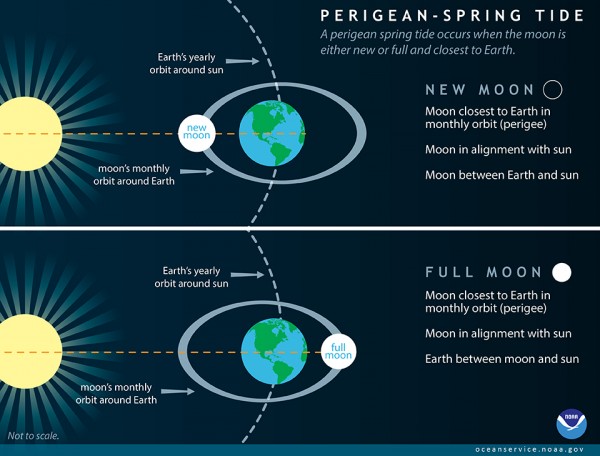
Around each new moon and full moon, the sun, Earth and moon lie more or less along a line in space. Then the pull on the tides increases, because the gravity of the sun reinforces the moon’s gravity. In fact, the height of the average solar tide is about 50% of the average lunar tide.
Thus, at new moon or full moon, the tide’s range is at its maximum. This is the spring tide: the highest (and lowest) tide. Spring tides are not named for the season. This is spring in the sense of jump, burst forth, rise.
So, spring tides bring the most extreme high and low tides every month. And they always happen – every month – around full and new moon.
Why?
When the new moon or full moon closely aligns with perigee – the closest point to Earth in the moon’s orbit – then we have a supermoon and extra-large spring tides.
In 2018, the January 1-2 full moon closely aligned with perigee to bring forth especially high tides. As it happened, on the day after the January 1-2 supermoon, Storm Eleanor hit Europe with winds of up to 100 mph (160 km/h). The wind and extra-high tides caused flooding, hampered travel, injured and killed people and left tens of thousands of homes without power across the U.K., Ireland and other parts of Europe. No doubt the extra-high tides contributed to the severity of the storm. Read more: High tides and winter storms (2018).
Why are the tides at their strongest around supermoons? It’s simply because the moon is at its closest to Earth, and thus the Earth’s oceans are feeling the pull of the moon’s gravity most powerfully.
Should you expect these highest tides on the exact day of a supermoon? Probably not. The highest tides tend to follow the supermoon (or any new or full moon) by a day or two.
What about flooding?
Do the most extreme high tides – those bringing floods – always occur at supermoons? Not necessarily. It’s when a spring tide coincides with a time of heavy winds and rain – flooding due to a weather extreme – that the most extreme flooding occurs.

What are neap tides?
There’s about a seven-day interval between spring tides and neap tides, when the tide’s range is at its minimum. Neap tides occur halfway between each new and full moon – at the first quarter and last quarter moon phase – when the sun and moon are at right angles as seen from Earth. Then the sun’s gravity is working against the gravity of the moon, as the moon pulls on the sea. Neap tides happen approximately twice a month, once around first quarter moon and once around last quarter moon.
Why two high and two low tides each day?
If the moon is primarily responsible for the tides, why are there two high tides and two low tides each day in most places? It seems as if there should just be one. If you picture the part of Earth closest to the moon, it’s easy to see that the ocean is drawn toward the moon. That’s because gravity depends in part on how close two objects are.
But then why – on the opposite side of Earth – is there another tidal bulge, in the direction opposite the moon? It seems counterintuitive, until you realize that this second bulge happens at the part of Earth where the moon’s gravity is pulling the least.
Earth spins once every 24 hours. So, a given location on Earth will pass “through” both bulges of water each day. Of course, the bulges don’t stay fixed in time. They move at the slow rate of about 13.1 degrees per day. That’s the same rate as the monthly motion of the moon relative to the stars. Other factors, including the shape of coastlines, also influence the time of the tides. That’s why people who live near coastlines like to have a good tide almanac.
Bottom line: The sun, the moon, the shape of a beach, the angle of the seabed leading up to land and the prevailing ocean currents and winds all affect the height of the tides. Expect higher-than-usual tides for a few days following a supermoon.
Read more: The moon illusion makes the moon look huge!
Enjoying EarthSky? Sign up for our free daily newsletter today!
Like what you read?
Subscribe and receive daily news delivered to your inbox.
More from
Deborah Byrd


Voyager 2: Our 1st and only visit to Neptune

1st photo of Earth from the moon 60 years ago
Voyager 2 spacecraft launched 49 years ago today
Total solar eclipse August 12, 2026: Best images