EarthSky // Tonight // Astronomy Essentials By EarthSky Dec 01, 2010

When is the next Blue Moon?

The next Blue Moon, according to folklore, will be August 31, 2012.

In the 21st century, according to folklore, the name Blue Moon has two meanings. A Blue Moon can be the second full moon in a calendar month. Or it can be the third of four full moons in a single season. There will be two full moons in a month on August 31, 2012 – the next scheduled Blue Moon.

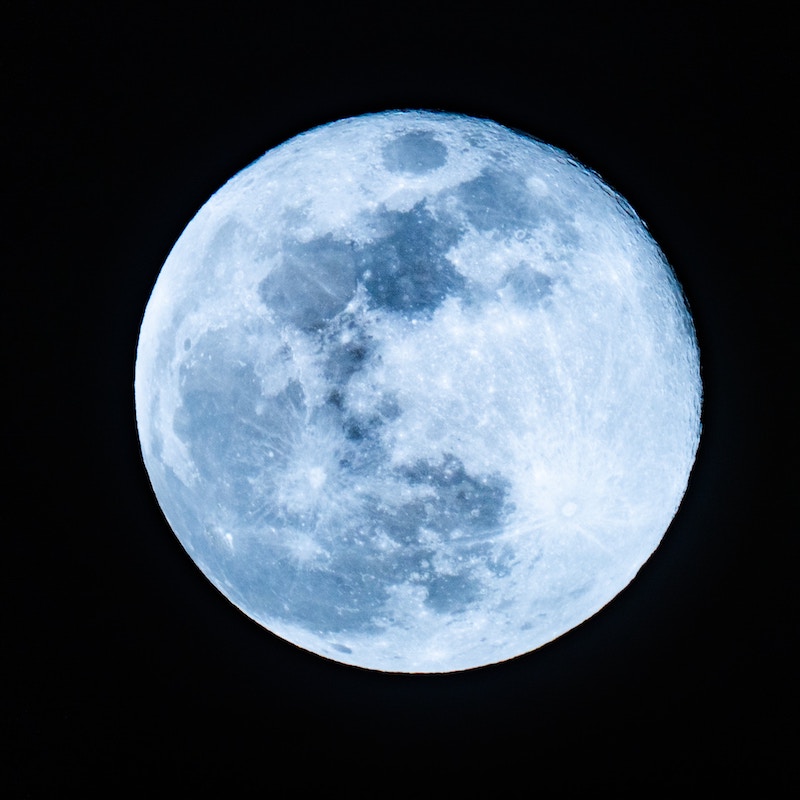
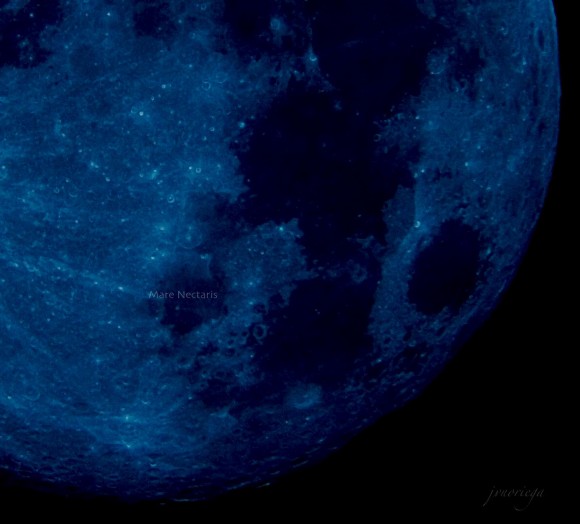
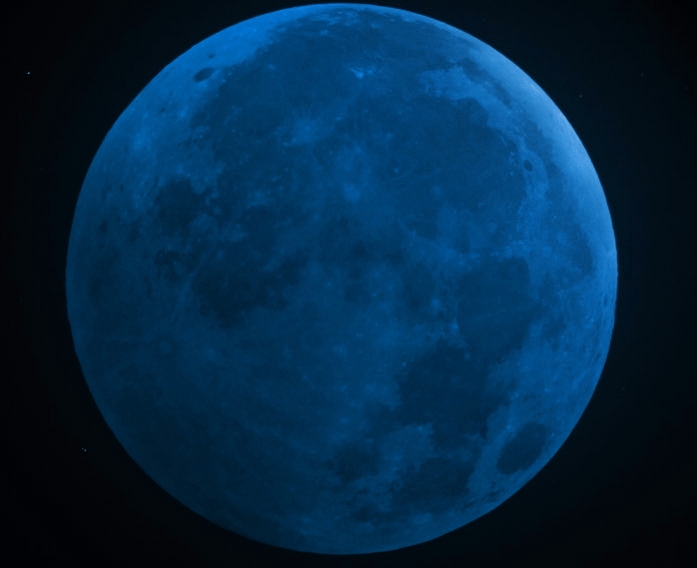
So don’t be misled by the photo above. Although certain-sized particles of dust or smoke can cause a moon to look blue in color, the sorts of moons people commonly call Blue Moons aren’t usually blue. For more about truly blue-colored moons, click here.

Every month has a full moon, and, most of the time, the names coincide with particular months or seasons of the year. By either definition, the name Blue Moon accounts for times when there happen to be more full moons than is convenient.

Second full moon in a month. In recent decades, many people have begun using the name Blue Moon to describe the second full moon of a calendar month.

The time between one full moon and the next is close to the length of a calendar month. So the only time one month can have two full moons is when the first full moon happens in the first few days of the month. This happens every 2-3 years, so these sorts of Blue Moons come about that often.

When is the next Blue Moon, according to this first definition? August 31, 2012.

The idea of a Blue Moon as the second full moon in a month stemmed from the March 1946 issue of Sky and Telescope magazine, which contained an article called “Once in a Blue Moon” by James Hugh Pruett. Pruett was using a 1937 Maine Farmer’s Almanac, but he simplified the definition. He wrote: “Seven times in 19 years there were — and still are — 13 full moons in a year. This gives 11 months with one full moon each and one with two. This second in a month, so I interpret it, was called Blue Moon.”

EarthSky’s Deborah Byrd happened upon a copy of this old 1946 issue of Sky and Telescope in the stacks of the Peridier Library at the University of Texas Astronomy Department in the late 1970s. Afterward, she began using the term Blue Moon to describe the second full moon in a calendar month on the radio. Later, this definition of Blue Moon was also popularized by a book for children by Margot McLoon-Basta and Alice Sigel, called “Kids’ World Almanac of Records and Facts,” published in New York by World Almanac Publications, in 1985. The second-full-moon-in-a-month definition was also used in the board game Trivial Pursuit.

Can there be two blue moons in a single calendar year? Yes. It last happened in 1999. There were two full moons in January and two full moons in March and no full moon in February. So both January and March had Blue Moons.

The next year of double blue moons is coming up in 2018.

Third full moon of four in a season. The Old Farmer’s Almanac defined a Blue Moon as an extra full moon that occurred in a season. One season – winter, spring, fall, summer – typically has three full moons. If a season has four full moons, then the third full moon may be called a Blue Moon.

The next blue moon by this definition will fall on August 21, 2013.

In recent years, a controversy has raged – mainly among purists – about which Blue Moon definition is better. The idea of a Blue Moon as the third of four in a season is older than the idea of a Blue Moon as the second full moon in a month. Is it better? Is one definition right and the other wrong? After all, this is folklore. So the folk get to decide, and, in the 21st century, both sorts of full moons have been called Blue.

As the folklorist Phillip Hiscock wrote in his comprehensive article Folklore of the Blue Moon: Old folklore it is not, but real folklore it is.

So enjoy Blue Moons!

Share your comments on Facebook

54 Responses to When is the next Blue Moon?

  1. Deborah says:

    I found this a very interestng article. I used to think a blue moon was really blue. Thank you for the clarification

  2. yooki says:

    In my opinion, there are 13 definitions of a blue moon, because there are 13 full moons in a blue moon year. The definition of blue moon as the second full moon in a month was, and still is, not a mistake or wrong!

    • Deborah Byrd says:

      Hi Yooki, ha! Yes, I have to smile a little at the people who call using the name Blue Moon for the second full moon in a month “wrong.” It’s folklore. The folk get to determine what’s right and what’s wrong!

      • Glenn says:

        You’re so right. And as I commented on Antoine’s brilliant explanation as to why the “third full moon in a four-full-moon season” is correctly called the blue moon (which is independent on where on earth one lives), it was your lovely voice :) on a CBS “Star Date” radio program circa 1980 that made the current debate possible, then supporting the “second full moon in a [calendar] month” side (although not everyone on earth gets to experience it).

  3. yosiah says:

    I am trying to find a source that defines a \”blue moon\” prior to the pre-calculated modern calendars that use the term \”month\” instead of \”moon\” like all ancient lunar based calendars did. Can anyone help me?

    • admin says:

      Yosiah,

      If you use a lunar calendar or a lunar/solar calendar whereby the month is based on the phases of the moon and not the calendar month, then you would have no blue moon by the modern definition of the term – the second full moon in a single calendar month. Since a calendar month (except for February) is longer than a lunar month, it is possible for two full moons to fall in a single calendar month. A blue moon by this definition happens about 8 times every 19 years.

      Another definition of blue moon – the 3rd of 4 full moons to fall in one season – is the older definition of the term.

      Bruce

  4. Donna says:

    Since hearing about the blue moon for 12/31/09, i have been reading some explanations of a blue moon. Some i’ve read said that it is caused by dirt/smoke particles in the air making the moon look blue i.e., volcano eruptions, etc. If this is the fact, then how can the blue moons be predicted in advance not knowing what the dirt/smoke particles would be like at that time? Secondly, the 2nd full moon in a month explanation, is the 2nd full moon always blue?

    • admin says:

      Donna,

      The “blue moons” which can be predicted in advance do not refer to the color of the moon, but to calendar oddities. The second full moon to fall in a single calendar month is said to be a “blue moon” in the sense that it is relatively rare phenomenon. A blue moon by this definition happens some 8 times every 19 years.

      An older blue moon definition refers to a different sort of calendar oddity: the 3rd of 4 full moons to fall in one season. Usually, a season only has 3 full moons. But every 19 years, 7 seasons harbor 4 full moons. Again, this definition of “blue moon” does not refer to the color of the moon but to a relatively rare calendar oddity.

  5. farheen says:

    i think thats such an information for young student cause some people cant imagine on solar stars or blue moon . plz search more information about comets,asteroids,and milky ways means glaxies

  6. Glenda says:

    Oh, for heaven sakes, all this dicussion about a blue moon. NOW we have been informed and only need to talk about it, ….well, ‘Once in a Blue moon’ :)

  7. Ken Brown says:

    I have a neighbor that swears that the name or term Blue Moon was an accident that happened when the painter of the Blue Boy splatered blue paint on a window. When the painter looked out window through the blue splater he saw a blue moon. He is a conservative. This may explain why he thinks that this is the one and only explanation.

  8. helena says:

    I’m so intesting to this article, reading it helped me understand about what is blue moon, opposite with my thought that I had before” blue moon” is the moon has blue color.

  9. Ken-Stuart, Fl says:

    Of all I have read about blue moons I find nothing that actually talks about where “blue” came from. I have seen it said it came from “once in a blue moon”, but isn’t that the chicken and egg sort of thing?

  10. Stacy Hebert says:

    I think this is really cool to know that as we will be ringing in the “New Year,”tonight, that there is gonna be a “Blue Moon” out in the sky! This to me is really Awesome and really Romantic…It’s just too sad to me that my husband will not be able to be right beside me:-( when the clock turns 12 a.m! Anyway,I will Love and Kiss him in my mind as if he were here! XOXO to you, MY CODY BEAR! I LOVE YOU ALWAYS-STACY “Red” AKA…”MRS.FIRE RED HEBERT!” “HAPPY NEW YEAR”… MY LOVE! “2010!”

  11. krista says:

    just want to say ! i LOVE blue moon ! :D

  12. yooki says:

    As Hiscock explained in the March issue, widespread adoption of the second-full-\”Moon-in-a-month definition followed its use on the popular radio program StarDate on January 31, 1980. We examined this show\’s script, authored by Deborah Byrd, and found that it contains a footnote not read on the air that cites Pruett\’s 1946 article as the source for the information. Byrd now writes for the radio program Earth & Sky, whose Web site contains a note giving her perspective on this modern contribution to lunar folklore.\”

    Where is the note?

  13. yooki says:

    According to Phillip Hiscock, the term “blue Moon” has been around a long time, well over 400 years. In fact, the very earliest uses of the term were remarkably like saying the Moon is made of green cheese. There are seven meanings for blue moon.

    Meanings number one and two: The concept that a blue Moon was absurd (the first meaning) led eventually to a second meaning, that of “never.” The statement “I’ll marry you, m’lady, when the Moon is blue!” would not have been taken as a betrothal in the 18th century.

    Meanings number three and four: That’s the third meaning ¡ª (by the mid-19th century) the Moon appearing blue in the sky, though rare, did happen from time to time ¡ª whence the phrase “once in a blue Moon.” It meant then exactly what it means today, a fairly infrequent event, not quite regular enough to pinpoint. That’s meaning number four, and today it is still the main one.

    Meaning number five: But meaning is a slippery substance, and a half dozen songs use “blue Moon” as a symbol of sadness and loneliness. That’s meaning number five.

    Meaning number six: A slinky blue liquid in a cocktail glass, one that requires curaçao, gin, and perhaps a twist of lemon. That’s number six.

    Meaning number seven: Finally we arrive at the most recent meaning of all, the second full Moon in a month.

    In fact, there is another meaning of blue moon: the 3rd of 4 full moons to fall in one season.

  14. yooki says:

    Bruce,

    “The second full moon to fall in a single calendar month is said to be a “blue moon” in the sense that it is relatively rare phenomenon. A blue moon by this definition happens some 8 times every 19 years. An older blue moon definition refers to a different sort of calendar oddity: the 3rd of 4 full moons to fall in one season. Usually, a season only has 3 full moons. But every 19 years, 7 seasons harbor 4 full moons.”

    In my opinion, strictly, a blue moon by the most recent definition happens 7 times every 19/20 years just as the older definition. There were two full moons in January and two full moons in March and no full moon in February in a double blue moons year. So one of full moons in January or March belongs to February — that is, there is a fake blue moon in such a year.

  15. Lisa says:

    Two definitions of blue moon– Farmer’s Almanac blue moon and the twice in a calendar month blue moon– do they ever fall on the same date and if so, how often does that happen?

  16. Wendy HIMFORD says:

    A blue moon cannot happen in the holy biblical lunar calendar of God when months start with the New Moon. Every full moon is the middle of the sacred month starting from the New Moon. Shalom from Vanuatu.

  17. This is certainly a useful resource you are providing and you give it away at no cost. I honestly enjoy discovering sites that understand the value of providing a helpful resource for no cost. I really enjoyed reading your article :-) Many thanks

  18. pasha says:

    Really enjoyed the article (thanks!) and the discussion. I remember the full-moon-less FEB back in 1999. Thought it was cool then, and now. It’s been mentioned as a fact, but only incidentally in connection with something else. I think it’s really interesting all by itself. So, when will it happen again? My memory from ’99 is that it will be a very long time. How often does FEB go without a full moon?

  19. [...] speaking of the moon, Sunday will be our next Blue Moon (follow this link to an explanation, definition and debate regarding the definition of ‘Blue Moon’). East [...]

  20. [...] “There is a more modern definition of Blue Moon. It’s the idea that a Blue Moon is a second full moon in a calendar month. The next Blue Moon to fit this description will come on August 31, 2012. Is one definition better or more true than the other? The great thing about folklore is that it’s whatever the folk say it is. So we all get to decide.” read more… [...]

  21. sylvan says:

    …just listen to Diane Shaw singing the Rogers&Hart tune…!!!

  22. Ben says:

    But I don’t understand why the third FM of the season is the blue one. If the 2nd FM of the month is the blue one, then it seems it is so because that is the one that is odd man out–it is blue because it is exception to the rule of one FM a month. But there is always a third FM in each season. The fourth one is the odd man out, so it ought to be the Blue Moon. Why isn’t the fourth FM of the season the blue one???

    • EarthSky says:

      Ben, I don’t know either. Maybe because full moon names coincide with months or seasons? Full moons each have many different names. But, for example, December’s full moon carries the name Moon Before Yule. It’ll still be the Moon Before Yule this year, even though it’s the 4th moon of the season. If that moon were the Blue Moon, and tonight’s moon were the Moon Before Yule … it might seem out of order somehow.

      I think giving the name Blue Moon to the third, not the fourth, full moon of the season just helps keeps the seasonal names in better order.

      - ES

  23. Antoine says:

    Folklore being what it is, each culture gives names to the full moon in different months and seasons. This November full moon is called Hunter’s Moon, Beaver Moon, Frost Moon, Snow Moon in Western cultures. Cultures with lunar calenders(Hindu, Thai, Hebrew, Islamic, Tibetan, Mayan, Neo-pagan, Germanic, Celtic, and Chinese)all have specific names for each moon.
    However, each season traditionally has three positional moons – early, mid and late. In a season with four full moons, the odd (blue) moon is placed in the third position so as not to upset the early, mid and late positional designation. In this autumn season of 2010, there are four full moons:

    * Sept. 23
    * Oct. 22
    * Nov. 21
    * Dec. 21

    September had the Early Autumn Moon, October the Mid and December will have the Late, leaving today’s moon as the betrayer (from the Old English “belewe” meaning both blue and betray).

    Just to throw a spanner, I think the folklore saying comes from a 1528 Protestant pamphlet ** violently attacking the English clergy (specifically Cardinal Wolsey),composed by two converted Greenwich friars, William Roy and Jerome Barlow, entitled “Rede Me and Be Not Wrothe” (“Read me and be not angry”: “If they say the moon is belewe / We must believe that it is true”
    But the belewe/blue here refers to the clerical “betrayer moon” which upsets the Christian Lenten moon calculations seven times in the lunar cycle. Thus, to my mind, a tongue in cheek 16th Century wordplay resulted in all this talk of a blue moon. The “true blue” moon should only be applied to these “betrayer” moons in March. How’s that for Folklore?
    A.Maze

    ** see http://www.bartleby.com/213/0414.html (line 61)

    • Glenn says:

      And we have a winner!!! What’s ironic is that EarthSky’s own Deborah Byrd resurrected the unfortunate “second full moon in a [calendar] month” definition on CBS’s old “Star Date” radio program circa 1980. I remember her lovely voice. :)

      And yes, I obviously side with the “third full moon in a four-full-moon season” definition, because this definition doesn’t depend on what part of the earth you live in. The other definition only works in some parts of the earth, because in other parts, either the first full moon takes place shortly before the month starts, or the second full moon takes place shortly after the month ends.

  24. Vonda says:

    really enjoyed reading all this – have wondered since i was a small child what “blue moon” meant. this info helps alot.

    thanks

  25. Vonda says:

    also, can’t wait for december 21st for the confusion to continue. ;-)

  26. s steele says:

    “By either definition, the name Blue Moon accounts for times when there happen to be more full moons than is convenient”

    Not convenient but perhaps conventional.
    Like the comments, I remember listing to StarDate and still enjoy Earth and Sky daily on NPR.

    • EarthSky says:

      S steele, right. Conventional is probably the better word. Thank you for your note, and that’s for listening to our show!

      - Deborah at EarthSky

    • Jas-Chico says:

      Reading through brought back some great memories of ‘Block & Byrd for Earth & Sky’. :^) I enjoy Blue Moons mostly for the fact that it shows us to be always just a little behind the ‘great calculator’.. the natural world. All of our math is just a 2-dimensional attempt to capture the 3-dimensional amazing place we live. ‘B&B for E&S’ Always brought that idea back to me and made me thankful. :^)

  27. [...] Moon (+859%). That’s what you saw last night if you looked up: The third of four full moons that will rise this season. But don’t let the name fool you — they’re not [...]

  28. [...] Moon (+859%). That’s what you saw last night if you looked up: The third of four full moons that will rise this season. But don’t let the name fool you — they’re not [...]

  29. [...] Moon (+859%). That’s what you saw last night if you looked up: The third of four full moons that will rise this season. But don’t let the name fool you — they’re not [...]

  30. I love blue moons! There so beautiful! o`

  31. marie says:

    this is a wonderful website
    i littery find everything for it
    in school in geography i even find when the first blue moon was and it gave me a simple but understandable answer
    this is awsome
    maria

  32. shani :) says:

    Ive heard so many stories that a Blue Moon is spiritualy connected to Hecate cause she is the godness of the moon? and it kinda got me thinking is it true?
    I know it sounds crazy but yeea i am really into this kinda stuff so im just wondering if there is a connection or not?

  33. Joe Domine says:

    The statement “Every month has a full moon, and, most of the time, the names coincide with particular months or seasons of the year.” is incorrect. February 2018 will not have a full moon, but both January and March will have two, thus two blue moons in one year!!

    See http://kalender-365.de/lunar-calendar.php?yy=2018

    For what it is worth, I susbscribe to the definition of Blue Moon as the second full moon in a calendar month. As you are aware, this can be location (time zone) dependant.

  34. donyaill gaines says:

    this is cool

  35. donyaill gaines says:

    i see u tristin

  36. Nala Jane says:

    Is it just me or does whenever a blue moon is about to occur kidnappings go off the chart?
    Well, I like when ever its supposed to be a blue moon because it give me an escuse to go camping and swimming at night. ;)

  37. sanks says:

    I want to ask whether blue moons look blue from everywhere or just a single place?can blue moon also look blue due to global warming?(in future ).

  38. mongoose says:

    ahem. blue moons just rock let it be space or underground

  39. Miezekatze says:

    The article answers when the next blue moon fitting one definition occurs, but when is the next that fits the other, if you please?

    • Bruce McClure says:

      Miezekatze,

      The next blue moon – meaning the third of four full moons in a single season – will fall on August 21, 2013.

      Bruce

  40. Ryan george says:

    I will tell you when a blue moon is a blue moon, and if you disagree it is for your pride that you do so.

    A blue moon is blue when it is blue. This can be any day, or any night, so long that is appears blue.

    There is no set day or set anything for this.

    anything else if your definition, and you define things as you WISH to, as is with EVERYTHING in your life, like love, like whatever

    IF something is blue it is blue, there needs no higher definition. GOT IT????

  41. marilyn says:

    Got to this website because of the Sopranos TV show and their intro song with “blue moon in your eyes”.
    Had to find out what a blue moon was. Thanks for the great site.
    Marilyn

Share your comments on EarthSky

Your email address will not be published. Required fields are marked *

*

You may use these HTML tags and attributes: <a href="" title=""> <abbr title=""> <acronym title=""> <b> <blockquote cite=""> <cite> <code> <del datetime=""> <em> <i> <q cite=""> <strike> <strong>