EarthSky // FAQsTonight // Astronomy Essentials By Bruce McClure Dec 15, 2011

How far is a light-year?

Light is the fastest-moving stuff in the universe. It travels at an incredible 300,000 kilometers (186,000 miles) per second. So, in a year, light travels far.

Stars other than our sun are so far distant that astronomers refer to their distances not in terms of kilometers or miles – but in light-years.

Light is the fastest-moving stuff in the universe. It travels at an incredible 300,000 kilometers (186,000 miles) per second. That’s very fast. If you could travel at the speed of light, you would be able to circle the Earth’s equator about 7.5 times in just one second!

A light-second is the distance light travels in one second, or 7.5 times the distance around Earth’s equator. A light-year is the distance light travels in one year. How far is that? Multiply the number of seconds in one year by the number of kilometers (or miles) that light travels in one second, and there you have it: one light-year. It’s about 9.5 trillion kilometers (5.88 trillion miles).

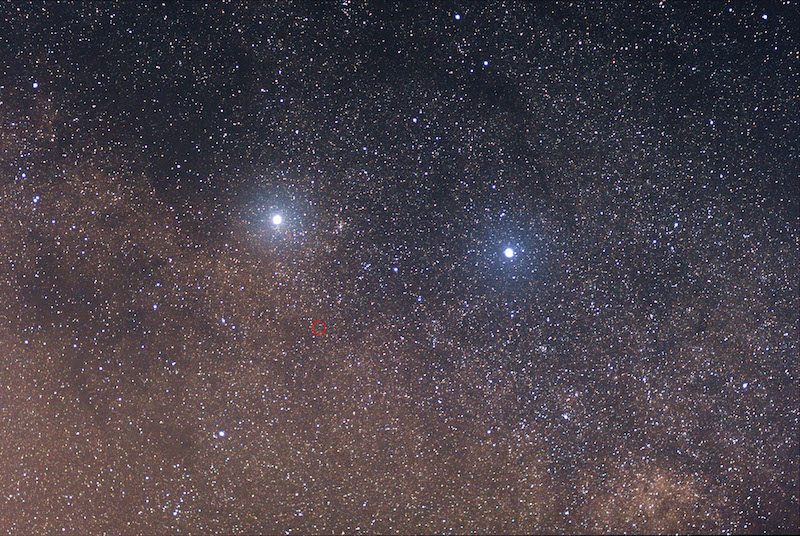
The Orion Nebula, 1,500 light years from Earth. Image credit: NASA/JPL-Caltech/STScI

Few of us can comprehend such a humongous number. Is there any way for us mere mortals to really understand how far a light-year is?

As a matter of fact, there is. The 20th century astronomer Robert Burnham Jr. – author of Burnham’s Celestial Handbook – devised an ingenious way to portray the distance of one light-year. He did this by relating the light-year to the astronomical unit – the Earth-sun distance.

One astronomical unit equals about 150 million kilometers (93 million miles). Another way of looking at it: the astronomical unit is a bit more than 8 light-minutes in distance.
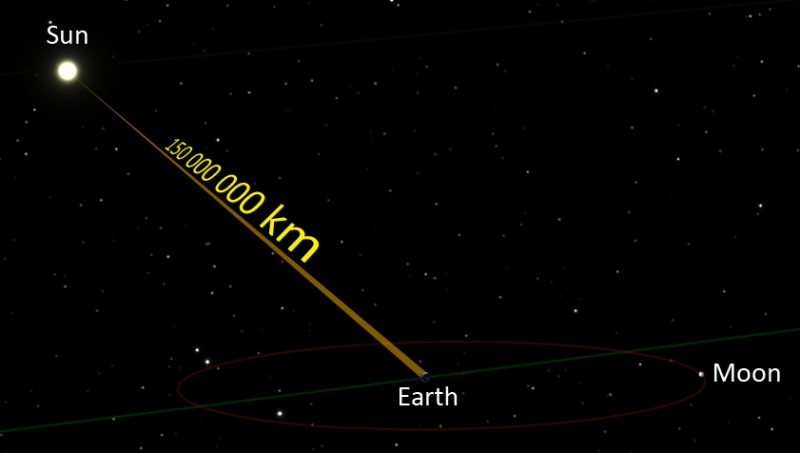
Quite by coincidence, the number of astronomical units in one light-year and the number of inches in one mile are virtually the same. For general reference, there are 63,000 astronomical units in one light-year, and 63,000 inches in one mile. This wonderful coincidence enables us to bring the light-year down to Earth. If we scale the astronomical unit – the Earth-sun distance – at one inch, then the light-year on this scale represents one mile.

Wikimedia Commons, Paul Stansifer, User:84

What is a light-year?

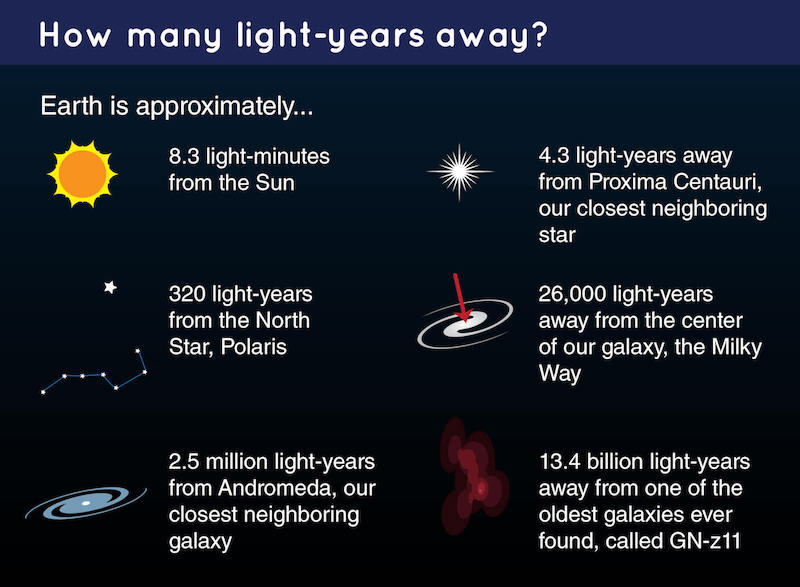
The closest star to Earth, other than the sun, is Alpha Centauri at some 4.4 light-years away. Scaling the Earth-sun distance at one inch places this star at 4.4 miles (7 kilometers) distant.

Scaling the astronomical unit at one inch, here are distances to various stars, star clusters and galaxies:

Alpha Centauri: 4 miles

Sirius: 9 miles

Vega: 25 miles

Fomalhaut: 25 miles

Arcturus: 37 miles

Antares: 600 miles

Pleiades open star cluster: 440 miles

Hercules globular star cluster (M13): 24,000 miles

Center of Milky Way galaxy: 27,000 miles

Great Andromeda galaxy (M31): 2,300,000 miles

Sombrero galaxy (M104): 65,000,000 miles

Share your comments on Facebook

63 Responses to How far is a light-year?

  1. Al says:

    By my calculations there are 9.02 trillion (9 x 10^12) miles in a light year.

    2.86×10^5(mi/s)x 3.6×10^3(s/hr)x24(hr/da)x 365(da/yr)= 9.02×10^12
    = 9.02 trillion miles per lightyear – not 5.88 trillion!

    • Al says:

      Correction on my calculation of the miles in a lightyeat.
      Light travels at 186,000 miles a second and not at
      286,000 miles a second which I used in my previous calculation.
      Thus the value of 5.866 trillion miles in a lightyear is correct!
      My bad!

    • Cailic says:

      From what I have read, the 5.8 trillion miles is correct. I haven’t done the math myself…I suck at math… but shouldn’t this have been set down as a standard somewhere? Oh, and I don’t realy suck at math, I’m just too lazy to do it. And I wonder, how many spoons are in a light year… Hmmm.
      Either way, regardless of how many spoons are in a light year, I was reading several years ago that it would take us 40 years (not light years) to reach Alpha Cenntauri. The article was saying we would incorporate either solor powered engines or antimatter. I didn’t know we had antimatter engines yet. But the article sugested we would embark on this venture within the next few years… which have past.
      Oh, and since I am actually responding to this, I will ask this question… not expecting a response to a year old posting… In the matter of propultion, or rather travel itself, given the theory of realitivity, (I realy cann’t see what I’m typing anymore, so forgive the spelling) The only practicle way to travel between the stars would to devise a plainer jump drive. It has been discribed as hyper space in some sy fi shows and described in spirituality as either the ether or astral plane. I don’t know if the Philidelphia experiment was real or fictional.. I have been told both. But it FEELS right that electromagnetic forces would be the key to instantanious travel to any location.
      I’m not a scientist by any means, I have simply observed and tried to piece things together…. so don’t laugh… at least not hard. I have heard some intersting accounts of space/time travel. A two hour trip only took thirty minutes, and some other ones I have forgotten the details to. I do remember that green fog was mentioned in each account. And if I remember correctly… was there a greenish fog associated with the philadelphia experment?
      Dang it! I know I spelled alot wrong, but I cann’t see. My reading glasses only work at a short distance. I wonder if there is an astrological reason that cataracts kick in at the age of 40?… those damned planets and stars. I know they are to blame.

  2. rebecca says:

    i really dont understand this question and i was wondering if you could help . . . .ok here goes . . . . .this is the distance of about 9.5 trillion kilometersthat light travels in one year( two words) and its supposed to start with an “n” . . . . .can you help me?

  3. Robin says:

    Hello,
    My name is Robin. I enjoy collecting spoons from around the world. What do you like to collect? Let’s be pen pals.
    Please send me your favorites list (ie, color, song, magazine, flower, rock star etc.) and I will return same.
    Mail to
    Robin
    1313 Harbour Boulevard
    Anaheim CA 90308

    Ohwa tah goo siam

  4. maggie says:

    how many miles have one lightyear and if galactic hit 65000lightyear how far was this, how many miles

  5. Steph says:

    Very informative, thank you!!

    • conveyancing says:

      It certainy is. It makes me wonder if 1 light year is so far, what is the furtherest distance we can travel with our current capabilities and whether the experiments they are conducting with the hyron collider will lead to some technology that will enable us to travel at speed near the the speed of light?

  6. Jimmy L. Porter says:

    let us suppose we can push our space ship 186,000 miles a second, wherein we crash into an impossible to pass, solid wall.

    I know that incredible energy is required to push mass to the speed of light, but if our mass stays stationary and we make our background go faster than light, less energy is used as the mass is not moving, only the background. I believe this is called warp speed. How can we calculate warp speed for our little space ship in any given background warping?

    Jimmy

    • Mike says:

      One cannot actually attain the speed of light. Any object possessing mass would require an infinite amount of energy to reach this speed, which is impossible. This is derived from Einstein’s famous E=mc^2 equation. As an object is accelerated, it becomes correspondingly more massive.

      The concept of a light year is also strange to one travelling at a very significant portion of light speed, as time *slows down* for that person relative to those left behind.

  7. Jimmy, I believe you have posited a physically impossible situation, if Einstein is to be believed. (And, to my way of thinking, nothing significant has come up to make us doubt him.). First, we cannot push a spacecraft to 186,000 mph, by which I assume you mean the full speed of light. In theory it is possible to come arbitrarily close to that, but not to ever quite reach it. It would take not just incredible energy, but infinite energy, to make any physical object go as fast as light.

    Then, to keep the mass “stationary” and have the “background” move at the speed of light would also take an infinite (and therefore impossible) amount of energy. It doesn’t matter if you consider the spaceship to be moving and the background stationary, or vice versa. The question is the relative motion. We are considering the relative speed between two frames of reference (say, one anchored to the spacecraft and the other to some arbitrarily chosen point in the background). The relative speed cannot reach the speed of light, so saying one is still and the other moving doesn’t get around that restriction. After all, it is the theory of “relativity.”

    What you are proposing is not the standard definition of “warp” speed in science fiction. There may be other ways possible to circumvent the restriction, but by current and well confirmed theory, it cannot be done this way. “Warp” speed supposedly involves “warping” space by changing the effective distance between two points, so a spacecraft has a shorter effective distance to travel, a bit like tunneling through a mountain rather than going over it. While this is really science fiction, such concepts are actually considered by physicists and astronomers and who knows, maybe someday we will do it.

  8. Eduardo Gonzalez says:

    Out of all the sites I have research, this one is one of the best. The formula for the astronomical mile is so well explained that an amateur such as I am, very much interested in the wonderful Universe created by God, can comprehend.
    Thank You

    • Travis says:

      Created by the big bang. There is no god.

      • Dellitt Wilson says:

        some people might argue either that god was the big bang. I don’t mean some bearded man, obviously, just the idea that the big bang had intention and therefore power. And I say some people might argue this, not necessarily meaning I am convinced one way or the other.

        • PepsiHog says:

          God or No God? If you believe in God and you’re right you go to heaven. If you believe and you’re wrong, you most likely lived well and people will remember you well. But if you don’t believe and you’re wrong, well…….oops!!! And what a price to pay!!!

  9. muhammad afzal shan says:

    hey sir plz tell me about noori saal i mean 1000light year and how much sarts and milkyways in the sky it is truth that after here that big stars those r so far from us are our living place

  10. sophia says:

    Read up on astronomy and you shall learn the answers to your questions! There is no excuse we have internet now…

  11. bibenero says:

    The question is the relative motion. We are considering the relative speed between two frames of reference

  12. Christopher says:

    Thank you for all of your helpful replies.

  13. panubon says:

    This is why I try and actually “walk” up to the person I need the answer, or help from, and engage in conversation. Amazing how much more obliging people are when you take the time to see them in person.

  14. lindersun says:

    What you are proposing is not the standard definition of “warp” speed in science fiction. There may be other ways possible to circumvent the restriction, but by current and well confirmed theory, it cannot be done this way.

  15. grills says:

    Great,Thank you for this article.

  16. ny_X says:

    Very intersting! Thanks for great article.

  17. vip says:

    That’s a great info. Thanks for sharing, really like your view. I can see that you are putting a lot of time and effort into your blog. Keep posting the good work.

  18. [...] lies some 430 light-years from Earth. Yet it’s already one of the brightest stars in Earth’s sky. The reason is that [...]

  19. Bahloo says:

    Very informative–thanks! I was wondering though, in science fiction there is the possibility of traveling in space at such great speeds that people the travelers have left behind on Earth age or die “quickly” while the travelers themselves are still young. There are settings in which the travelers return to Earth and it’s entirely changed from the many years that have passed. How does this work? I’ve come across science fiction settings like this on more than one occasion, so I’m assuming there’s a theory behind the whole aging process while traveling at lightspeed? I can’t really grasp the concept of outliving friends and relatives by hundreds of years while traveling in space.

    Thanks for any help in answering this question!

    • Bruce McClure says:

      Bahloo,

      Let’s suppose a friend of yours travels to a planet that’s orbiting a star at 15 light-years away. Traveling at three-fifths (3/5) the speed of light, it’d take your friend 50 years to make the 30 light-year round trip by your clock. Using the Pythagorean theorem, we can figure how long it’d take your firiend to make the 30-light-year round trip by his clock. We solve for x:

      x squared + 3/5 squared = 1
      x squared + 9/25 = 1
      x squared = 16/25
      x = 4/5

      So by your friend’s clock, the round trip only takes 40 years (4/5 x 50 = 40 years).

      However, this presumes that the rocket ship doesn’t accelerate or decelerate during the trip. But I don’t know how the rocket ship could land on the planet, or even circle the planet, without decelerating. After all, a rocket ship isn’t like a beam of light that can bounce off a surface without losing speed.

      Anyone out there know more about time dilation than I do? If so, please feel free to add to the conversation.

      Bruce

  20. Great,Thank you for this article.

  21. Saint says:

    Can these types of energies be combined to create a wormhole effect

    Combine these forms of energy to create a wormhole: Make a wave effect
    Energy occurs in many forms including: chemical energy, thermal energy, electromagnetic radiation, gravitational energy, electric energy, elastic energy, nuclear energy, rest energy. These can be categorized in two main classes: potential energy and kinetic energy.

  22. David Maynard says:

    so then all we need to do is create an engine that is capable of generating enough thrust to travel at 670,773,442 miles per hour and we can get there in 20 years… Come on Government Motors this is what you should be working on… we gotta get off this rock… or at least some of us do it is too small.

  23. Anil says:

    The light from stars takes many light years to reach earth.

    Regarding the expanding Universe theory , is it correct to say that the Universe *is* expanding’ ?

    Perhaps the right way to say should be, a million/billion/trillion years ago, universe ‘*was*’ expanding

    How can we determine the current state of the Universe , Stars etc (as there is always a time lag)

  24. Melanie says:

    Great pics! I can’t wait to share these with my 3rd grade class. Thanks, too, for putting light years into an easy perspective. My class is so curious about the universe and sometimes it is difficult to bring it down to size for them. Love this site.

  25. Dale of Atnarko says:

    There is one thing faster than the speed of light: the speed of dark. But seriously, is it true that everything in the universe is moving away from us? Does that mean we are at the exact center of the Universe? Does it mean that the tiny singularity from which the universe was born was right here in our present solar system at the instant of the big bang?

    Also, I heard that everything is not only moving away from us, but also is accelerating at enormous speeds. How is that possible? Is there a super mega super massive black hole at the center of the universe?

  26. [...] system visible in the light-colored region on the image right. The star system, located only 400 light years away, is distinguished by its colorful surroundings, which include a red emission nebula and [...]

  27. [...] system visible in the light-colored region on the image right. The star system, located only 400 light years away, is distinguished by its colorful surroundings, which include a red emission nebula and [...]

  28. hillllll says:

    This is sooooooo confusing… who would think that something could be soo far but really not be that far at all

  29. Wizle says:

    Nice information keep it up. Come to think of it, can humans reach the nearest star?

  30. George Langley says:

    So, what about the recent CERN announcement that they think they’ve broken the light speed barrier?Will this help us to understand how light is made?

  31. TheEngineer says:

    I find it impossible in my mind to ever have a human traveling at, or even near the speed of light. The first obstacle would be to find an energy source with the capability to reach this speed. Next would be the terrible effects of acceleration on a human body. Even if the acceleration were spread over a long time, any slight change in course would be so abrupt as to crush any human instanly. Even cosmic dust would be lethal at that speed, or anything near it. I will attempt to calculate the time required to accelerate to lightspeed without exceeding 11Gs ( I think this is the maximum a human can endure for any length of time.)

  32. Anyways, a year passed and that i felt that it had been time to get a 3D tv. this point to switch my recent 40″ Samsung that was currently in my bedroom. I researched on-line and visited multiple stores comparing brands, sizes and therefore the distinction between active and passive 3D.

  33. [...] slightly brighter than Antares in our sky. Hipparcos satellite data places Antares at about 604 light-years away, in contrast to Betelgeuse’s distance of 428 light-years, explaining why the larger star [...]

  34. [...] slightly brighter than Antares in our sky. Hipparcos satellite data places Antares at about 604 light-years away, in contrast to Betelgeuse’s distance of 428 light-years, explaining why the larger star [...]

  35. tammy says:

    Really wish someone could come up with a replenishing source of energy… that may power a craft more than a light year…. and there is infinite possibilities when we see something like this ..Earth like planet found
    http://www.bbc.co.uk/news/science-environment-16040655

  36. tiger says:

    in this picture it’s like a some kind of bird (if you pay attention on 1st picture).

  37. [...] It’s part of a vast stellar “nursery,” where new stars are being born, and is nearly 1,500 light-years away. Through a telescope, you can see four bright stars within the nebula, called the [...]

  38. [...] Feeling a little small The new star they found is 950 light years away so I began calculating and not enough zeroes on any calculator. To think I could circle the earth 7.5 times in a second makes me feel … sheesh. How far is a light-year? | Astronomy Essentials | EarthSky [...]

  39. Don Callen says:

    The distance to other worlds…………don’t think we are going to make the trip any time soon.

    How far in earth days from the earth to the two new planets that appear to support life as we know it?

  40. Dellitt Wilson says:

    Seems to me that determining if we can send a space ship to the nearest star is jumping the gun a bit. If we know that light travels faster than anything else, it seems we should be sending light to neighboring stars. Are there any projects to send the equivalent of what is contained on the Voyager spacecraft via light?

    the next step beyond sending light would be to send the next fastest traveling ‘thing’. I don’t know what that is, but I know that astronomers study x-rays, radio waves, I’m sure they study how sound travels through space as well? does it? Anyway. Seems we could send these things through space faster than a ship.

    As for moving matter at or close to the speed of light, is the theory that beyond a certain velocity matter becomes pure energy? What is the limit, then, so far as we know, of how fast the smallest unit of matter can travel? Is that an electron? Anyway, seems we need to first move a grain of sand at maximum velocity before we can send a rocket.

    And the reason I came to this site in the first place. Now that I can somewhat imagine the distance a light year is, how long would it take current spacecraft to travel a light year (not factoring in all the variables, obviously, like gravitational pull, etc)?

  41. I was watching the series of the Stargazing series on BB2 and was wondering what the actual distance of a iight year was in mies……..wow! And there were discussing stars that we millions of light years away. It really does put into some form of perspective the vast area that we call space.

  42. in this picture it’s like a some kind of bird (if you pay attention on 1st picture).

  43. Please note that a research article covering the low re-incarceration rate of people taught yoga has already been published in the International Journal of Yoga Therapy. A link to it may be found at my website at shivadancing.com and I can email the pdf version.

  44. 24payturn says:

    in this picture it’s like

  45. ashutosh pandey says:

    my name ashutosh pandey i a, doing a one parctcel and iam observ our space is one type of

Share your comments on EarthSky

Your email address will not be published. Required fields are marked *

*

You may use these HTML tags and attributes: <a href="" title=""> <abbr title=""> <acronym title=""> <b> <blockquote cite=""> <cite> <code> <del datetime=""> <em> <i> <q cite=""> <strike> <strong>