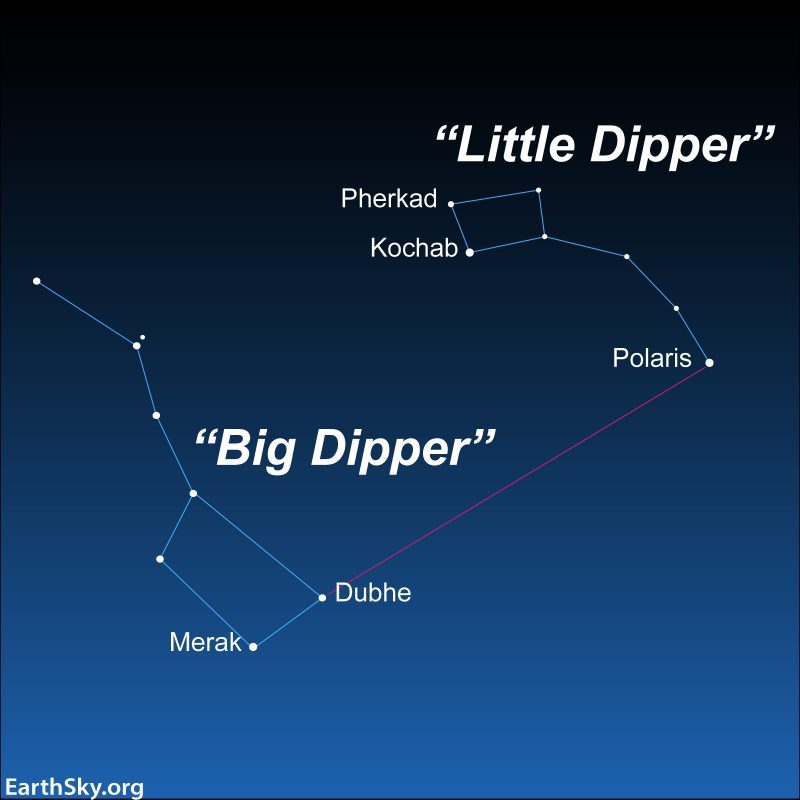
People are always asking how to find Polaris, the North Star. It’s easy! If you can find the Big Dipper in the northern sky, you can find Polaris.
Use the Big Dipper to find Polaris
A well-known trick for finding Polaris – the legendary North Star – is that the two outermost stars in the bowl of the Big Dipper point to it. Hence, they’re well known among amateur astronomers by the nickname The Pointers. Those stars’ names are Dubhe and Merak.
At one time, sailors’ livelihoods and survival depended on these pointer stars of the Big Dipper. In fact, many considered them their lucky stars. Scouts also learn to use the Big Dipper and Polaris to find the direction north.
Polaris isn’t the brightest star in the sky, as is commonly believed. Instead, it’s a moderately bright 2nd-magnitude star. But it’s bright enough to be easily seen in a dark sky. Unlike the other stars – which either rise in the east and set in the west, or else wheel in a circle around Polaris – the North Star appears fixed in the northern sky.
March is excellent for the Dipper

By the way, for evening skywatchers in the Northern Hemisphere, spring is the best time of year to see the Big Dipper. Also, just remember during the evening hours, it’s best viewed in the spring, and worst in autumn. Every March, at nightfall and early evening, the seven stars of the Big Dipper climb into your sky, ascending above the northeastern horizon.
From the northern part of the Northern Hemisphere, the Big and Little Dippers are in the sky continuously. In fact, they are always above your horizon, circling endlessly around Polaris. So, given an unobstructed horizon, latitudes north of 35 degrees north (the approximate location of the Mediterranean Sea and Tennessee’s southern border) can expect to see the Big Dipper at any hour of the night every day of the year.
Likewise, for the Southern Hemisphere, the Big Dipper is visible from about 26 degrees south latitude and all latitudes farther north.
The Big Dipper is an asterism
Also, the Big Dipper itself isn’t a constellation. It’s an asterism, a recognizable pattern of stars on the sky’s dome.
It’s part of the constellation Ursa Major the Great Bear. Indeed, it really does look like a dipper, and it’s pretty bright. Some sources say the Dipper makes up the Bear’s (rather unusual) tail and hindquarters.
You can see the Bear, too, if you watch for the Dipper in March under a very dark sky.
Use Polaris to find directions
If you stand facing Polaris, then, you’re facing the direction north. So, if you place Polaris to your back, you’re facing south. You can use Polaris to find directions only in the Northern Hemisphere, however. South of the equator, Polaris drops below the northern horizon.
Images from our community
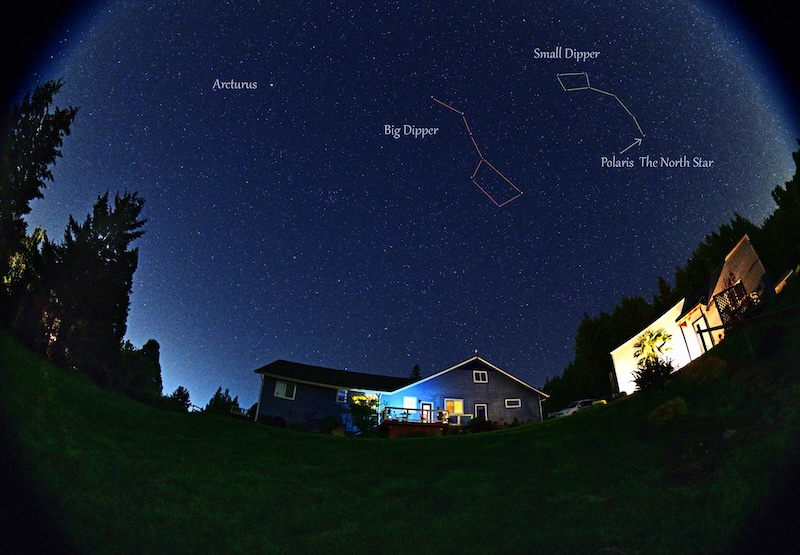
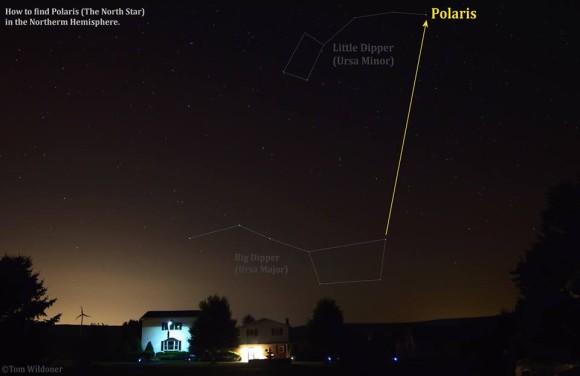
Bottom line: Use the two outer stars in the bowl of the Big Dipper to find Polaris, the North Star.
EarthSky astronomy kits are perfect for beginners. Order today from the EarthSky store
Like what you read?
Subscribe and receive daily news delivered to your inbox.
More from
Editors of EarthSky


Venus brightest in the evening sky this week

See Venus in the daytime: Here are 3 tips
Crepuscular rays are sunrays in twilight skies
What is retrograde motion? And why is the moon moving backwards?