
The star Zubeneschamali – in Libra the Scales – has long been famous as the sky’s bright green star. Modern astronomers say stars can’t appear green. Yet many observers swear they see a pale green tint. Whether it’s truly green, or if the color is a quirk of human vision, remains one of astronomy’s enduring little mysteries.
Zubeneschamali is also called Beta Librae. Professional astronomers generally classify it as a hot blue-white B-type star. They point out that stars emit a range of colors and shouldn’t shine in such a narrow way as to appear truly green to human vision.
But historical observers often described Beta Librae as a green star. For example, the incomparable Burnham’s Celestial Handbook quotes the famous amateur astronomer William Tyler Olcott (1873–1936) on this subject. Olcott referred to Zubeneschamali as the only green star visible to the unaided eye.
Many stargazers agree. Others don’t. So is Zubeneschamali green … or not?
The colors of stars
According to scientists, we don’t see green stars. Stars emit a spectrum (“rainbow”) of colors, including green. But – within the range of wavelengths and intensities found in stars – greens get mixed with other colors. And so – according to astrophysicists – stars can’t appear green.
For stars, the general colors are, from lower to higher temperatures, red, orange, yellow, white and blue.
Physicist Ben Bartlett delves into the details of why stars can’t be green in the comments associated with the following tweet.
Be sure to click on the comments icon to get to this conversation.
As stars burn hotter and hotter, they go from looking red to orange to yellow to white to blue…
But why are there no green stars?? [1/4] pic.twitter.com/4pRFmv7ojF
— Ben Bartlett (@bencbartlett) November 10, 2020
Bartlett also has a neat animation to help you visualize why stars don’t look green.
So scientists can explain to you why stars can’t look green. Yet many stargazers swear that Zubeneschamali proves otherwise.
How to see Zubeneschamali from the Northern Hemisphere
Look for yourself. If you’re in the Northern Hemisphere, check this star out on a summer evening. It will be shining high in your southern sky. Look for it a good two fist-widths to the northwest (upper right) of the brilliant red star Antares in the constellation Scorpius the Scorpion.
If Zubeneschamali doesn’t appear green to your unaided eye, try binoculars. Have your friends look at this star too. You might at least discover that people see colors differently.
How to see Zubeneschamali from the Southern Hemisphere
Via Daniel Gaussen, Founder & Guide – Stargaze Mackenzie – New Zealand
For observers in the Southern Hemisphere, Libra is even better placed. During the autumn and winter months (roughly April through July), the constellation climbs high into the northern sky, with Zubeneschamali reaching around 55–60 degrees above the horizon from much of southern Australia and New Zealand.
This higher altitude means its light passes through less of Earth’s atmosphere, reducing distortion and making any subtle color differences easier to judge. Libra also appears in a more upright orientation than it does in many Northern Hemisphere star charts, making its quadrilateral shape easy to recognize between Virgo and Scorpius.
Once you’ve found Zubeneschamali, compare its color with the distinctly orange-red glow of nearby Antares. Most observers see a blue-white star, while others report the faint greenish tint that has intrigued sky-watchers for centuries.
Zubeneschamali is brighter than Zubenelgenubi
Zubeneschamali is slightly brighter than its brother star, Zubenelgenubi. But Zubenelgenubi is designated as the alpha star of the constellation Libra. Why?
It might be because the other star, Zubenelgenubi, sits squarely on the ecliptic, which is the line the sun travels in your sky.
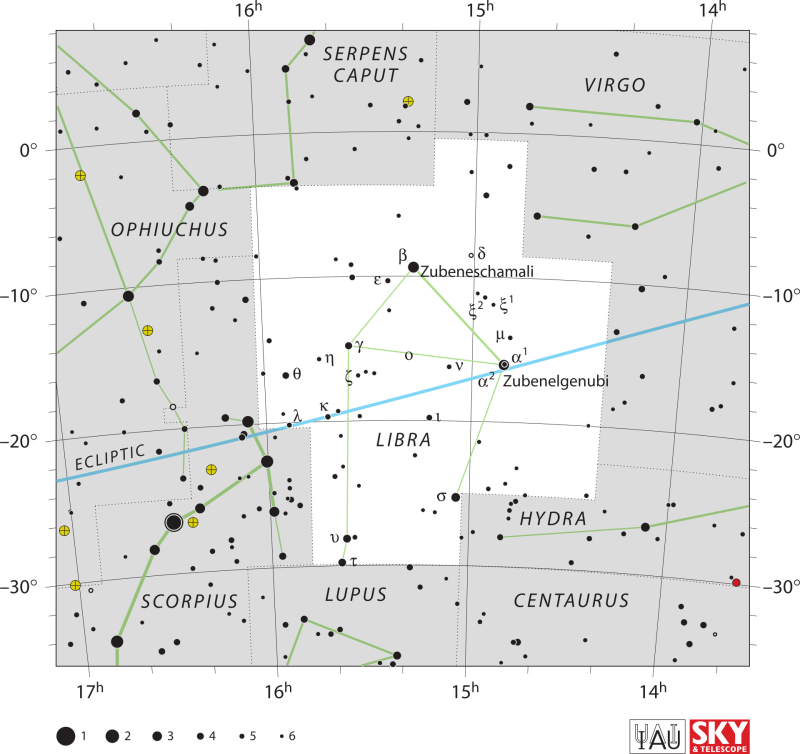
History and mythology of Zubeneschamali
Both of these star names – Zubeneschamali and Zubenelgenubi – rhyme with Obi-Wan Kenobi of “Star Wars” fame.
They are Arabic phrases meaning the Northern Claw (of the Scorpion) and the Southern Claw (of the Scorpion), respectively. Many thousands of years ago in ancient Babylon, these two stars once belonged to the constellation Scorpius the Scorpion, and once depicted the Scorpion’s outstretched claws.
Apparently, the ancient Greeks and Romans redrew the boundaries, creating the constellation Libra the Scales. Well over 2,000 years ago, the sun on the autumn equinox shone in front of Libra, the balance symbolizing the equal duration of day and night on the equinox. At present, the sun is in front of the constellation Virgo the Maiden on the autumn equinox, which falls annually on or near September 22.
In the star lore of the ancient Greeks, the constellation Virgo represents Astraia, the goddess of justice, holding Libra the Scales and weighing judgment upon human souls. It’s thought that Roman citizens associated Libra with Augustus, the dispenser of divine judgment.
Zubeneschamali science
Science has helped Zubeneschamali to one-up its biggest rival in Libra, the alpha star Zubenelgenubi. Astronomers have determined that Libra’s beta star is considerably brighter intrinsically than its rival Zubenelgenubi.
Yet these two Libra stars appear nearly the same brightness as seen from Earth. Why? It’s because Zubenelgenubi lies at less than half Zubeneschamali’s distance. Zubenelgenubi is 75 light-years away, while Zubeneschamali is 185 light-years away.
Zubeneschamali’s intrinsic brightness is nearly five times that of Zubenelgenubi and 130 times that of our sun.
Bottom line: Professional astronomers can explain to you why stars can’t look green. Yet many stargazers insist that Zubeneschamali proves otherwise. What’s the truth?
Like what you read?
Subscribe and receive daily news delivered to your inbox.
More from
Bruce McClure


Meet Aquarius the Water Bearer and its stars

Check out the Double Cluster in Perseus on October evenings
Find the Andromeda Galaxy using Cassiopeia
Alpha Cephei, or Alderamin, is a fast-spinning star