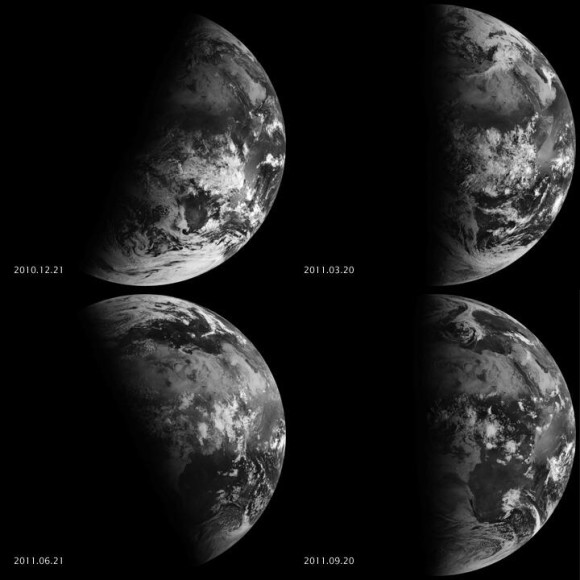
In 2026, the Northern Hemisphere’s summer solstice – and Southern Hemisphere’s winter solstice – falls on June 21, 2026, at 8:25 UTC (that is 3:25 a.m. in central North America; translate UTC to your time). Read more about the June solstice.
Longest sunsets in June and December
Here’s a natural phenomenon you might not have imagined: the longest sunsets happen around the time of the solstices. That is, it takes more seconds for the body of the sun to sink below your western horizon around the solstices, and fewer seconds around the equinoxes. It’s true whether you live in Earth’s Northern or Southern Hemisphere.
As viewed from both the Northern and Southern Hemispheres, the sun rises and sets farthest north at the June solstice and farthest south at the December solstice.
Now consider that the farther the sun sets from due west along the horizon, the shallower the angle of the setting sun. That means a longer duration for sunset at the solstices.
Meanwhile, at an equinox, the sun rises due east and sets due west. That means on the day of an equinox, the setting sun hits the horizon at its steepest possible angle.
Longest sunsets are how long?
The sunset duration varies by latitude. But let’s just consider one latitude: 40 degrees north, which is the latitude of Denver or Philadelphia in the United States, Sardinia in the Mediterranean, or Beijing in China.
At that latitude, on the day of a solstice, the sun sets in about 3 minutes and 15 seconds.
That’s half a minute longer than the sunset at the same latitude on the day of an equinox. The equinox sun at 40 degrees north latitude sets in roughly 2 minutes and 45 seconds.
At more northerly temperate latitudes, the sunset duration is greater; and at latitudes closer to the equator, the sunset duration is less. Near the Arctic Circle (65 degrees north latitude), the duration of a solstice sunset lasts about 15 minutes. At the equator (0 degrees latitude), the solstice sun takes a little over 2 minutes and 15 seconds to set.
Regardless of latitude, however, the duration of sunset is always longest at or near the solstices.
The sunsets are longer in December than June
As it turns out, the sunset and sunrise are a tad longer on the December solstice than they are on the June solstice.
That’s because the sun is closer to Earth in December than it is in June. Therefore, the sun’s disk looms a bit larger in our sky in December, and so it takes slightly longer to set.
Additionally, the closer December sun moves eastward upon the ecliptic at a faster clip, helping to slow down the December solstice sunset (and sunrise) even more. For instance, at 50 degrees north latitude, the winter solstice sunset (sunrise) lasts about 4 minutes and 18 seconds, or about 8 seconds longer than the sunset (sunrise) on the summer solstice.
And now you know!
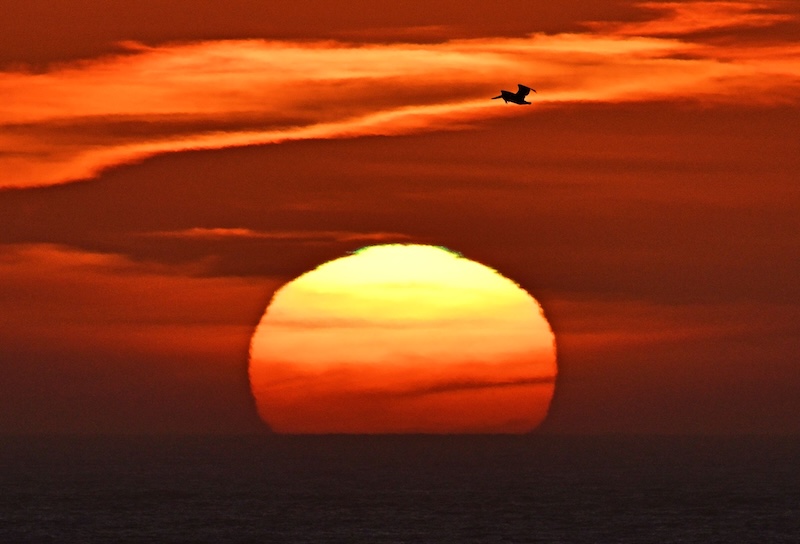
Some sunsets from EarthSky Community Photos

Bottom line: Here’s a natural phenomenon you might never have imagined: the longest sunsets happen around the time of a solstice.
Like what you read?
Subscribe and receive daily news delivered to your inbox.
More from
Bruce McClure


Meet Aquarius the Water Bearer and its stars

Check out the Double Cluster in Perseus on October evenings
Find the Andromeda Galaxy using Cassiopeia
Alpha Cephei, or Alderamin, is a fast-spinning star