February 28 planet parade?
The internet is packed with claims that you can see a spectacular lineup of six visible planets on February 28! But, as is often the case with online chatter, these claims aren’t entirely accurate.
So which planets can you really see in the sky on the evening of February 28?
As soon as the sun sets, the first sky object you’ll notice in the sky is the moon. It’ll have risen earlier in the east and it’ll be big and bright, at almost 93% full. It’ll be just a few days away from full moon on March 3, when – in the predawn hours for North America – there will be the last total lunar eclipse for nearly three years.
Will you see a 6-planet parade on February 28? No. EarthSky’s Deborah Byrd and Marcy Curran discuss which planets you can see in the late February night sky.
Here’s what you’ll really see
On the evening of February 28, the moon won’t be full yet. But it’ll be waxing toward full and bright in our evening sky.
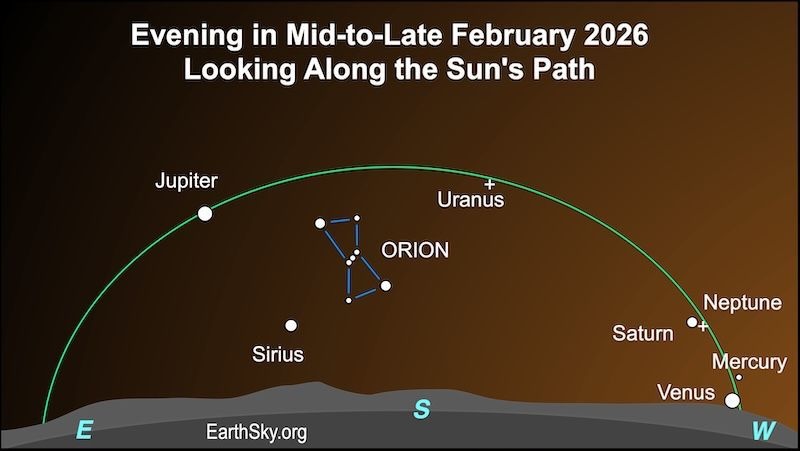
And there’ll be a bright “star” blazing near the moon. That star is really the king among planets in our solar system, Jupiter. While Jupiter and the moon will make a pretty scene, you’ll have to tear your eyes away and look toward the western horizon, where the sun has recently set, to see the other visible planets. There you’ll find a cluster of three bright planets that will set soon after the sun.
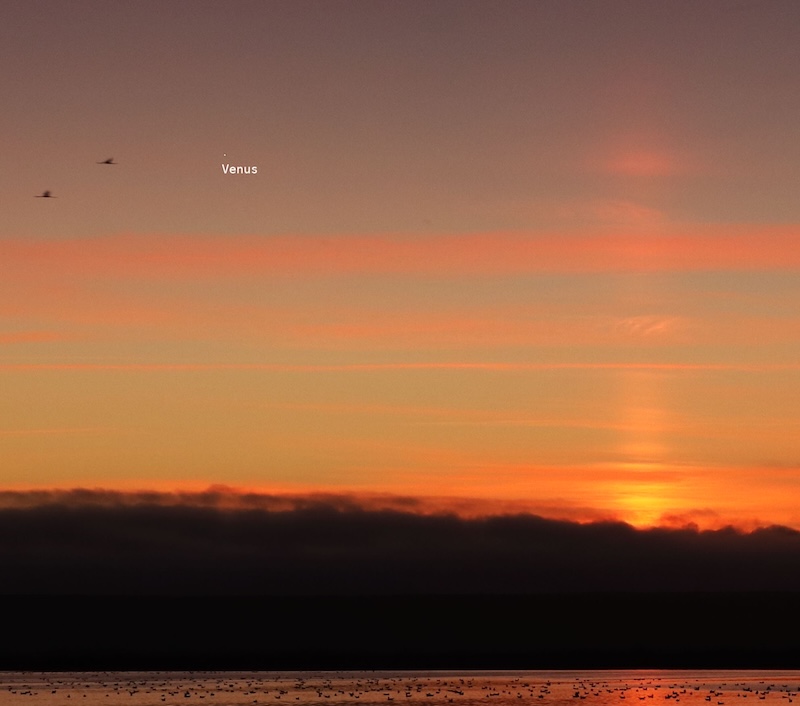
Venus is the brightest of the three, but it’s also currently close to the sunset horizon and visible only in a twilight sky. As it competes with the evening glow of twilight, its brightness will appear diminished. Still, you’ll find Venus surprisingly bright for being so low in the sky.
Venus orbits one step inward from Earth around our sun. And Mercury – which orbits one step inward from Venus – is also in the west after sunset, dimmer and north of Venus in the twilight sky. Mercury was brighter and higher above the sunset horizon earlier this month. It’s faint and challenging on February 28, rapidly fading in brightnesss and very low on the western horizon.
Next is Saturn, a bit higher than Venus or Mercury above the sunset horizon. Saturn is moderately bright, brighter than Mercury now, and visible to the unaided eye. It appears as a steady, golden “star” low in the west as the sky grows darker. But to see any of these three, you must have a flat horizon with no buildings, trees or other obstructions blocking your view.
So that’s only four planets, and really just one of them (Jupiter) is easy to see. There are two other planets in the sky that night as well, but they’re even harder to see. Uranus is close to the pretty star cluster known as the Pleiades, while Neptune is not far from Saturn. To see either of those outer planets, you’ll need optical aid and a star chart showing their location in front of the stars.
February 26 and 27 evenings: Moon, Jupiter and twin stars

Will there be a 6-planet “parade” on February 28. Not exactly. Read more here.
Keep up with the moon and planets every night with EarthSky’s visible planets guide.
Our charts are mostly set for the northern half of Earth. To see a precise view – and time – from your location, try Stellarium Online.
February 28 evening: Moon, Jupiter and twin stars

Will there be a 6-planet “parade” on February 28. Not exactly. Read more here.
Keep up with the moon and planets every night with EarthSky’s visible planets guide.
Will we have a planet parade on February 28? Not exactly
Four of the five bright planets have been in our sky since mid-February. So why do posts on social media point to February 28? We don’t know. It’s a mystery, because the planets have been in these same general positions for weeks. We suspect this date is popular because the moon is at one end of the line of planets, near bright Jupiter, on February 28. But honestly? We don’t know why February 28 was chosen for the various “planet parade” graphics floating around the internet.
Check out the charts below to find where the planets are, in case you want to hunt them down yourself.

Bottom line: Rumors of a February 28 planet parade are sweeping the internet. But are they true? Will you be able to see six planets in a line? No. Get the details here.
Listen to this month’s “Planetary Parade” with NASA’s Chandra
Like what you read?
Subscribe and receive daily news delivered to your inbox.
More from
Kelly Kizer Whitt


Visible planets and night sky guide for October

Is the Mars Grand Canyon still tectonically active?
Why does anything exist? New theory emerges
Euclid was mapping the universe. Then it found a comet