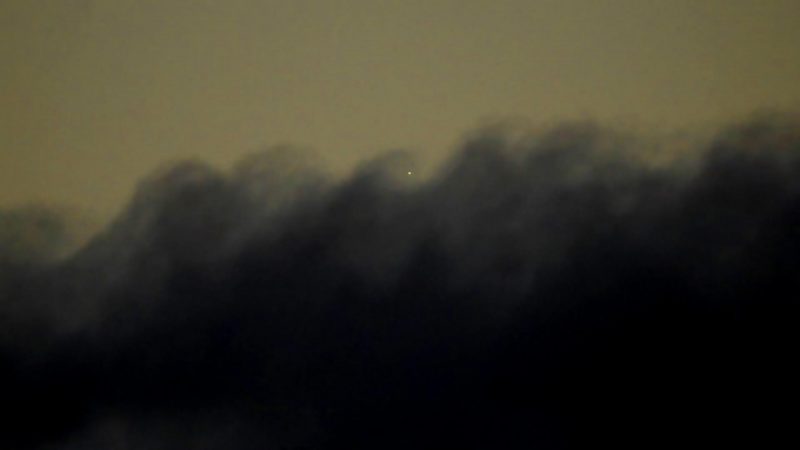
The Observer’s Handbook – a great tool for serious skywatchers – says that in April 2021 Venus is:
Too close to the sun to be easily seen. Might be spotted with difficulty low above the horizon in bright evening twilight late in the month.
And now, indeed, an EarthSky community member has spotted it in the western sky after sunset. Helio Vital in Rio de Janeiro, Brazil, is an old hand at capturing bright stars and planets low in the sky. He wrote on April 20, 2021, that he caught Venus this week:
… a mere 6 degrees away from the sun … using only my Nikon CoolPix P900 camera at manual mode with magnifications around 50-100x, I was able to capture it at sunset on April 19. Best wishes from Rio de Janeiro!
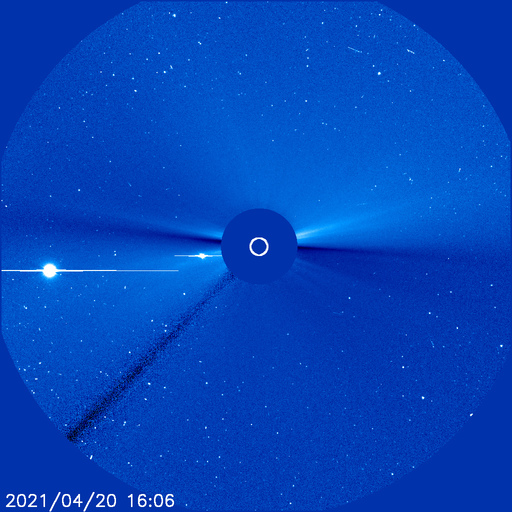
Thank you, Helio! Venus is really close to the sun now, so close that it’s still in the field of view of the LASCO C3 instrument on NASA’s SOHO spacecraft. This instrument has a 15-degree field of view. See the image below.
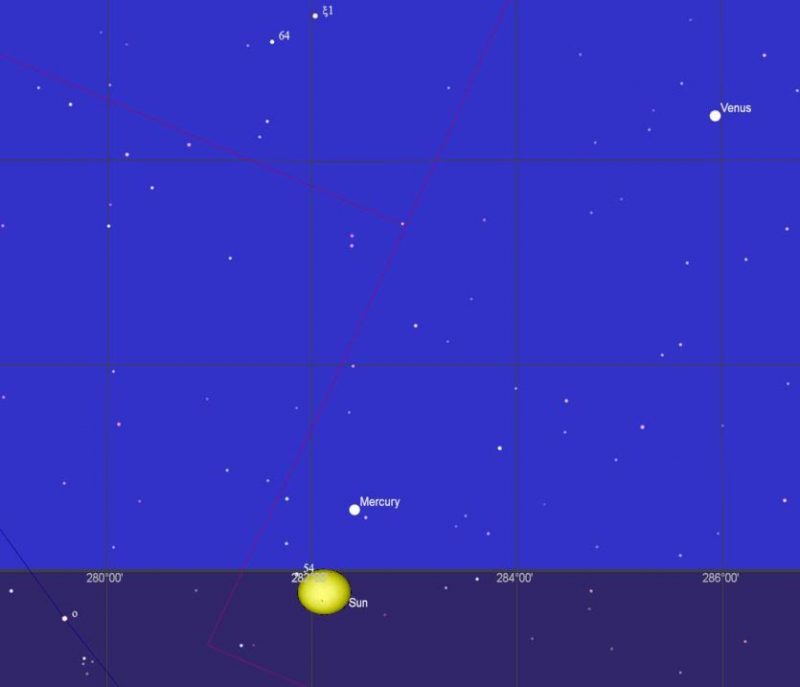
And Helio sent along a computer-generated view of the western sky after sunset now, as seen from his location, showing the whereabouts of Venus and Mercury. We see these two worlds exceedingly near the sun in our sky now, which is to say they’re both difficult-to-impossible to see, except with optical aid. But both will be coming into much easier view in May, when you’ll see them with the eye alone, shining in the west after sunset.
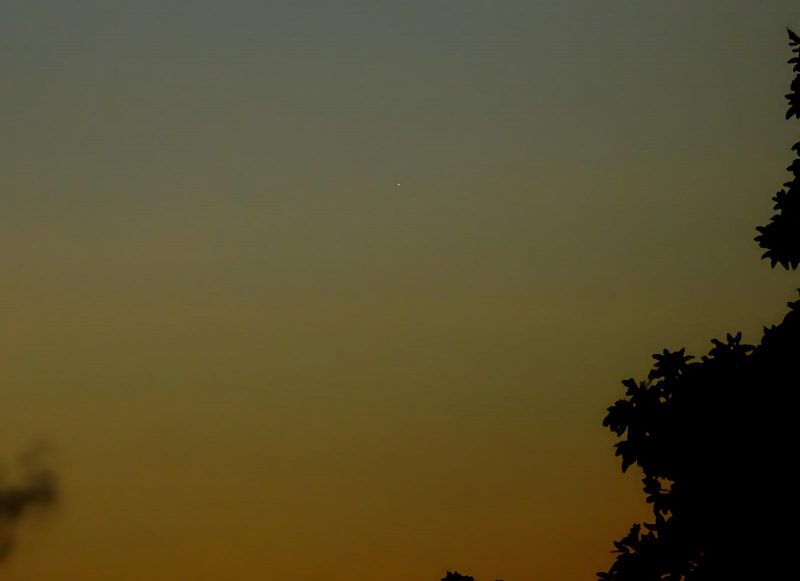
Bottom line: Venus and Mercury are back in the evening sky. Have you seen them? Probably not; they’re exceedingly close to the sun. But EarthSky Community member Helio Vital did manage to capture a photo of Venus on April 19. Way to go, Helio!
Like what you read?
Subscribe and receive daily news delivered to your inbox.
More from
Deborah Byrd


2026 September equinox: All you need to know

Why is planet Venus so bright in Earth’s sky?
Zodiacal light: Start watching for it now
Orion’s Belt points to Sirius on September mornings