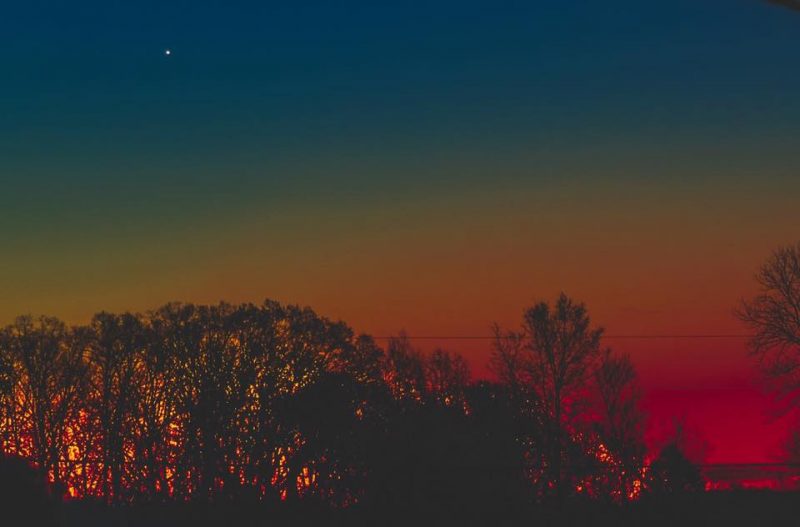
Tim Herring caught Venus on April 9, 2017 and wrote: “Woke to let the dogs out, to find Venus shining above the dawn horizon. Grabbed my camera and hand held this shot. A bit grainy as auto ISO ‘helped.’ I wish I could have crossed the field to get more of the tree silhouette, but it is in my neighbors field and the geese are pairing up and nesting – best not to disturb them.”
All eyes are trained on the moon and Jupiter over these next few nights, but – if you’re up early – remember to look east for Venus, too. Venus is even brighter than Jupiter. It’s the brightest planet – brighter than any sky objects besides the sun and moon. throughout April 2017, people have been waking up to find Venus in the east before dawn, even though this planet has only recently shifted over into our predawn sky. To see it, find an unobstructed eastern horizon shortly before the sun comes up. Then … its brightness might surprise you!
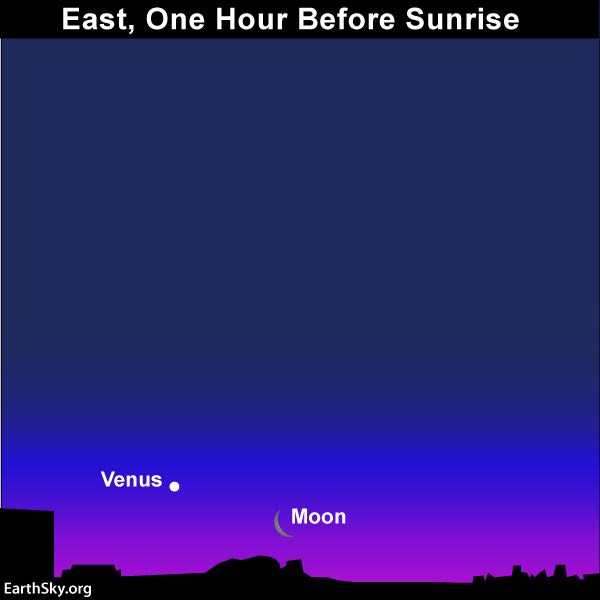
Before the month ends, Venus will pair with the moon around April 23. It’ll have another time of greatest brilliancy before the month ends. It’s always an eerie sight at greatest brilliancy; expect UFO reports to increase in late April!
Start watching Venus now before dawn. It’ll reward you with many beautiful beginnings to the day.
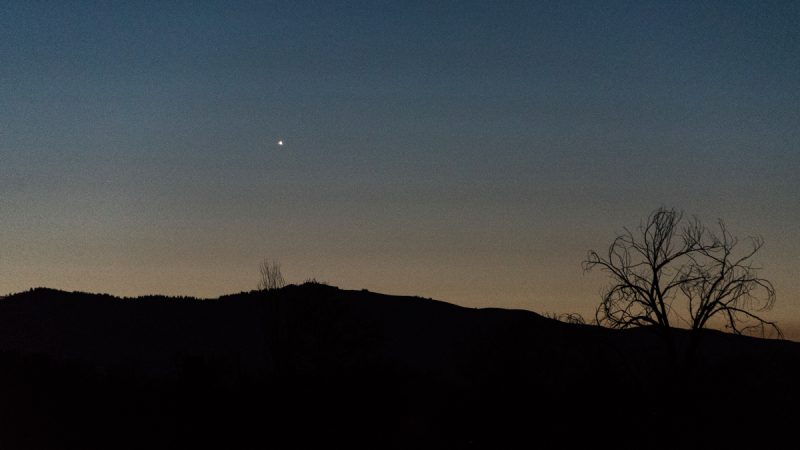
Chris Davis in Loretto, Tennessee captured Venus in the east before dawn on April 2, 2017.If you could see Venus through a telescope now, you’d find it in a waxing crescent phase. Because it was so recently between us and the sun, its lighted half – or day side – is still facing mostly away from us. Photo taken Saturday morning, April 1, 2017 by Nick Southall on Mon Louis Island, Alabama.Throughout April 2017, Venus will be appearing a bit higher each morning in the east before dawn, and it’ll be getting brighter! Watch for it on April 23, when it’ll pair with the waning moon. And watch around April 30, when Venus will be at greatest brilliancy for this morning apparition.
Bottom line: Photos from the EarthSky community of Venus in April, 2017, in the east before dawn.
Deborah Byrd (asteroid 3505 Byrd) helps edit EarthSky.org and is a frequent host of EarthSky videos. Deborah created the EarthSky radio series in 1991 and founded EarthSky.org in 1994. Prior to that, she had worked for the University of Texas McDonald Observatory since 1976, and created and produced their Star Date radio series. She has won a galaxy of awards from the broadcasting and science communities, including having an asteroid named in her honor in 1990, a Public Service Award from the National Science Board in 2003, and the Education Prize from the American Astronomical Society in 2020. A science communicator and educator since 1976, Byrd believes in science as a force for good in the world and a vital tool for the 21st century. "Being an EarthSky editor is like hosting a big global party for cool nature-lovers," she says.
Like what you read? Subscribe and receive daily news delivered to your inbox.
Thank you! Your submission has been received!
Oops! Something went wrong while submitting the form.