On special dates throughout 2025, Saturn’s large moon Titan has been casting its shadow on Saturn’s cloudtops. Some in the EarthSky community have captured these remarkable events, which happen only about every 15 years. EarthSky’s Deborah Byrd – and our friend Bob King, aka AstroBob – explain and show pictures. Watch in the player above or here.
Have you captured Titan and its shadow? Submit your image here.
Titan casts a shadow on Saturn
While shadow transits of the Galilean satellites at Jupiter are common, they are not as frequent at Saturn. In fact, they only occur about every 15 years. But luckily, right now, conditions to witness Titan’s shadow on Saturn are favorable.
According to Sky and Telescope:
Titan transits occur only during the relatively brief time Earth and Saturn both lie nearly on the same plane, which coincides with when the rings appear approximately edge-on.
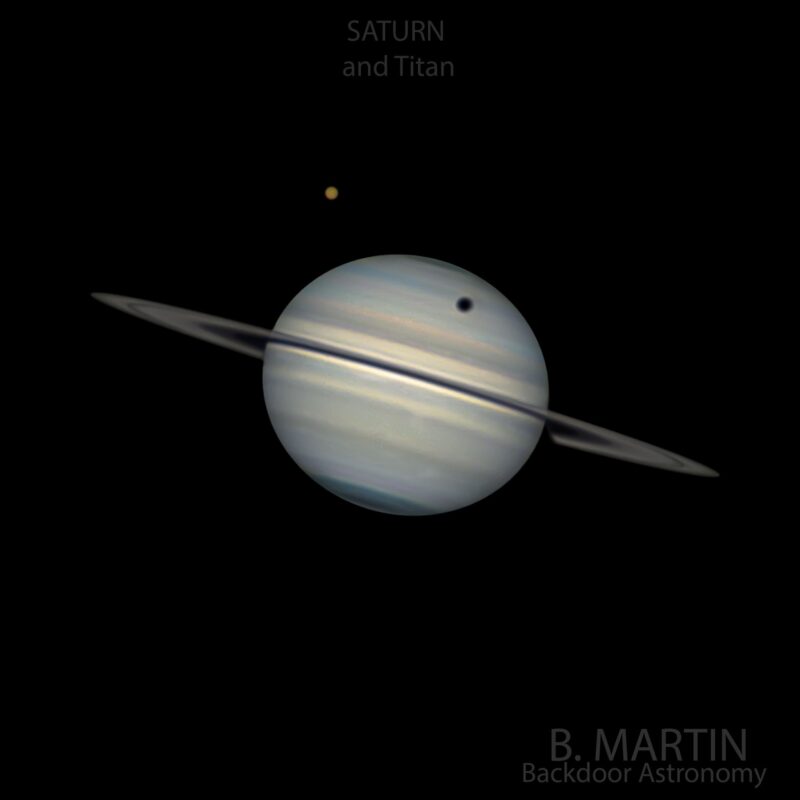
EarthSky Community photos
In March, Saturn passed between Earth and the sun, so at that moment, its rings appeared nearly edge-on to us on Earth. Saturn is ascending in the morning sky, and its rings are tilted less than 4 degrees. Consequently, the rings are less prominent, so shadows and details on the planet’s disk are easier to see.
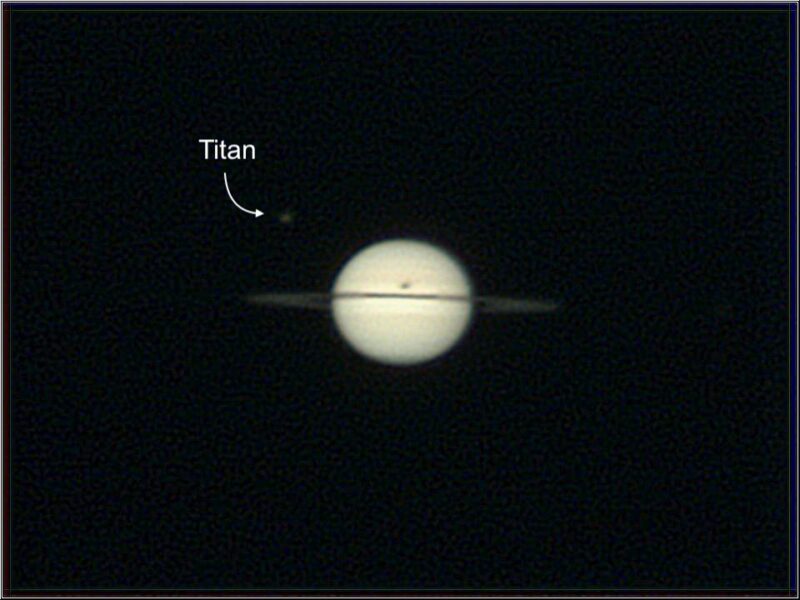
EarthSky’s friend Robert Lunsford captured the remarkable image below showing Titan’s shadow on Saturn. And that faint dot at the 10 o’clock position is Titan.
More upcoming shadow transits on Saturn
You can see more Titan shadow transits through October. The dates are listed here.
Rhea, Saturn’s second largest moon, orbits closer to Saturn, so it transits the planet more frequently. You can see Rhea through telescopes of 8 inches (20 cm) or larger.
Check Stellarium-Web for possible shadow transits of Saturn’s moons from your location.
About Saturn’s largest moon
Titan is the only moon in our solar system with a dense atmosphere. It’s is the second largest moon in our solar system, after Jupiter’s Ganymede. And it is Saturn’s largest moon. Its diameter is 3,200 miles (5,150 kilometers), which means it is larger than the planet Mercury. Titan shines at 8.4 magnitude, so you’ll need a telescope to see it.
From telescopes on Earth, it appears 0.8 arcseconds wide. And yes, that’s tiny, considering one degree of sky is equal to your pinky finger held at arm’s length. Furthermore, it takes 60 arcminutes to make up one degree, and 60 arcseconds to make up one arcminute.
Bottom line: Right now, Saturn’s rings appear almost edge-on to us, and you can observe shadow transits of some of its moons. See images here.
Weird! Titan’s atmosphere is wobbling like a gyroscope
Read more: Frigid Titan has soaring, bubbling clouds with unusual rains
Like what you read?
Subscribe and receive daily news delivered to your inbox.
More from
Marcy Curran


Visible planets and night sky guide for October

Smart scopes are amazing. Here’s why I love mine
Meteor shower guide 2026: Up next … the Draconids
Deep partial lunar eclipse overnight