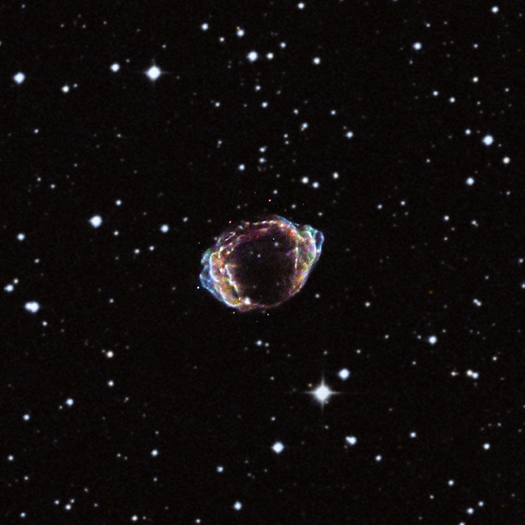
This is the object called G1.9+0.3 by astronomers. It’s about 28,000 light-years from Earth near the center of our Milky Way galaxy. The object is an expanding shell of gas, left behind by the most recent supernova, in Earth’s time frame, known to have occurred in our galaxy.
If gas and dust had not heavily obscured it, the supernova explosion would have been visible from Earth just over a century ago.
A new observation with NASA’s Chandra X-ray Observatory made this image possible. For astronomers, these Chandra observations – made over the equivalent of 11 days of time – reveal new details about the explosion.
Like what you read?
Subscribe and receive daily news delivered to your inbox.
Thank you! Your submission has been received!
Oops! Something went wrong while submitting the form.
More from
Deborah Byrd
View All


Visible planets and night sky guide for October

October 9, 2026
Hera mission hits the brakes to arrive at asteroid
October 8, 2026
Flashing star in autumn? Here are 3 candidates
October 6, 2026
Stargazing tips! 10 great tips for beginning astronomers
October 1, 2026