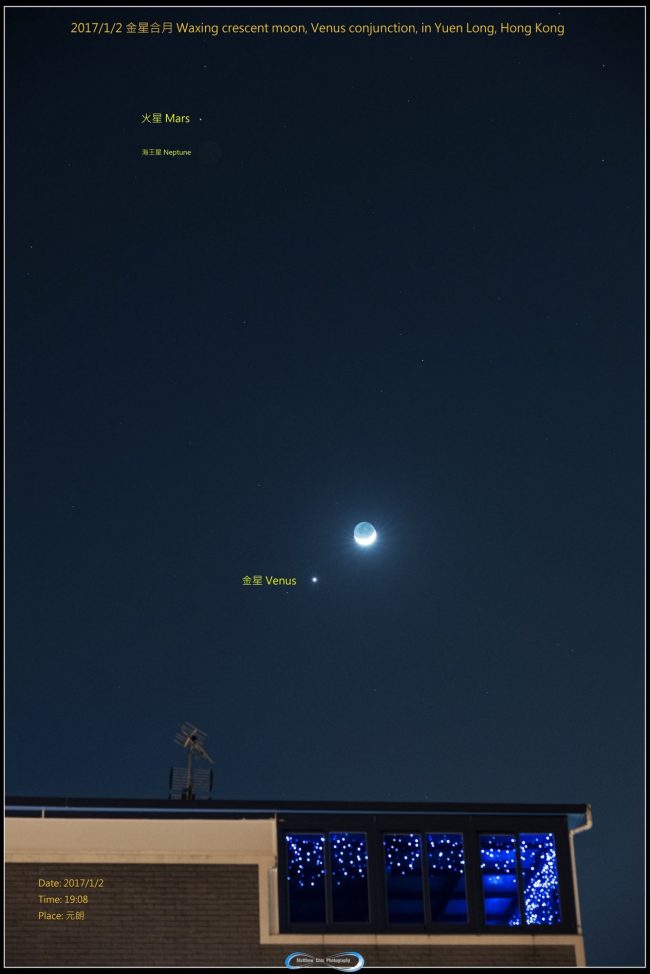
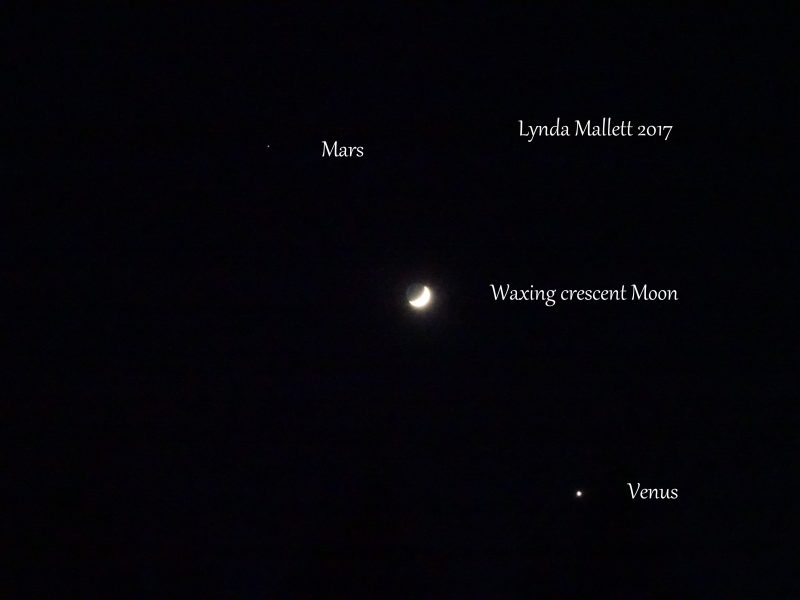
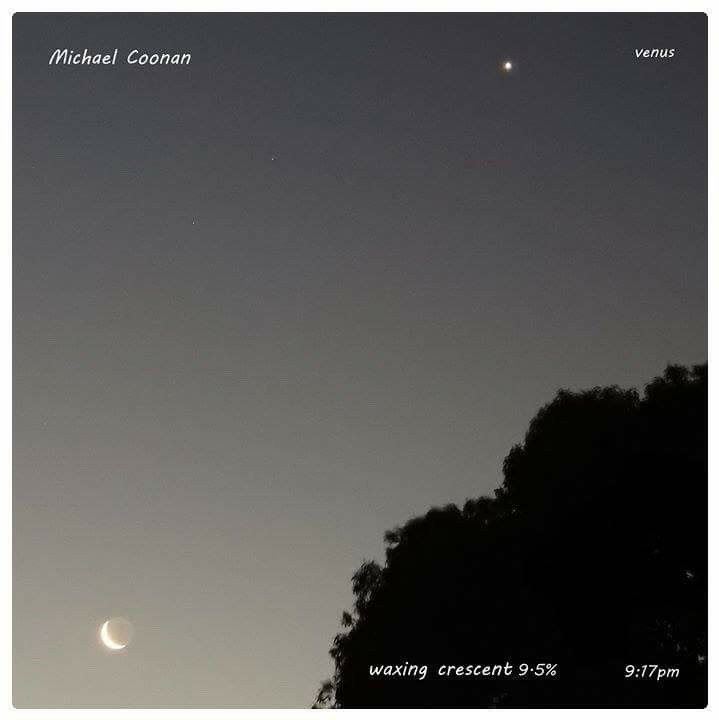
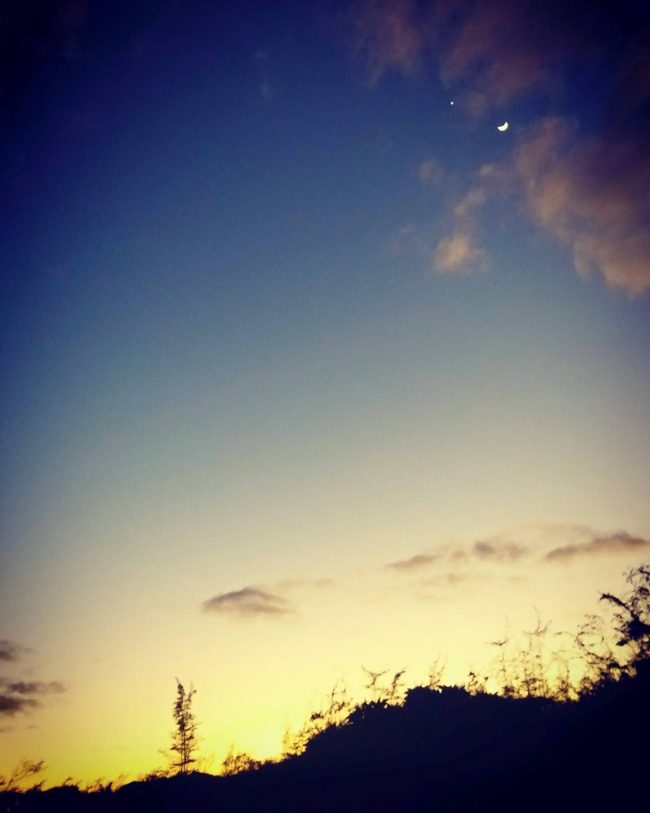
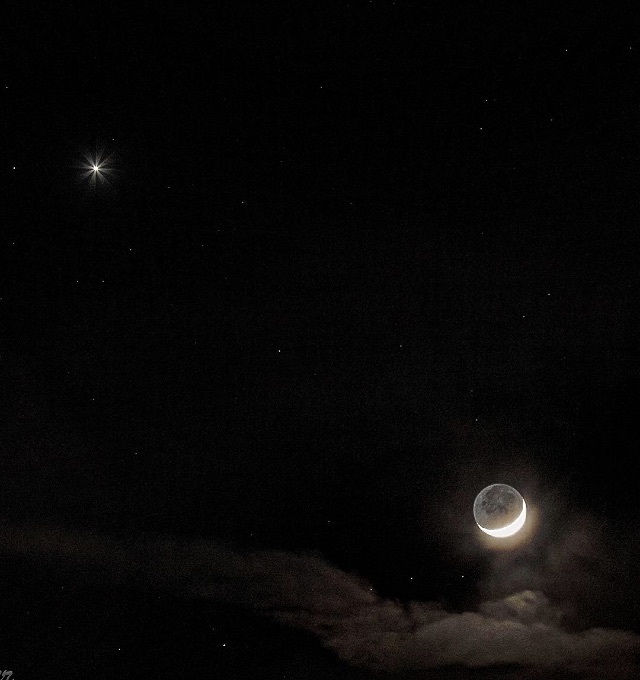
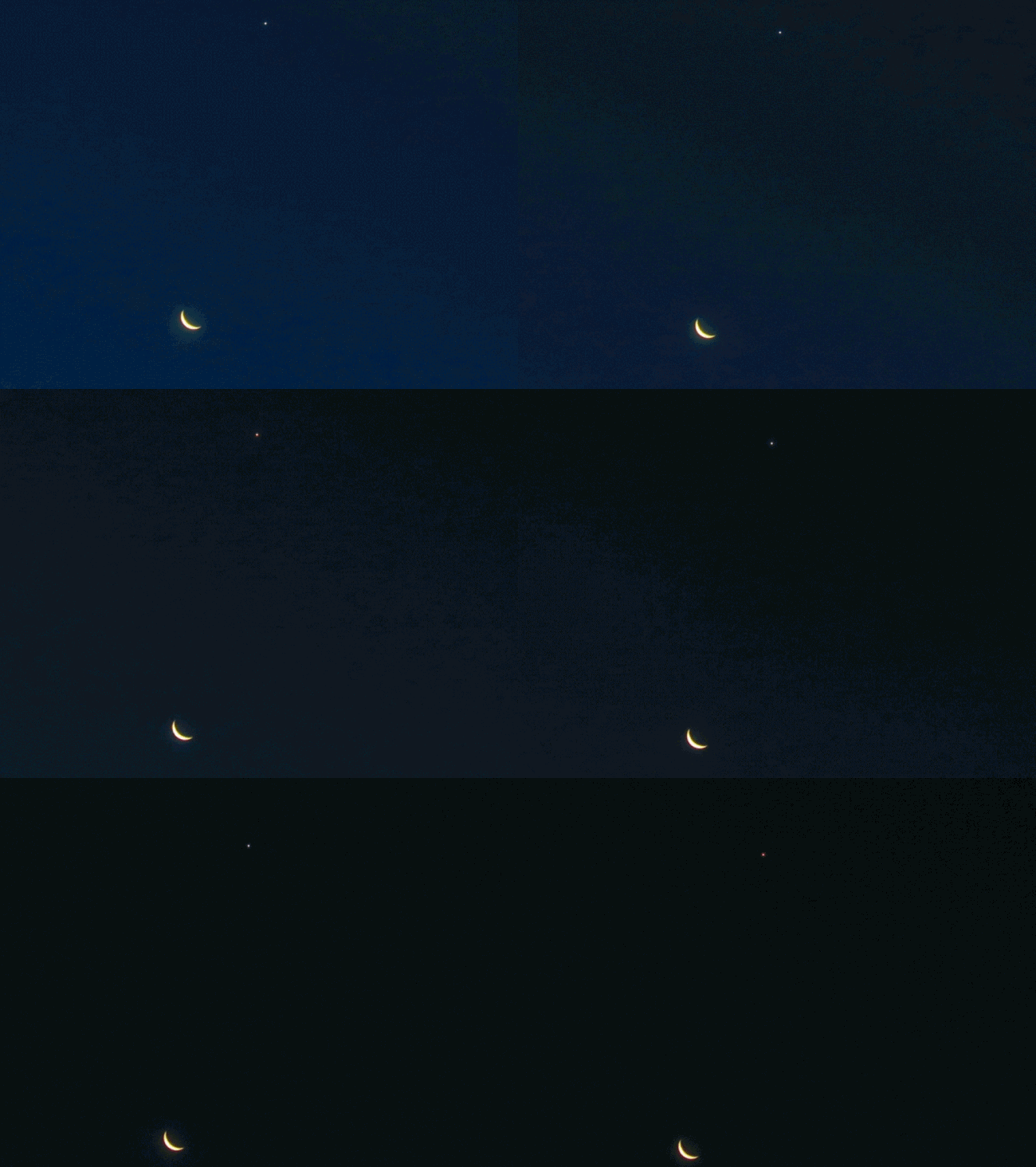
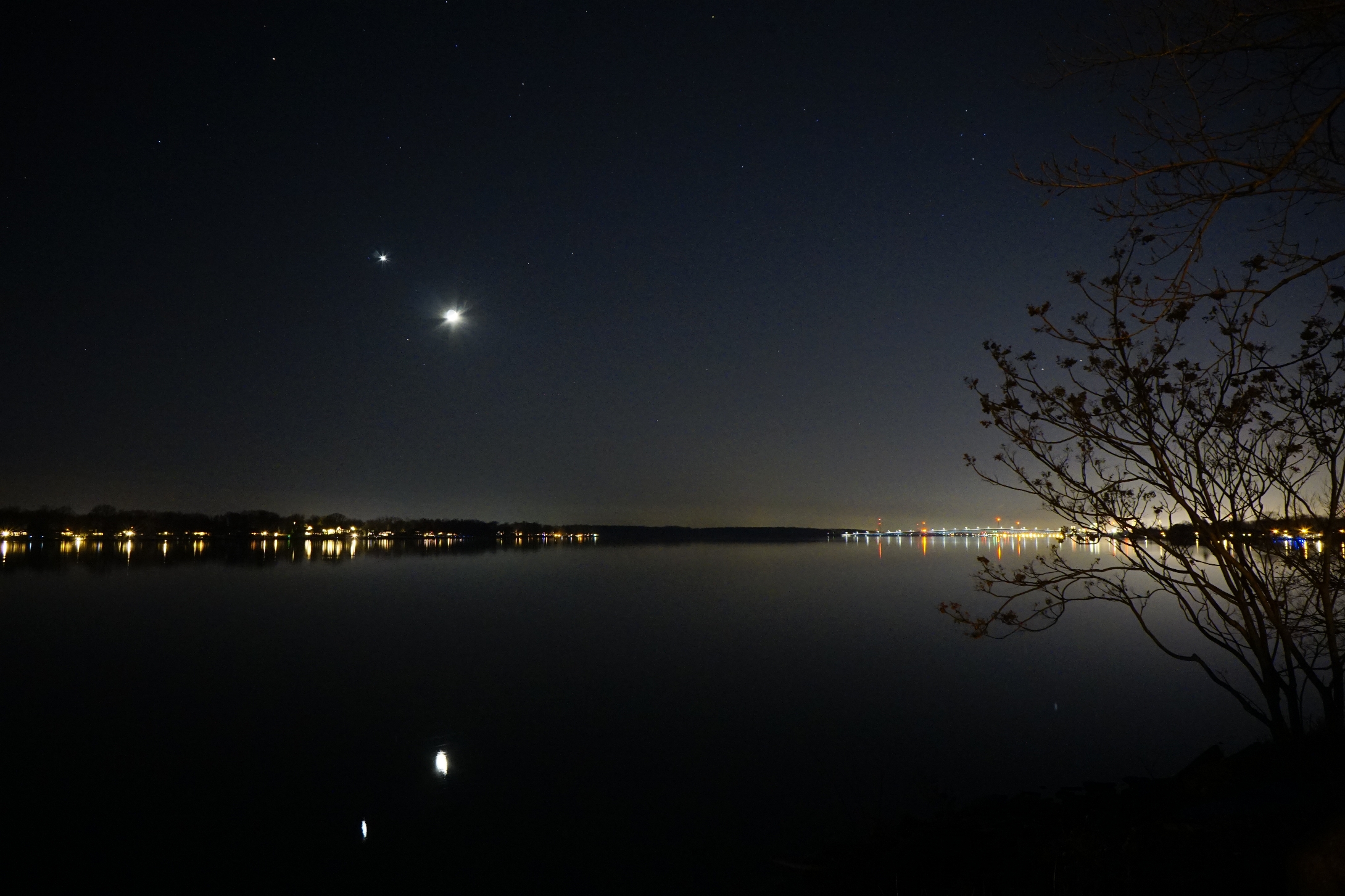
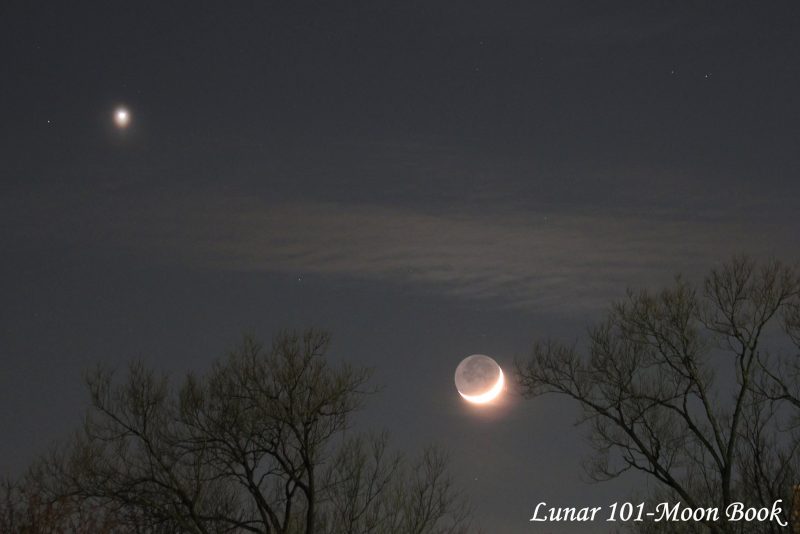
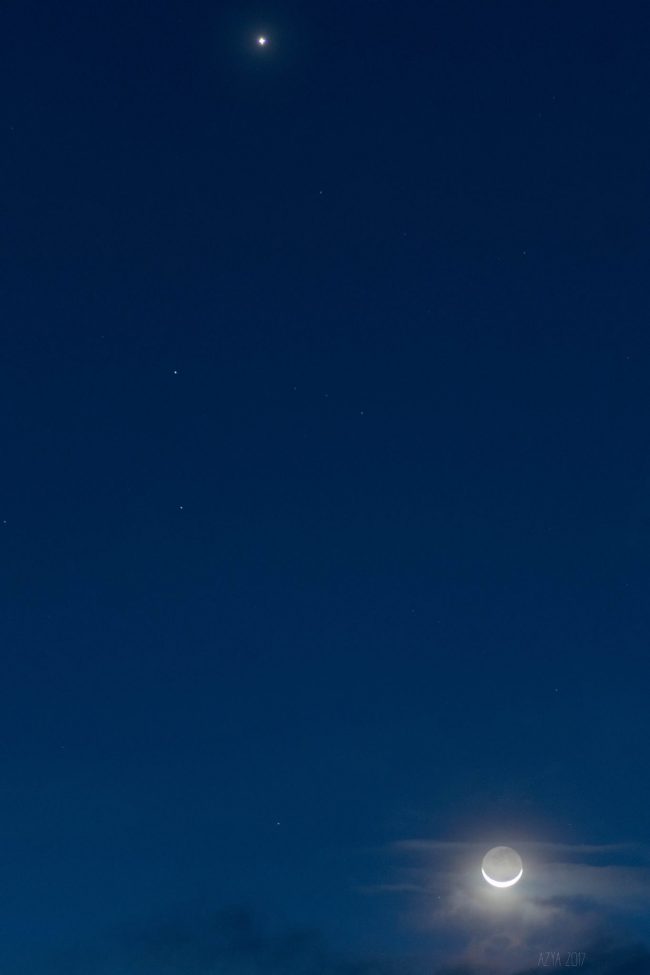
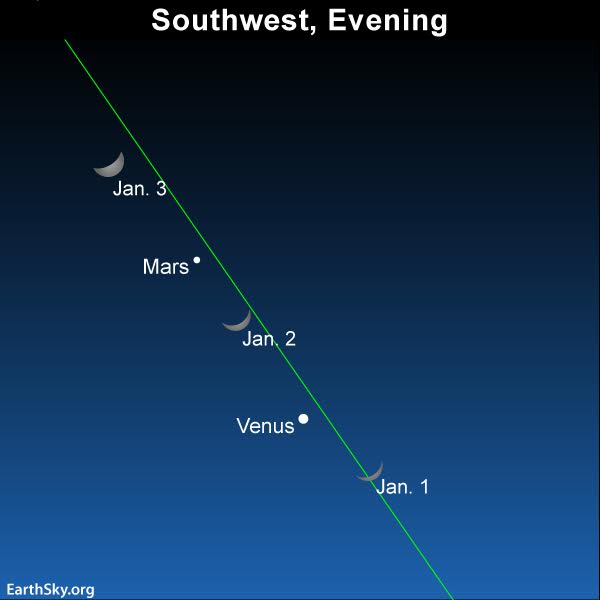
The moon moves continually eastward in orbit. It has now swept up past Venus and will continue getting higher in the west after sunset. Here’s the view from Hong Kong on the evening of January 2. Thank you, Matthew Chin!On January 2, 2017 – as seen from Nova Scotia, Canada – the moon was sandwiched between Mars and Venus. Photo by Lynda Mallett.As seen from the Northern Hemisphere, the moon, Venus and Mars arced up and to the left of the sunset Sunday evening, January 1, 2017. Photo by Gowrishankar Lakshminarayanan Parsippany, New Jersey. Thank you, Gowri!As seen from the Southern Hemisphere, they arced up and to the right of the sunset on January 1. Photo by Michael Coonan in Wodonga, Australia. Thank you, Michael.You could see them as soon as it got dark outside. January 1 photo by Patricia J Agustin M at Lydgate State Park in Hawaii. Thanks, Patricia!If you had enough optical aid, you could see Neptune, too. January 1 photo by Stuart Kenn in Beeton, Ontario, Canada. Thank you, Stuart.Karl Diefenderfer in Quakertown, Pennsylvania wrote: “Earthshining moon and Venus in a sea of stars. What a great way to begin a new year of watching the heavens.” Agree! Thank you, Karl.As Earth spun on its axis, the moon and Venus on January 1 followed the sun below the western horizon. By early evening, they were gone. Animation by Helio C. Vital in Rio de Janeiro, Brazil. Thanks, Helio.Venus and the moon are Earth’s two brightest nighttime objects. See them shining in the water? January 1, 2017 by Tony Leeat the upper Niagara River, looking west to Grand Island. Thank you, Tony!A few thin clouds on January 1 enhanced the view for our friend Lunar 101-MoonBook. Thank you for all you do!Azya Matsumoto in Malaysia – just west of the International Date Line – caught the youngest moon of the pics we saw … farthest from Venus. Because the moon is always moving in orbit around Earth, it edged closer to Venus throughout the day on January 1, 2017. Thank you, Azya!If you look westward after sunset, you’ll easily see a very bright starlike object. That’s the planet Venus. The moon is sweeping past Venus on the first few evenings of 2017.The moon will sweep by Venus and Mars again before January, 2017 ends. Read more.
Bottom line: Photos of the moon, Venus and Mars (and Neptune) in early January, 2017.
Deborah Byrd (asteroid 3505 Byrd) helps edit EarthSky.org and is a frequent host of EarthSky videos. Deborah created the EarthSky radio series in 1991 and founded EarthSky.org in 1994. Prior to that, she had worked for the University of Texas McDonald Observatory since 1976, and created and produced their Star Date radio series. She has won a galaxy of awards from the broadcasting and science communities, including having an asteroid named in her honor in 1990, a Public Service Award from the National Science Board in 2003, and the Education Prize from the American Astronomical Society in 2020. A science communicator and educator since 1976, Byrd believes in science as a force for good in the world and a vital tool for the 21st century. "Being an EarthSky editor is like hosting a big global party for cool nature-lovers," she says.
Like what you read? Subscribe and receive daily news delivered to your inbox.
Thank you! Your submission has been received!
Oops! Something went wrong while submitting the form.