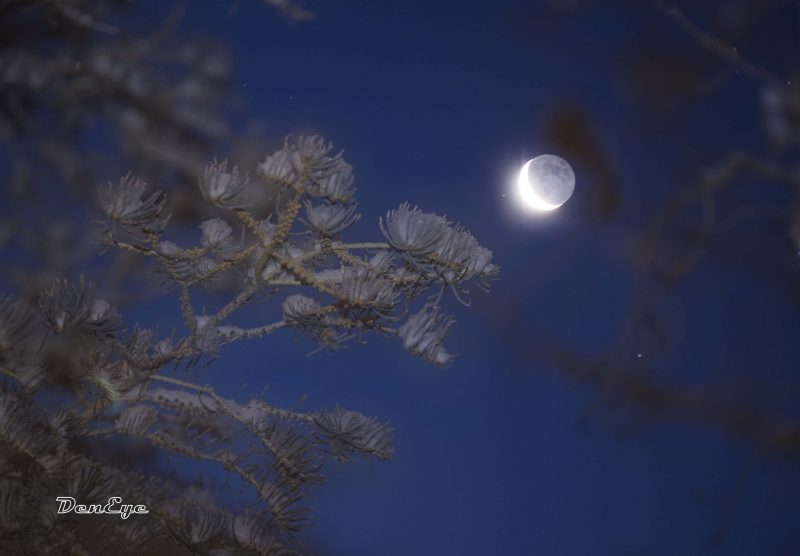
Saturn is the brighter “star” below and to the right of the moon in this photo by Dennis Schoenfelder. The fainter true star in the moon’s glare is (I think) HIP90806, a faint star in the constellation Sagittarius. Photo by Dennis Schoenfelder
Dennis Schoenfelder in Alamosa, Colorado, wrote on February 11, 2018:
We got a couple inches of snow, and my wife and I went out this morning to move snow. I let her start without me when I saw the moon and Saturn. It was -7 degrees Farenheit [editor’s note: about -22 degrees Celsius]. My fingers got cold but I got the picture.
Oh… we did clear our sidewalk, as well as the sidewalks of two of our neighbors.
Thank you for submitting your photo to EarthSky, Dennis!
Of course, Dennis wasn’t the only person who spotted the moon and Saturn Sunday morning. People around the world would have seen them. More Sunday-morning moon-and-Saturn images, below:
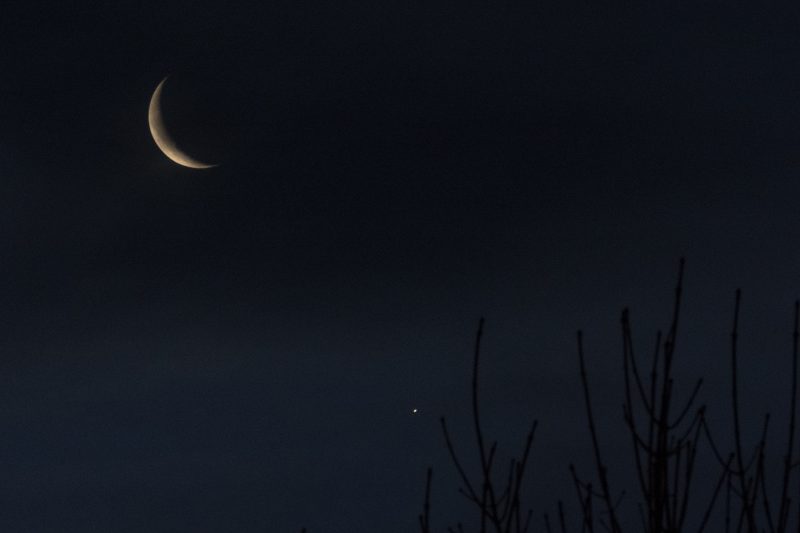
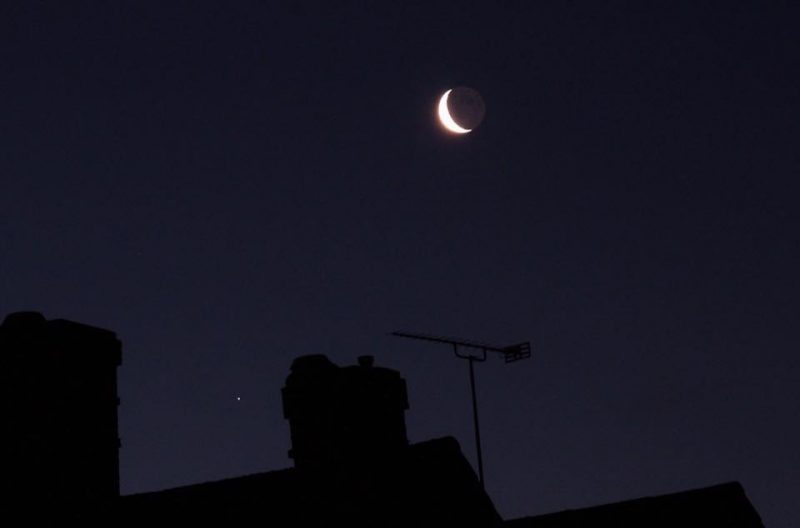
Moon and Saturn Sunday morning – February 11, 2018 – from Paul Dawson in Boise, Idaho.Steve Pond in the UK caught the moon and Saturn – to the left of the chimney – Sunday morning, too. Notice the difference between the 2 photos above and this photo. From the UK, the moon appeared farther from Saturn. In the hours it took Earth to spin, bringing the moon and Saturn above the horizon for Dennis and Paul in the U.S., the moon had moved in its orbit, to appear closer to Saturn.
Bottom line: Photos of the waning crescent moon and planet Saturn, Sunday morning, February 11, 2018.
Deborah Byrd (asteroid 3505 Byrd) helps edit EarthSky.org and is a frequent host of EarthSky videos. Deborah created the EarthSky radio series in 1991 and founded EarthSky.org in 1994. Prior to that, she had worked for the University of Texas McDonald Observatory since 1976, and created and produced their Star Date radio series. She has won a galaxy of awards from the broadcasting and science communities, including having an asteroid named in her honor in 1990, a Public Service Award from the National Science Board in 2003, and the Education Prize from the American Astronomical Society in 2020. A science communicator and educator since 1976, Byrd believes in science as a force for good in the world and a vital tool for the 21st century. "Being an EarthSky editor is like hosting a big global party for cool nature-lovers," she says.
Like what you read? Subscribe and receive daily news delivered to your inbox.
Thank you! Your submission has been received!
Oops! Something went wrong while submitting the form.