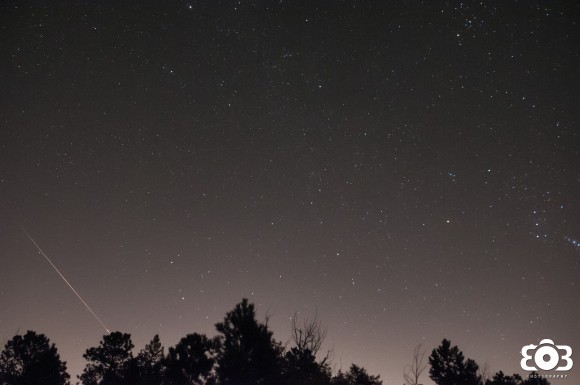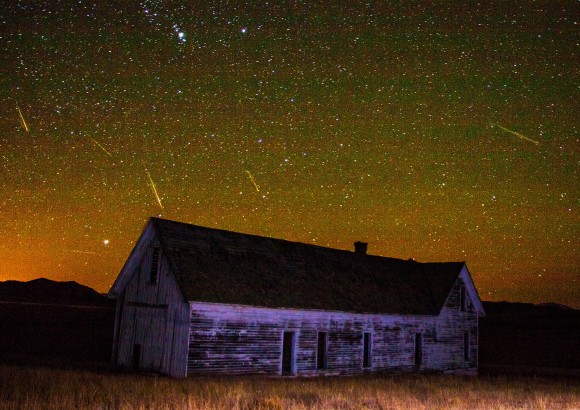
Joe Randall created this composite shot of the Orionid meteor shower from images taken on October 21, 2014. Thanks, Joe!
The peak of the annual Orionid meteor shower has now passed, but you might see some meteors still from this shower if you’re looking in a dark country sky. That’s because Earth is still moving through the orbit of Comet Halley, which last returned near Earth in 1986 and which is due to return again in 2061. This comet spawned this annual meteor shower by leaving bits of dusty debris behind in its orbit. Each year when we intersect the orbit of Comet Halley, we see the Orionid meteor shower!
Thanks to all who posted photos of this year’s shower at EarthSky Facebook!
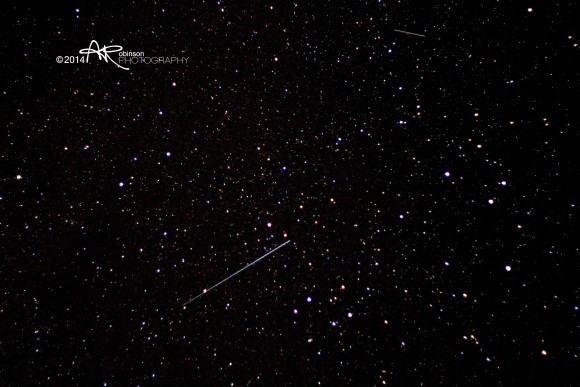
Orionid meteor, October 21, 2014, by Aaron Robinson. Thank you, Aaron.Brian Brace wrote, “Almost slept in last night, but I’m glad I didn’t. Found a nice spot in Genesse that’s only 25 minutes away from Denver, Colorado where I live. Didn’t want to go too far so I thought this was ideal for a couple hours of stargazing after hearing about the start of Orionid meteor shower. As I turned off I 70, I knew this was going to be a good place after seeing how dark everything was, Around the first hairpin turn there was this perfect turn off that faced the dark eastern sky. There was some light pollution from Denver, but not much, After a few hours into our adventure we only witnessed a few meteors flying by. But right before i took the camera down this huge fireball looking meteor streamed across the northeastern sky. That one meteor made the whole night worth it.” Thank you, Brian!
Deborah Byrd (asteroid 3505 Byrd) helps edit EarthSky.org and is a frequent host of EarthSky videos. Deborah created the EarthSky radio series in 1991 and founded EarthSky.org in 1994. Prior to that, she had worked for the University of Texas McDonald Observatory since 1976, and created and produced their Star Date radio series. She has won a galaxy of awards from the broadcasting and science communities, including having an asteroid named in her honor in 1990, a Public Service Award from the National Science Board in 2003, and the Education Prize from the American Astronomical Society in 2020. A science communicator and educator since 1976, Byrd believes in science as a force for good in the world and a vital tool for the 21st century. "Being an EarthSky editor is like hosting a big global party for cool nature-lovers," she says.
Like what you read? Subscribe and receive daily news delivered to your inbox.
Thank you! Your submission has been received!
Oops! Something went wrong while submitting the form.