



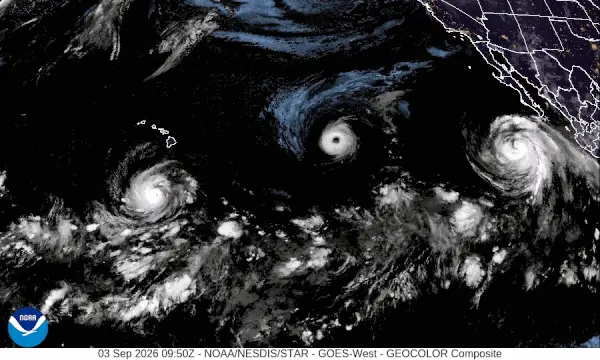
Hurricane triplets spin across the Pacific Ocean
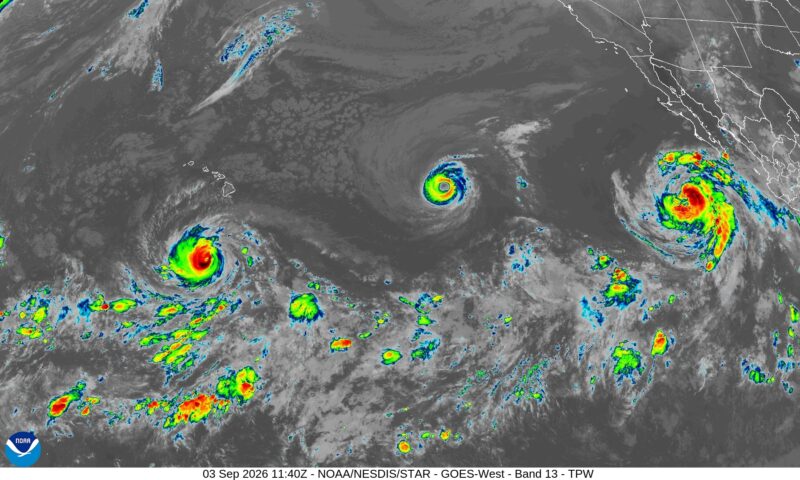
On September 2, 2026, Tropical Storm Marie strengthened into a hurricane. This hurricane joins two others already spinning in the Pacific Ocean: Lowell and Karina. The last time there were three simultaneous hurricanes in the Pacific Ocean of any strength was in September 2015. Those hurricanes were Kilo, Ignacio and Jimena. They all became major Category 4 hurricanes.
Lowell rapidly strengthened this week. On Wednesday, Lowell had reached Category 5, with sustained winds of 160 mph (257 kph). It weakened slightly Wednesday and as of Thursday morning is 145 mph. That puts it back in Category 4. At the moment, it’s safely south of Hawaii and heading west. But it will make a northerly turn by the weekend. Hawaii will have to keep a close eye on the forecast.
Karina had sustained winds of 145 mph (233 kph) on Wednesday, placing it in Category 4. It, too, weakened overnight, with winds dropping to 120 mph, dropping to a Category 3. But that still makes it a major hurricane. It’s east of Hawaii but will also make a northward turn over the weekend, fortunately before it reaches Hawaii.
Marie is the lightweight at 85 mph (129 kph) but the only one strengthening. It’s a Category 1 hurricane that is near the Baja California peninsula of Mexico. There was initially some concern that it could stray northward and affect California. But now it appears the hurricane will move safely out into the Pacific.
By the way, these giant low-pressure storms are hurricanes when in the eastern and central North Pacific, typhoons in the northwestern Pacific, and cyclones in the South Pacific.
Are the 3 hurricanes related to El Niño?
We are currently in El Niño conditions. The conditions were met after the sea surface temperatures in the equatorial Pacific Ocean rose 0.9° Fahrenheit (0.5° Celsius) above average for several months. And we might end up having the strongest El Niño on record.
The El Niño conditions have contributed to the formation of hurricanes in the Pacific. Warmer-than-average waters in the Pacific mean evaporation happens more quickly, sending water vapor into the atmosphere. There’s also reduced wind shear, which allows storms to grow.
But El Niño produces opposite conditions in the Atlantic. And, not surprisingly, the hurricane season in the Atlantic has been quiet. So far, there have been only five named storms. The named storms were all tropical depressions or tropical storms. There were no hurricanes in the Atlantic in August.
The record for the Atlantic’s latest first hurricane of the season is September 11, with a handful of hurricanes falling in September. The records date back to 1966, when we first began observing storms with satellites. The latest first hurricanes are as follows:
- Arlene ~ September 2, 1967
- Erin ~ September 9, 2001
- Diana ~ September 10, 1984
- Umberto ~ September 11, 2013
- Gustav ~ September 11, 2002
Bottom line: Rare hurricane triplets are currently spinning across the Pacific Ocean: Lowell, Karina and Marie. Currently, strong El Niño conditions make it more conducive for hurricanes to form in the Pacific.
Read more: Atlantic hurricane season forecast updated due to El Niño
Read more: 2026 name list for Atlantic hurricanes: Is yours among them?
Like what you read?
Subscribe and receive daily news delivered to your inbox.
More from
Kelly Kizer Whitt


Planetary systems fall into 2 distinct families, astronomers say

Strange cloud! What was it? Observers in U.S. East report
Visible planets and night sky guide for October
Proxima Centauri is the closest star to our sun



