EarthSky’s Dave Adalian will talk live with Brad Cenko, principal investigator of the Neil Gehrels Swift Observatory. Swift has spent more than 20 years chasing some of the universe’s most powerful explosions. Now this remarkable space telescope is about to drop back into Earth’s atmosphere, ending its mission. But it’s still working. What happened during the extraordinary attempt to rescue Swift? Why did scientists make the decision to put the telescope back to work for as long as possible? Will Swift still have time to catch one more extraordinary cosmic explosion? Watch the livestream here or on YouTube at 12 noon CDT (17 UTC) on October 2.
Swift rescue mission is unsuccessful
On August 19, 2026, NASA said:
Due to an ongoing commercial spacecraft attitude control issue, NASA and Katalyst Space announced Wednesday the LINK spacecraft will not capture or boost an agency satellite to a higher altitude to extend its science mission as planned.
Katalyst Space had launched LINK, a spacecraft meant to capture the failing Swift satellite and boost it into a higher orbit. Swift is a space telescope that watches for events such as gamma-ray bursts. But after more than 20 years, the spacecraft’s orbit has been quickly decaying. It needed a boost back in space or it would crash back to Earth. Unfortunately, the rescue mission will not be able to provide that boost after all. So Swift will fall back to Earth sometime in 2026. Experts expect it will burn up entirely when it hits the atmosphere, so it should not be a danger to anyone on the ground.
Why can’t Swift be saved?
Katalyst’s LINK spacecraft has recently experienced attitude control issues. So it will not be able to capture Swift and boost it higher above Earth. Still, while the main purpose of the mission has failed, NASA and Katalyst will continue to conduct rendezvous and proximity operations with Swift to gather information for the future. NASA Administrator Jared Isaacman said:
This is not the outcome we were working toward, but it does not change why this mission was worth attempting. The team moved with extraordinary speed to give Swift a chance to carry out more science while advancing capabilities America will need for satellite servicing in the future. We are going to learn everything we can from LINK’s rendezvous attempt and put those lessons to work on the missions that follow.
Stay tuned as we learn later this year just when and where Swift will reenter Earth’s atmosphere, likely in October.
The Sociedad de Astronomía del Caribe in Añasco, Puerto Rico, captured this video at about 8:02–8:03 p.m. AST on August 10, 2026. It shows an experimental commercial robotic repair vehicle called LINK, slightly ahead of NASA’s Swift spacecraft in low Earth orbit (by about a minute). LINK was a rescue mission to boost the Swift spacecraft, whose orbit is decaying. But NASA said on August 19, 2026, that LINK will not be able to complete its mission. Therefore, Swift will crash back to Earth later this year.
LINK as the would-be rescuer
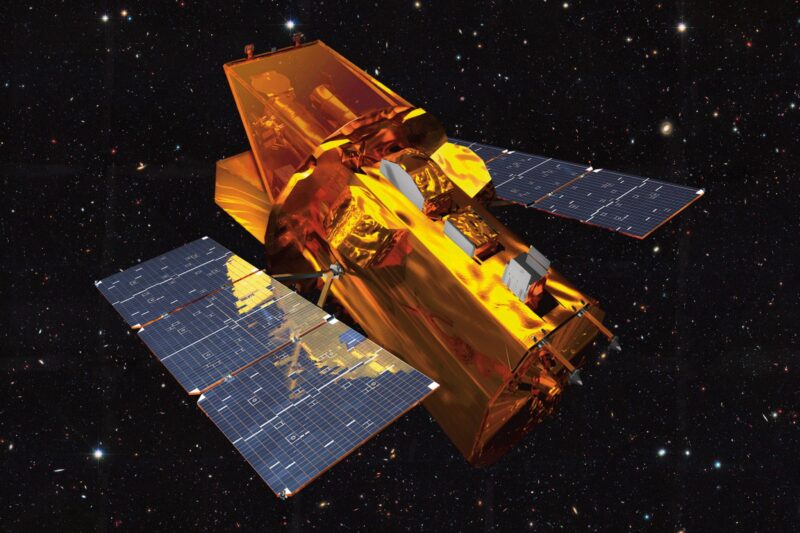
The Neil Gehrels Swift Observatory, better known as Swift, has been orbiting Earth since 2004. It has been studying the most powerful explosions in the universe: gamma-ray bursts. Now, Swift’s orbit is rapidly decaying. That means Swift is slowly falling back to Earth.
And now it looks like nothing will stop it. It’s now destined to put on a spectacular, fiery show.

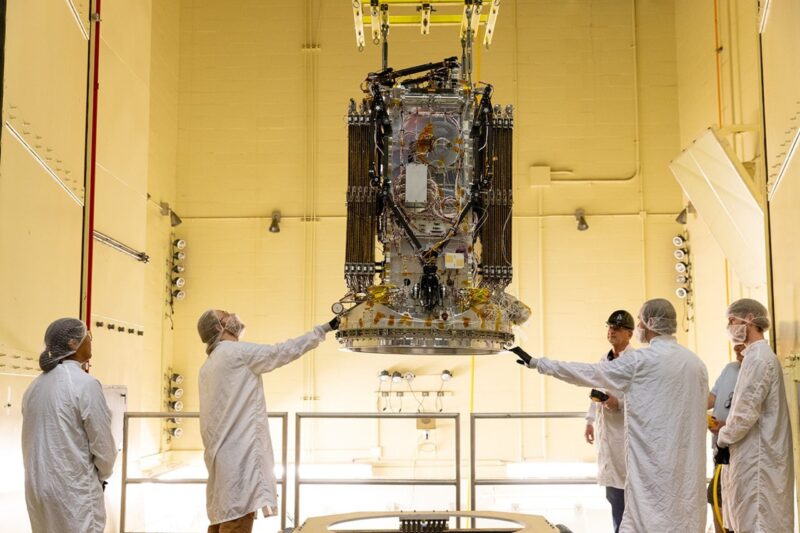
NASA tried to stop Swift’s fall with a 2nd spacecraft. The would-be rescuer was a commercial robotic repair vehicle called LINK, by Katalyst Space. It launched on July 3, 2026.
So LINK was supposed to chase down Swift, grab it, and raise its orbit. But about three weeks into the mission, two of LINK’s three reaction wheels failed, sending LINK into an uncontrolled spin and causing communication to be intermittent.
A view of the rescue attempt
Amateur astronomers in Puerto Rico – with the Sociedad de Astronomía del Caribe – captured video of both LINK and Swift in the same (or a similar) orbit around Earth. The video comes from Añasco, Puerto Rico, at about 8:02–8:03 p.m. AST on August 10, 2026. Watch the video at the top of this post. And keep reading to learn more.
Seeing Swift and LINK in orbit
Amateur astronomers frequently try to spy faint spacecraft in orbit around Earth, and LINK and Swift are no exceptions. The website Heavens-Above.com is designed specifically to enable observers to become aware of satellite passes from their location.
The Sociedad de Astronomia del Caribe in Añasco, Puerto Rico, caught both Swift and LINK on video on August 2, 2026. That earlier video showed that Link was about 8 minutes behind the Swift spacecraft.
But, between August 9 and 10, the club’s cameras showed LINK as slightly ahead of Swift in orbit. That’s what you’ll see if you watch the video above.
In the Sociedad de Astronomia del Caribe video at the top of this post, the Link rescue spacecraft passes very close to a bright star. The star is Antares, brightest light in the constellation Scorpius the Scorpion. A minute later, the Swift Observatory is seen also passing by this bright star.
The video capture was possible by analyzing the trajectory of both spacecraft using various sources including Heavens-Above.com.
Can you see LINK and Swift?
Observers can try to glimpse the decaying Swift Observatory with the eye. It sometimes reaches a visual magnitude around +2.0 to +1.5, making it as bright as a moderately bright star.
It would be especially easy to spot if you were observing far from city lights, once you know where to look.
The Link rescue spacecraft is fainter and more difficult to see. But some experienced observers have reported seeing it with the unaided eye.
How to spot Swift or LINK
To spot the Swift Observatory or the LINK rescue vehicle in orbit using the website Heavens-Above.com, you need custom visibility predictions for your exact location.
Here’s how to set your observing location:
- Navigate to the Heavens-Above main site or open the Heavens-Above mobile app.
- Click on Configuration (or the location selector in the upper-right corner).
- Input your specific city or exact GPS coordinates so that pass times and trajectory angles calculate accurately for your horizon.
Here’s how to find the 2 spacecraft:
- Return to the main database menu and locate the Satellites section.
- Select Search database for satellite (or use the Satellite database / Search link).
- Query for Swift (the Neil Gehrels Swift Observatory, NORAD ID 28485) or LINK (or Katalyst Space / Pegasus XL payload related to the mission).
Here’s how to generate the pass predictions:
- Open the satellite’s details page and click 10-day predictions for visible passes (or change filters to show “All passes” if you want daytime/radio passes).
- Review the pass table for key metrics. These are: start/ highest/ end times; altitude aka elevation (look for passes exceeding 30 to 40 degrees elevation for clear viewing above trees or buildings); and brightness aka magnitude (lower or negative numbers indicate brighter objects, and Swift typically reaches a visual magnitude of around +1.5 to +2.0, making it visible to the unaided eye under dark sky conditions.)
Here’s how to use the interactive sky charts
- Click on any specific date/pass row to generate a star chart.
- The chart overlays the satellite’s precise trajectory against recognizable constellations and stars (such as Scorpius or Antares), showing you exactly where to aim your eyes, binoculars, or camera equipment.
This video walk-through shows how to set up your ground coordinates and fetch pass predictions on Heavens-Above: How to Track the ISS with Heavens-Above.com.
More about the Swift spacecraft
The Swift spacecraft has three telescopes that watch the night sky. They are the Burst Alert Telescope, X-Ray Telescope and Ultraviolet/Optical Telescope.
The Burst Alert Telescope (BAT) is Swift’s wide-field gamma-ray detector. This telescope continuously monitors a large portion of the sky, watching for sudden flashes of high-energy gamma rays from gamma-ray bursts. When it detects a burst, it quickly calculates the object’s position and sends the coordinates to astronomers worldwide. It also directs the Swift spacecraft to rapidly turn toward the event for closer study.
X-Ray Telescope and Ultraviolet/Optical Telescope
Once Swift has slewed toward a newly detected gamma-ray burst, the X-Ray Telescope (XRT) takes over. It observes the burst’s fading X-ray afterglow. And it measures how its brightness changes over time and analyzes the energies of the emitted X-rays. Also, the XRT can pinpoint a burst’s location better than BAT and can continue tracking the event for days or even weeks. So the XRT helps scientists understand the physics of these powerful explosions and their environments.
Finally, the Ultraviolet/Optical Telescope studies gamma-ray bursts and other cosmic objects in ultraviolet and visible light. It provides Swift’s most precise positions for newly discovered bursts. It also captures details about their brightness, color and evolution. Overall, these observations help astronomers determine distances, identify host galaxies and better understand the nature of the explosions and other transient events Swift observes across the universe.
Bottom line: NASA said on August 19, 2026, the mission to save the Swift spacecraft will not work after attitude control issues. Swift will crash back to Earth this year.
Read more: What is the Earth’s most distant spacecraft?
Read more: Remember when DART struck an asteroid? New surprises!
Like what you read?
Subscribe and receive daily news delivered to your inbox.
More from
Kelly Kizer Whitt


Visible planets and night sky guide for October

Moon and Jupiter pics here! A cosmic hide-and-seek
Solar system’s most bizarre moons! Take the tour
Hurricane Nolo is now Typhoon Nolo. Where is it going next?