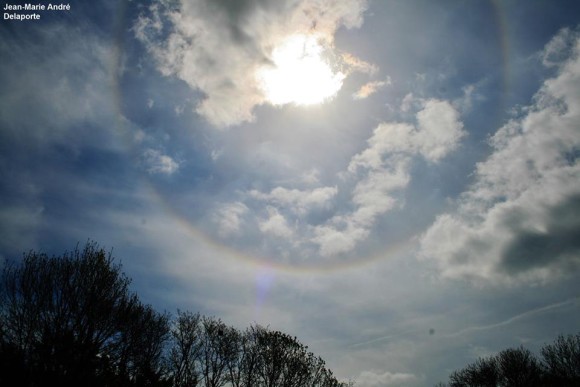
This is a classic solar halo, what scientists call a 22-degree halo. Halos like this one can be seen around the world, throughout the year, and around either the sun or moon. These halos are caused by both refraction, or splitting of light, and also by reflection, or glints of light from ice crystals high in Earth’s atmosphere. The crystals have to be oriented and positioned just so with respect to your eye, in order for the halo to appear.
Like what you read?
Subscribe and receive daily news delivered to your inbox.
Thank you! Your submission has been received!
Oops! Something went wrong while submitting the form.
More from
Deborah Byrd
View All


Visible planets and night sky guide for October

October 9, 2026
Hera mission hits the brakes to arrive at asteroid
October 8, 2026
Flashing star in autumn? Here are 3 candidates
October 6, 2026
Stargazing tips! 10 great tips for beginning astronomers
October 1, 2026