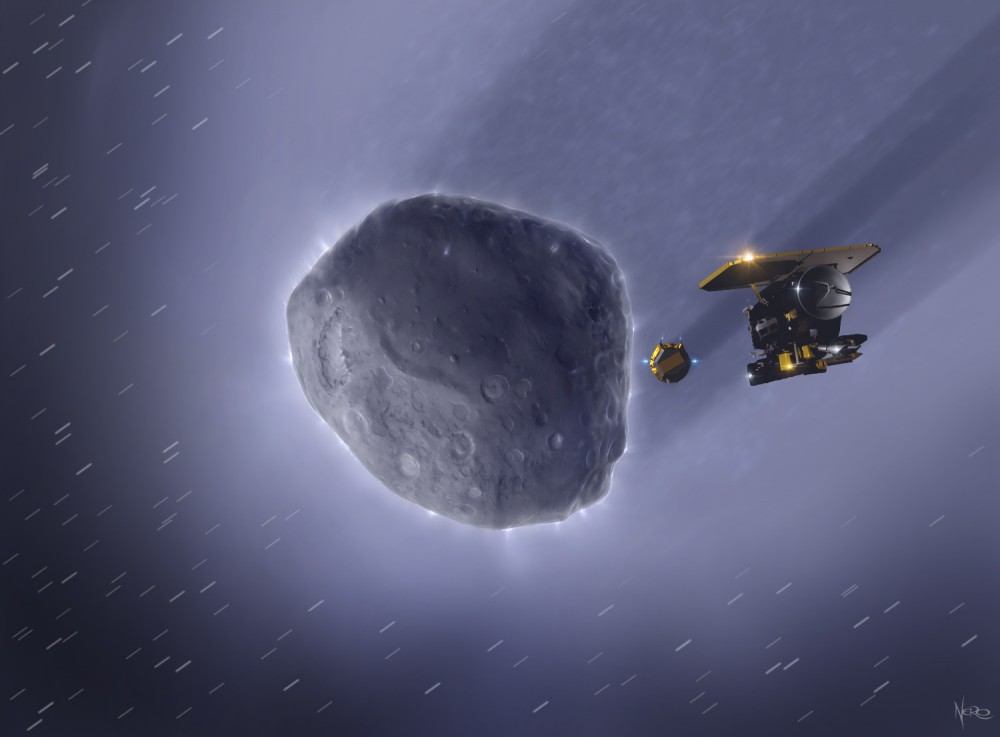
Marco Nero submitted this artist’s concept to EarthSky. He created this image of NASA’s Deep Impact probe’s historic appointment with Comet Tempel 1 on July 4, 2005. Marco wrote:
After 174 days of space travel, the Deep Impact probe released an “impactor” carrying a copper payload (since scientists didn’t expect the comet to contain copper… and the metal wouldn’t interfere with the scientific instruments aboard the probe).
Delivering 100kg of copper at a closing velocity of more than 10km/s, the impactor’s kinetic energy was equivalent to 4.8 metric tons of TNT. The resulting collision exposed the interior of the comet’s nucleus and answered questions concerning comet composition.
Marco Nero – who is in Sydney, Australia – is working on a book on the subject of meteorite hunting and collecting. This is one of the images he created to go along with an article on comets.
By the way, the collision between the coffee table-sized impactor and city-sized comet was the first of its kind. Read more about the Deep Impact mission to Comet Tempel 1, from NASA.

Bottom line: An artist’s concept – and a real photo – from the first ever impact from an earthly space probe, NASA’s Deep Impact probe, onto the surface of a comet. The comet was Tempel 1. The impact took place on July 4, 2005.
Like what you read?
Subscribe and receive daily news delivered to your inbox.
More from
Deborah Byrd


Visible planets and night sky guide for October

Cassiopeia the Queen is overhead on autumn evenings
What star in the northeast flashes colorfully? It’s Capella!
Proxima Centauri is the closest star to our sun