Sun news November 3: How a quiet sun stirs up auroras
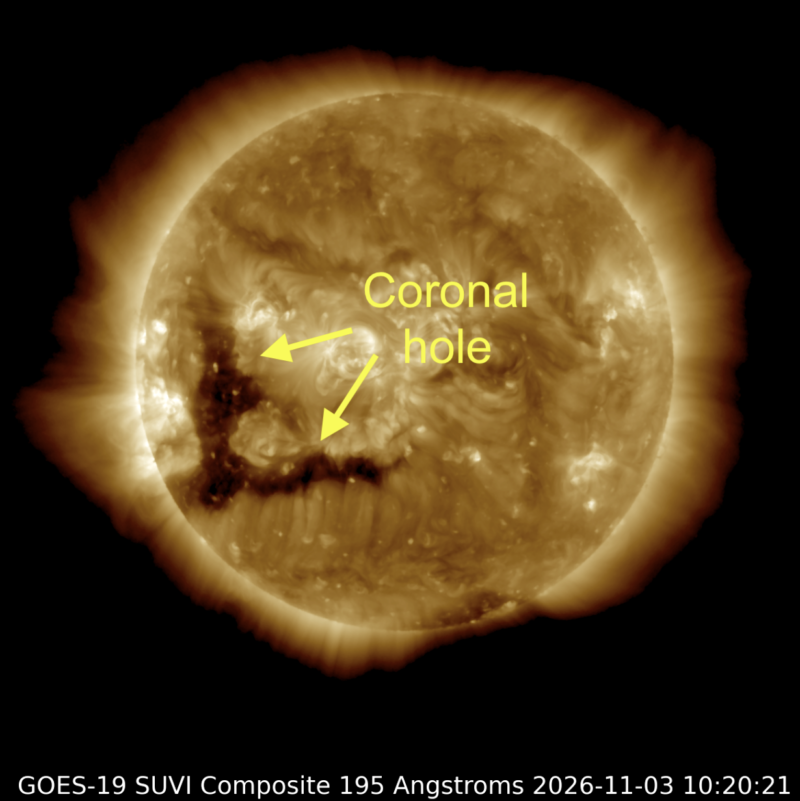
Today’s top story: The sun is in a quiet stretch. Only three small sunspot regions dot its face, and none fired anything stronger than a weak B-class flare today. Yet in the coming days, we could see auroras light up high-latitude skies. How can a quiet sun still stir up auroras? The answer is coronal holes.
Coronal holes are regions in the sun’s atmosphere, or corona, where the magnetic field opens into space instead of looping back down. As a result, high-speed streams of solar wind escape freely along those open field lines. In extreme ultraviolet images, coronal holes look like dark patches because the escaping plasma leaves them cooler and less dense.
When a fast stream reaches Earth, it can rattle our planet’s magnetic field. As the magnetic field inside the stream ripples back and forth, the north-south component — which scientists call the Bz — swings south again and again. Each southward swing opens the door for solar wind energy to pour into Earth’s magnetic bubble. And when these charged solar particles collide with gases in our atmosphere, the air molecules can glow, forming what we see as auroras.
And this scenario could happen this week. A weak solar wind stream from a coronal hole might arrive around November 5. And, combined with a glancing blow from a coronal mass ejection (CME) launched on November 1, it could trigger auroras at high latitudes. Keep watching the skies!
Past 24 hours on the sun
(11 UTC November 2 – 11 UTC November 3)
Flare activity: Very low. The sun fired five flares during this period, all B-class (weak).
- Strongest flare: B8.0 from AR4566, peaking at 22:08 UTC on November 2.
- Lead flare producer: AR4566 took the top spot, with three B flares, including the strongest.
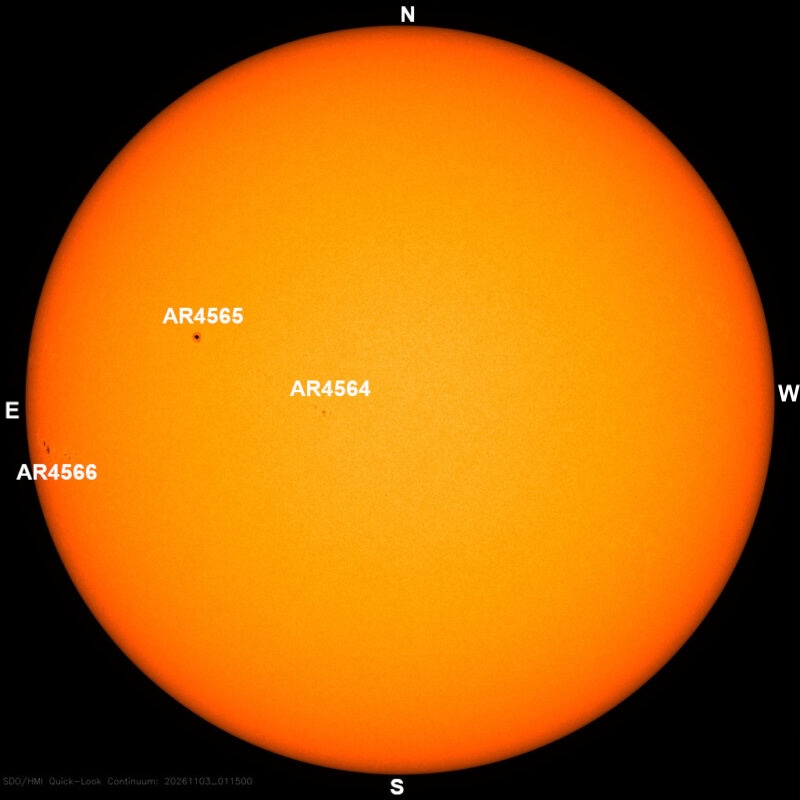
Sunspot regions: Our star now shows three numbered regions on its Earth-facing side. A newcomer rotated into view on the southeast limb, and forecasters numbered it AR4566.
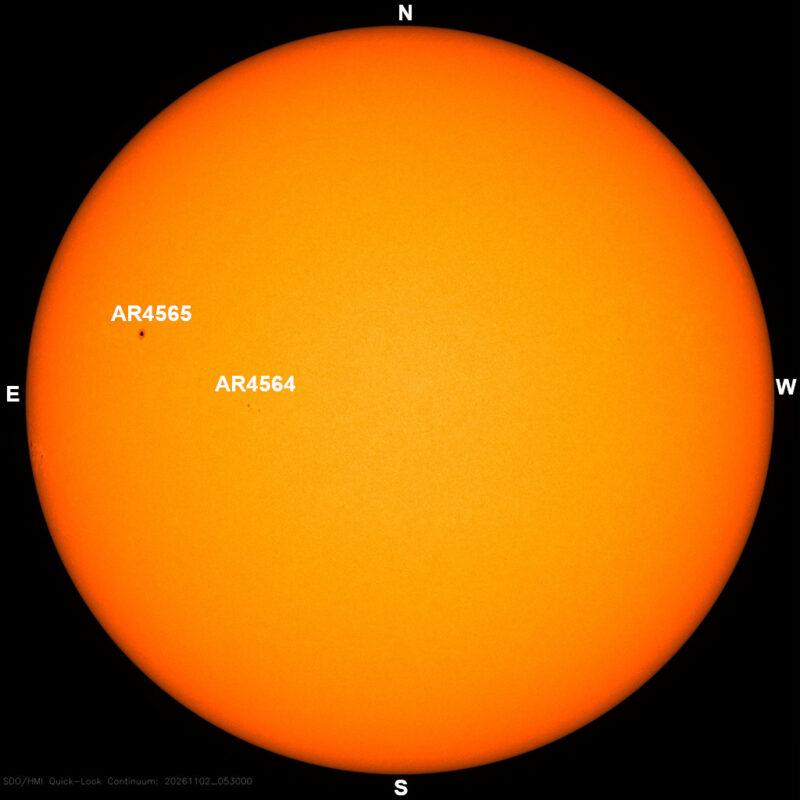
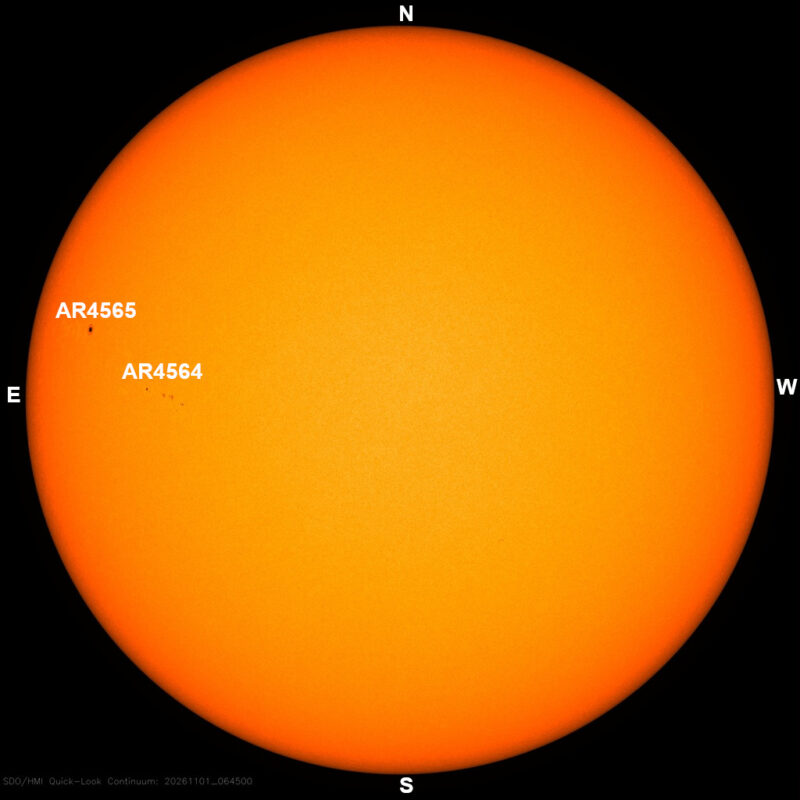
- AR4564 (alpha): This small region continued to decay. It simplified from beta to alpha and produced no flares this period.
- AR4565 (alpha): This region produced only one B flare.
- AR4566 (beta): This newcomer rotated into view on the sun’s southeast limb, or edge. Before it appeared, it was already active on the far side, launching the jets we reported on October 31. It quickly became the period’s top flare producer.
Blasts from the sun? Analysts finished modeling the coronal mass ejection (CME) that erupted around 15 UTC on November 1. They found a component heading toward Earth. As a result, it might deliver a weak glancing blow on November 5. Meanwhile, observers spotted no other CMEs in available coronagraph imagery.
Past 24 hours in space weather
Solar wind: Solar wind speeds dropped from moderate to low levels during the period. That’s because a positive-polarity coronal hole high-speed stream continued to fade.
Bt, Bz and magnetic coupling: The total interplanetary magnetic field (Bt) stayed weak on average. The Bz component pointed south until 17 UTC on November 2. It then turned north and stayed there until 2:30 UTC this morning. After that, it swung south again for the rest of the period. A southward Bz favors energy transfer into Earth’s magnetosphere.
Earth’s magnetic field: The geomagnetic field returned to quiet levels during the period, with Kp index values of 0 to 2. At the time of this report, Kp sits at 2.
What’s ahead? Sun–Earth forecast
Flare activity forecast: Forecasters expect very low to low activity through November 5, with a chance of isolated C-class (common) flares. Two of the visible regions lack the size and magnetic complexity for anything stronger. However, newcomer AR4566 is the most likely flare source.
Geomagnetic activity forecast:
- November 3-4: Mostly quiet conditions expected (Kp 1-2) as solar wind returns to near-normal levels.
- November 5: Unsettled to active conditions possible (Kp 3-4), with a slight chance of G1 (minor) storm intervals. A weak high-speed stream from a negative-polarity coronal hole may bring slightly faster wind. In addition, the slow CME from November 1 has a modeled arrival around this date. If both contribute, high-latitude aurora watchers in northern Scotland, Scandinavia and similar latitudes could get a show.
The sun in recent days
Earlier sun images
Sun images from our community
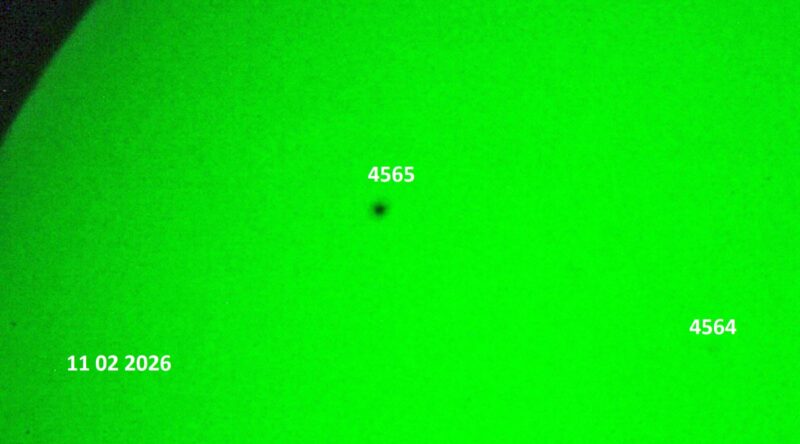
We sometimes feature sun images obtained using hydrogen-alpha filters. Read why.
Bottom line: Sun news November 3, 2026: Few sunspots, but still auroras? Thank coronal holes! Their fast solar wind can stir Earth’s magnetic field for days.
Like what you read?
Subscribe and receive daily news delivered to your inbox.
More from
C. Alex Young


Sun activity archive for October 2026

Yes, there’s an aurora season, and it’s here
Sun activity archive for September 2026
Sun activity archive for August 2026