Sun news November 11: A very different star 1 year later
Today’s top story: The current roughly 11-year solar cycle peaked in late 2024. Since then, activity has been waning. And you get a clear indication of that when you compare today’s sun with the sun a year ago! While activity over the past day has been low, with only 10 C flares produced, this day last year saw our star fire an enormous X5.1 (strong) flare. It came from active region AR4274, which had also blasted an X flare on each of the two prior days. That was the last time we saw three X flares in three days. Now, exactly a year later, we haven’t seen a single X flare since July 4. Enjoy watching your star breathe after a frenzied solar maximum!
Past 24 hours on the sun
(11 UTC November 10 – 11 UTC November 11)
Flare activity: Low. The sun produced 11 flares this period: 10 C-class (common) and one B-class (weak) flare.
- Strongest flare: C2.8 from AR4566, peaking at 13:28 UTC on November 10.
- Lead flare producer: Once again, AR4566 produced almost all of the period’s flares. The only C-class exception was a C1.9 that peaked at 3:48 UTC on November 11, from the northeast newcomer now numbered AR4573.
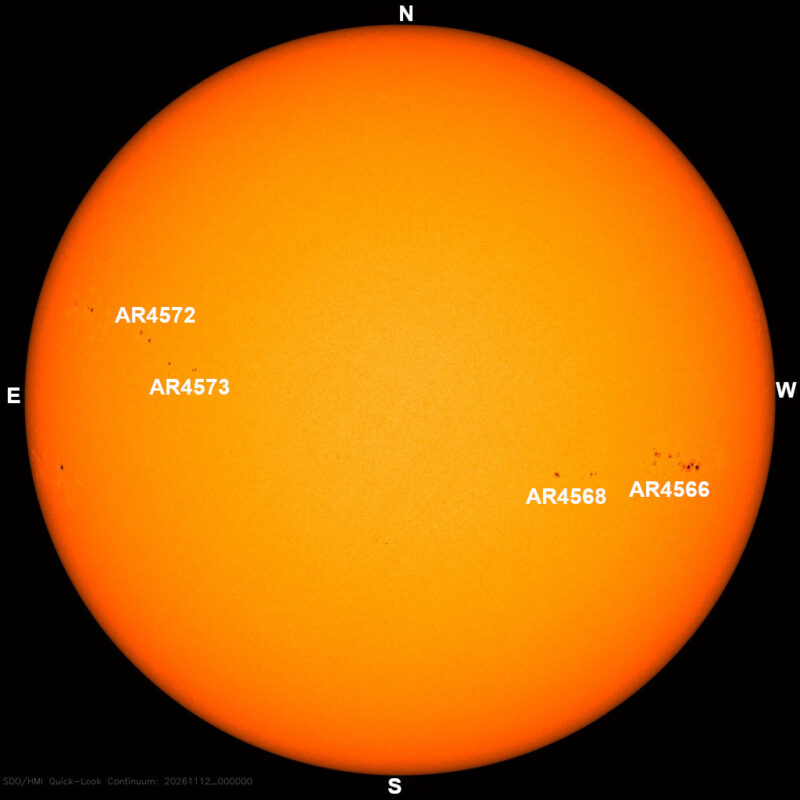
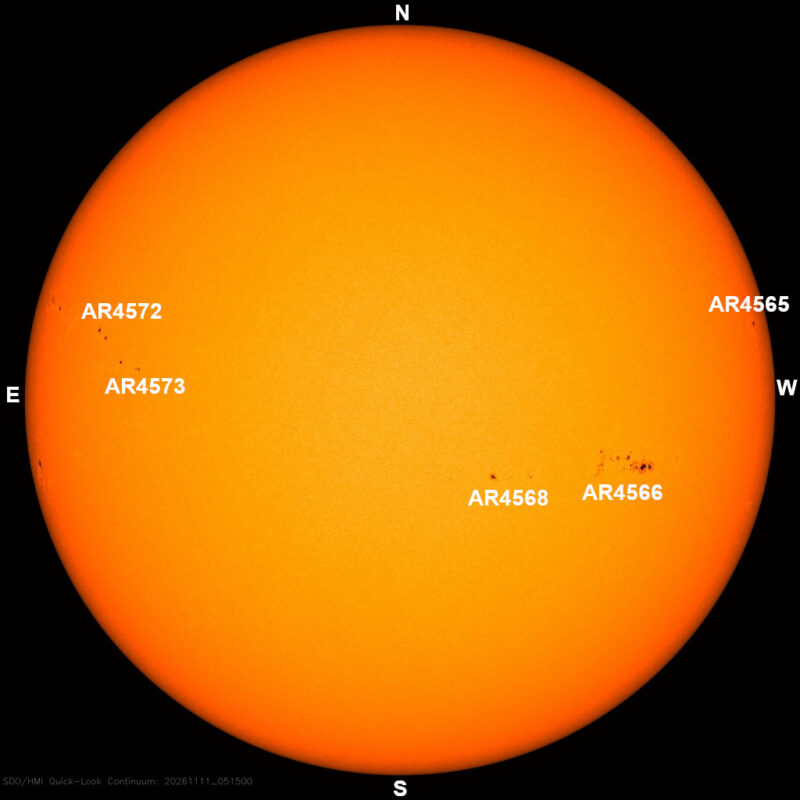
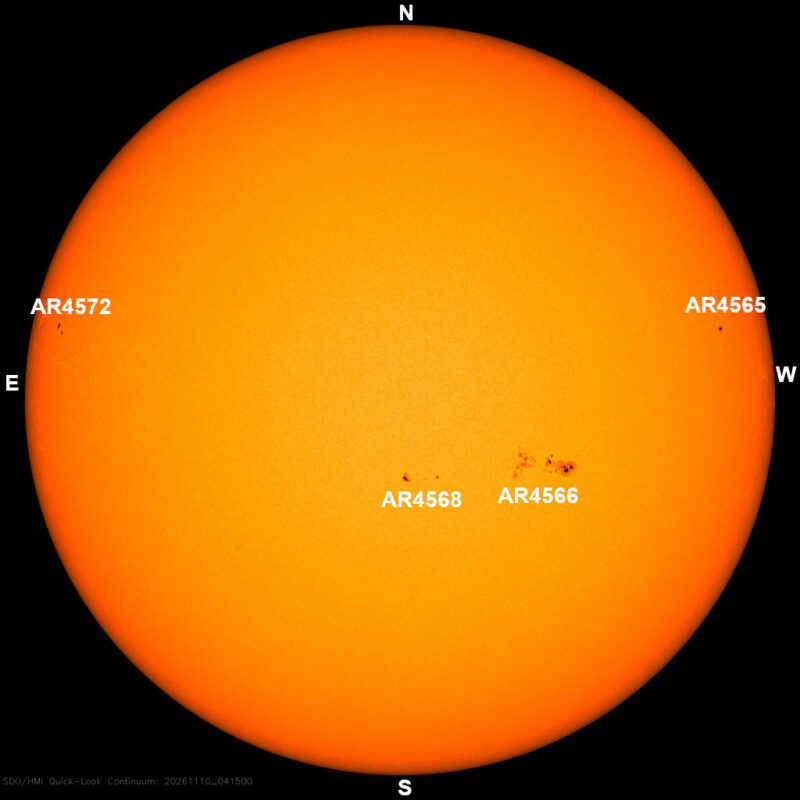
Sunspot regions: The sun shows five numbered sunspot regions on its Earth-facing side. A newcomer in the northeast received a number this period: AR4573.
- AR4566 (beta-gamma-delta magnetic configuration): This region showed general signs of decay. Even so, it kept its delta complexity and remains the largest and most magnetically complex group on the sun.
- AR4565 (alpha): This small, magnetically simple region stayed stable and quiet.
- AR4568 (beta): This region grew slightly.
- AR4572 (alpha): This newcomer kept its simple alpha configuration. It stayed stable and produced no flares.
- AR4573 (beta): This newcomer emerged just south of AR4572 in the northeast quadrant, and it has already fired a C flare.
Blasts from the sun? Analysts found no Earth-directed coronal mass ejections (CMEs) in available coronagraph imagery from SOHO or other sources.
Past 24 hours in space weather
Solar wind: Solar wind speeds held at moderate levels during the period. Meanwhile, the high-speed stream from a coronal hole kept fading.
Bt, Bz and magnetic coupling: The total interplanetary magnetic field stayed weak on average. The north-south component (Bz) pointed mostly north, and its southward dips stayed weak. As a result, little solar wind energy reached Earth’s magnetosphere for most of the period.
Earth’s magnetic field: Geomagnetic conditions stayed quiet to unsettled, with Kp index values of 2 to 3. At the time of this writing, Kp sits at 2.
What’s ahead? Sun–Earth forecast
Flare activity forecast: Forecasters expect moderate flare activity to continue through November 12. AR4566 remains the main player, since its beta-gamma-delta magnetic setup and prolific flaring keep it the top possible producer. The chance of C flares stands at 99% today. Meanwhile, M flares hold at a 60% chance and X flares at 15%.
Geomagnetic activity forecast:
- November 11-12: Quiet to unsettled conditions expected as coronal hole effects keep fading.
- November 13: Quiet conditions expected.
Sun news November 10: Powerful sunspot region facing Earth
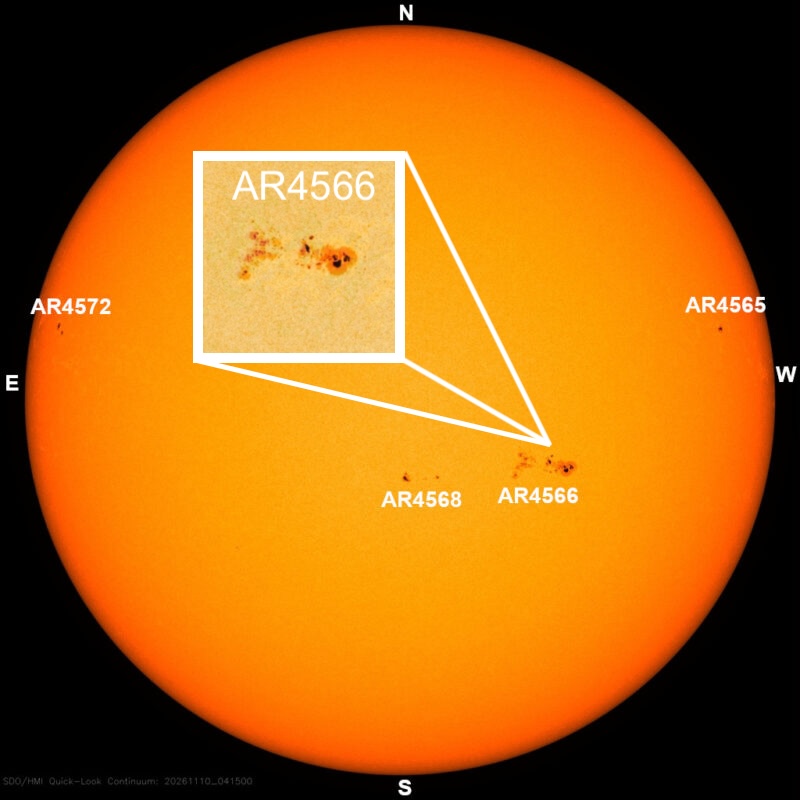
A powerful sunspot region is staring right at us. AR4566 is the largest sunspot group currently visible on our star, and the most volatile, too. It has the highest possible magnetic complexity — beta-gamma-delta — which means it has the potential to fire large M (moderate) or even X (strong) flares. And now that it’s just rotated past the center of the Earth-viewed sun, it’s in the perfect position to send an eruption our way. So if it fires a flare strong enough to launch a coronal mass ejection (CME), that blob of solar stuff could head straight for Earth and potentially trigger beautiful auroras. Stay tuned!
Past 24 hours on the sun
(11 UTC November 9 – 11 UTC November 10)
Flare activity: Low. The sun produced 19 flares this period, all C-class (common).
- Strongest flare: C9.3 from AR4566, peaking at 08:34 UTC on November 10.
- Other notable flares: AR4566 also fired a C5.3 that peaked at 14:26 UTC and a C5.1 at 17:14 UTC on November 9. Then, this morning, it added a C8.6 at 08:06 UTC on November 10.
- Lead flare producer: AR4566 produced 18 of the period’s 19 flares. The only exception was a C1.9, that peaked at 01:45 UTC on November 10, from the newcomer in the northeast.
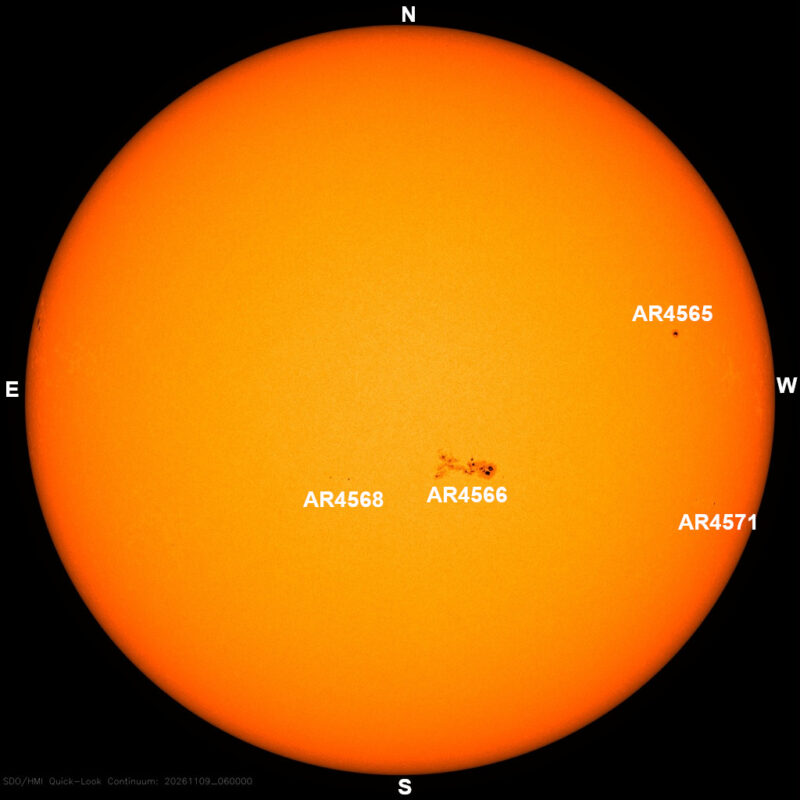
Sunspot regions: Four numbered regions currently dot the sun’s Earth-facing side. AR4571 is gone from view. However, a newcomer in the northeast got its number this period: AR4572.
- AR4566 (beta-gamma-delta): This region showed slight signs of decay, and its spots began to spread apart. Even so, it kept its delta complexity and remains the largest and most magnetically complex group on the sun.
- AR4565 (alpha): This small, magnetically simple region stayed stable and quiet.
- AR4568 (beta): This region grew a little during the period.
- AR4571 (beta): This region in the southwest is no longer visible.
- AR4572 (alpha): This newcomer rotated into view near the northeast limb, or edge, with a simple alpha configuration.
Blasts from the sun? Analysts found no Earth-directed CMEs in available coronagraph imagery from SOHO or other sources.
Past 24 hours in space weather
Solar wind: Solar wind speeds eased from high to moderate levels during the period. That’s because the high-speed stream from a negative-polarity coronal hole started to fade.
Bt, Bz and magnetic coupling: The total interplanetary magnetic field (Bt) weakened again. The north-south component (Bz) kept flipping between north and south, but its southward dips stayed weak. As a result, little solar wind energy reached Earth’s magnetosphere.
Earth’s magnetic field: Geomagnetic conditions settled to quiet and unsettled levels, with Kp index values of 2 to 3. At the time of this writing, Kp sits at 2.
Sun news November 9: Auroras continue! More tonight at northern U.S. latitudes?
A powerful stream of fast solar wind kept buffeting Earth over the past 24 hours. Speeds peaked near 814 km/s, even faster than yesterday. The stream pushed Earth’s magnetic field to G1 (minor) geomagnetic storm levels. The source is the large coronal hole we’ve been tracking in the sun’s atmosphere. Its influence should gradually fade over the coming days.
Meanwhile, AR4566, the sun’s most complex sunspot region, stayed restless. It fired one M-class (moderate) flare and a steady stream of C flares (common). It has now crossed the center of the sun’s face, so its future big eruptions would aim more directly at Earth. Forecasters expect more M flares in the days ahead, with a slight chance of an X-class (strong) flare.
So what about tonight? Forecasters see a chance of more G1 (minor) storm intervals today, November 9, before conditions settle toward midweek. If you live at high latitudes, keep an eye out for auroras tonight. Still, displays will likely be less widespread than the weekend show, when auroras reached northern Minnesota.
Past 24 hours on the sun
(11 UTC November 8 – 11 UTC November 9)
Flare activity: Moderate. The sun produced 20 flares during the period: one M-class and 19 C-class.
- Strongest flare: M1.1 from AR4566, peaking at 18:27 UTC on November 8. It caused a brief R1 (minor) radio blackout.
- Other notable flares: AR4566 also fired a C8.0 that peaked at 20:53 UTC on November 8. Then, on November 9, it added a C4.7 at 01:14 UTC and a C5.7 at 04:10 UTC.
- Lead flare producer: AR4566 produced 19 of the 20 flares. Only one C1.3 flare, peaking at 08:33 UTC on November 9, came from an unidentified source.
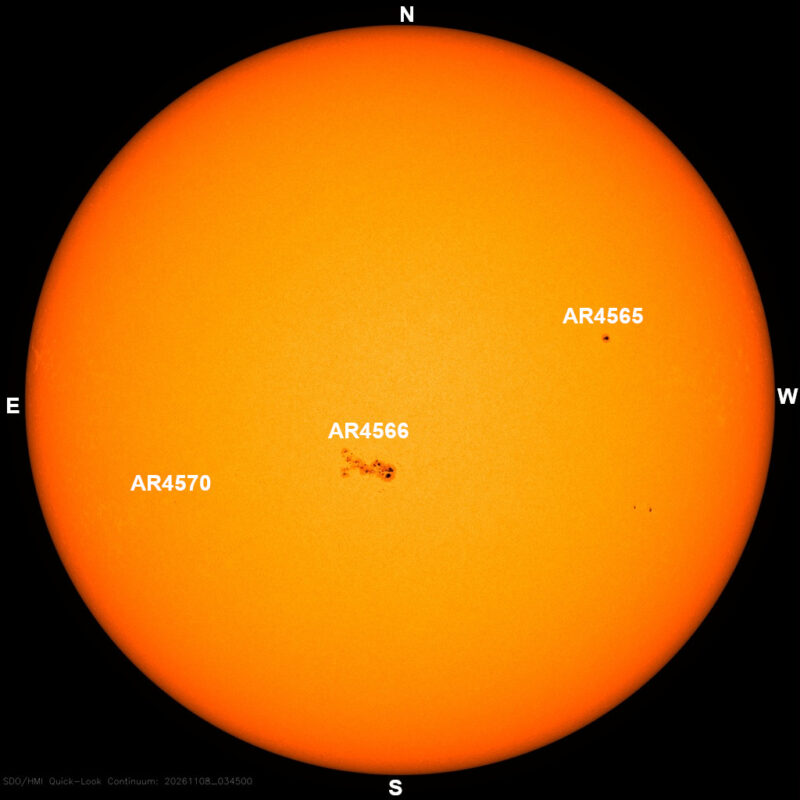
Sunspot regions: Four numbered sunspot regions dot the sun’s Earth-facing side, down from six yesterday. AR4567 rotated out of view, while AR4569 and AR4570 decayed.
- AR4566 (beta-gamma-delta): This region sits near disk center and remains the largest and most magnetically complex group on the sun. Its intermediate and trailing spots grew larger. In addition to frequent C flares, it fired the period’s M1.1 flare. As a result, it’s the main threat for stronger flares in the days ahead.
- AR4565 (alpha): This small, magnetically simple region stayed stable and quiet.
- AR4568 (beta): This region re-emerged but stayed relatively simple and quiet.
- AR4571 (beta): This newcomer is the region we saw developing in the southwest yesterday. Now numbered, it stayed quiet this period.
Blasts from the sun? Analysts found no Earth-directed coronal mass ejections (CMEs) in available coronagraph imagery from SOHO or other sources.
Past 24 hours in space weather
Solar wind: Solar wind speeds stayed high throughout the period, driven by a high-speed stream from a negative-polarity coronal hole. Speeds peaked at about 814 km/s. Meanwhile, particle density ran below average and slowly fell.
Bt, Bz and magnetic coupling: The total interplanetary magnetic field (Bt) reached 10 nT. The north-south component (Bz) dipped as far south as about -9 nT. However, it swung back and forth and never stayed south for long. The phi angle pointed mostly in the negative (toward-sun) sector, matching the coronal hole’s negative polarity.
Earth’s magnetic field: Geomagnetic conditions ranged from unsettled to G1 (minor) storm levels. The Kp index reached 5, with the stormiest stretch from 00 to 3 UTC on November 9. After that, conditions eased slightly. Auroras were possible at high latitudes, including northern Scotland, as well as far southern New Zealand.
Energetic particles: The greater than 2 MeV electron flux at geostationary orbit reached high levels. Meanwhile, the greater than 10 MeV proton flux stayed at background levels.
Sun news November 8: Auroras glowed over northern Minnesota last night
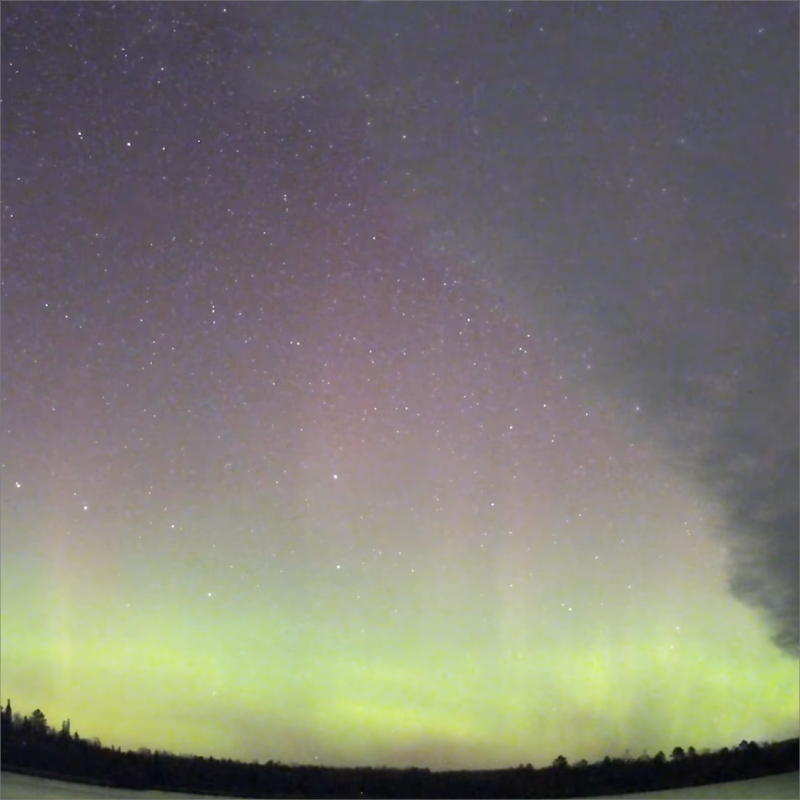
The fast solar wind has arrived, and so have the auroras! A coronal hole high-speed stream slammed into Earth’s magnetic field late on November 7. It pushed solar wind speeds above 700 km/s and sparked a G1 (minor) geomagnetic storm. As a result, auroras reached all the way down to the lower 48 U.S. states, where observers spotted a green glow over northern Minnesota.
And the show might not be over. Forecasters expect unsettled-to-active conditions to continue through November 9, with a chance of G2 (moderate) storm levels. So aurora watchers across the northern U.S., Canada and northern Europe, head outside after dark tonight and look north. If you catch the lights, share your photos with our community!
Meanwhile, AR4566, the sun’s most complex sunspot region, kept churning out flares at a remarkable pace over the past day. It fired 20 flares in the past 24 hours, including three M-class flares. Moreover, it still has its beta-gamma-delta magnetic setup. That keeps the door open for more moderate to strong flares in the next few days. And there’s a new twist: AR4566 has now rotated close to the center of the sun’s face, where any big eruption would aim more directly at Earth.
For now, though, observers spotted no Earth-directed coronal mass ejections (CMEs). The coronal hole wind alone is driving today’s geomagnetic forecast.
Past 24 hours on the sun
(11 UTC November 7 – 11 UTC November 8)
Flare activity: Moderate. The sun produced 20 flares during the period: three M-class (moderate) and 17 C-class (common). All of them came from a single active region.
- Strongest flare: M1.9 from AR4566 (S06E04), peaking at 18:42 UTC on November 7. It caused an R1 (minor) radio blackout.
- Second M flare: M1.7 from AR4566, peaking at 07:46 UTC on November 8. It also caused an R1 (minor) radio blackout.
- Other notable flares: AR4566 also fired an M1.4 that peaked at 17:17 UTC on November 7, with another R1 radio blackout. Among the C flares, a C9.1 peaked at 03:31 UTC and a C8.0 peaked at 08:43 UTC on November 8. Both came close to M-class territory.
- Lead flare producer: AR4566 produced every flare of the period.
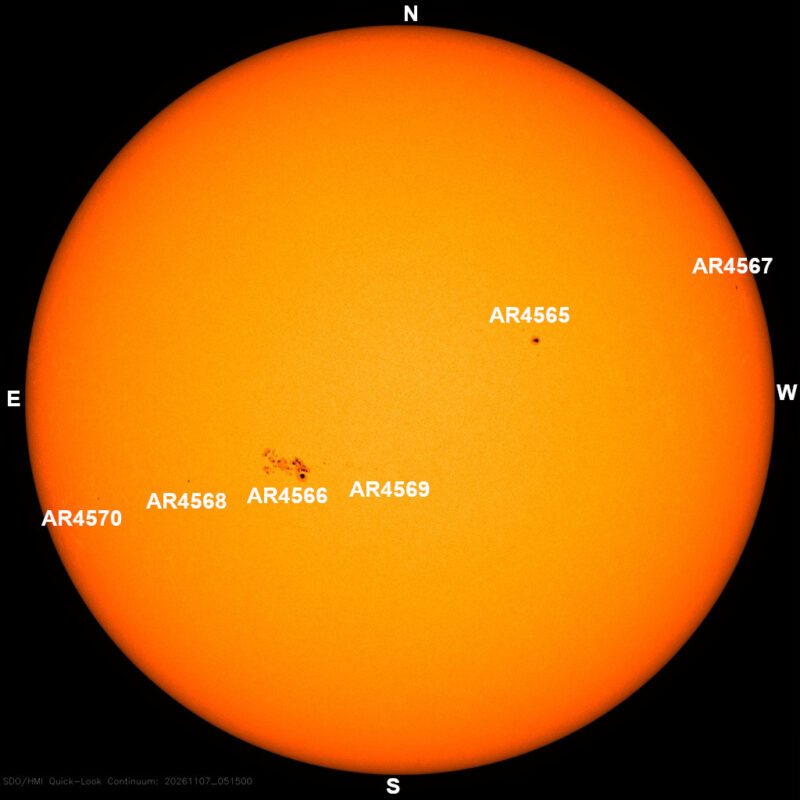
Sunspot regions: Six numbered regions dot the sun’s Earth-facing side. In addition, a new region is developing in the southwest.
- AR4566 (beta-gamma-delta): This region sits near the center of the solar disk (S06E06) and remains the sun’s dominant feature. Its intermediate and trailing spots kept developing, so it held on to its complex magnetic setup. It produced all 20 of the period’s flares, including the three M flares. As a result, it’s the top candidate for more M flares and possible X-class flares.
- AR4569: This small region continued to fade and produced no notable activity.
- Remaining regions: The four other numbered regions were stable or decaying, with simple magnetic setups. None produced reportable flares. Meanwhile, the new region in the southwest is still developing, and forecasters haven’t classified it yet.
Blasts from the sun? Observers detected no Earth-directed CMEs during the period. Analysts cataloged two CMEs, but neither poses a threat to Earth.
Past 24 hours in space weather
Solar wind: Solar wind speeds rose sharply as a high-speed stream from a negative-polarity coronal hole arrived. Speeds climbed from a low of about 425 km/s to a peak near 736 km/s.
Bt, Bz and magnetic coupling: The total interplanetary magnetic field (Bt) reached 15 nT. Meanwhile, the north-south component (Bz) dipped as far south as -11 nT. That allowed solar wind energy to couple efficiently into Earth’s magnetosphere.
Earth’s magnetic field: Geomagnetic activity ranged from quiet to active (Kp 2 to 4) for most of the period. However, Kp reached 5, a G1 (minor) geomagnetic storm, between 18:00 and 21:00 UTC on November 7. Then, after dark, auroras appeared as far south as northern Minnesota in the U.S.
The sun in recent days
Earlier sun images
Sun images from our community
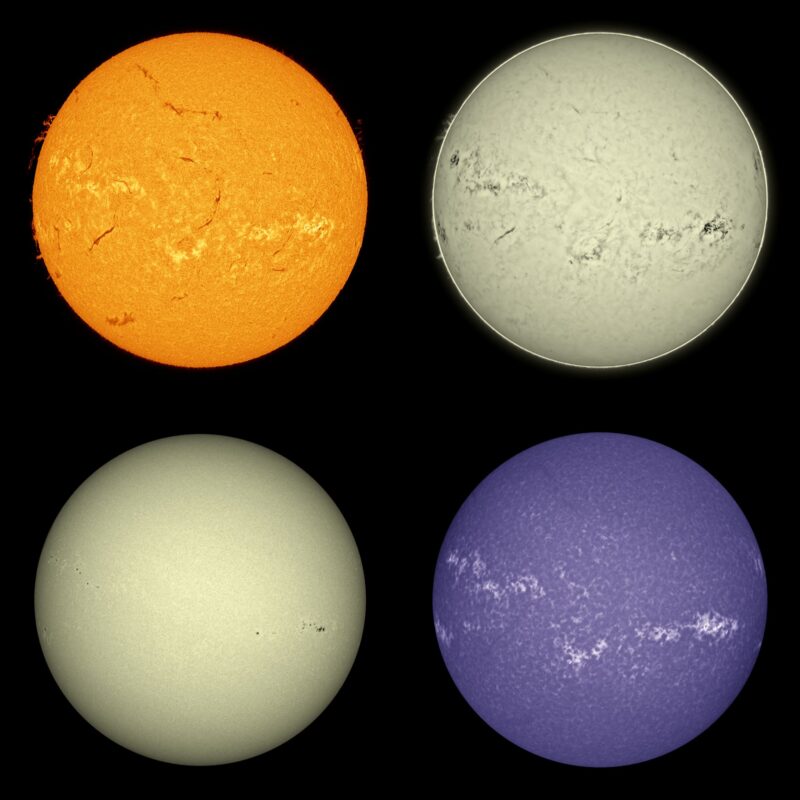
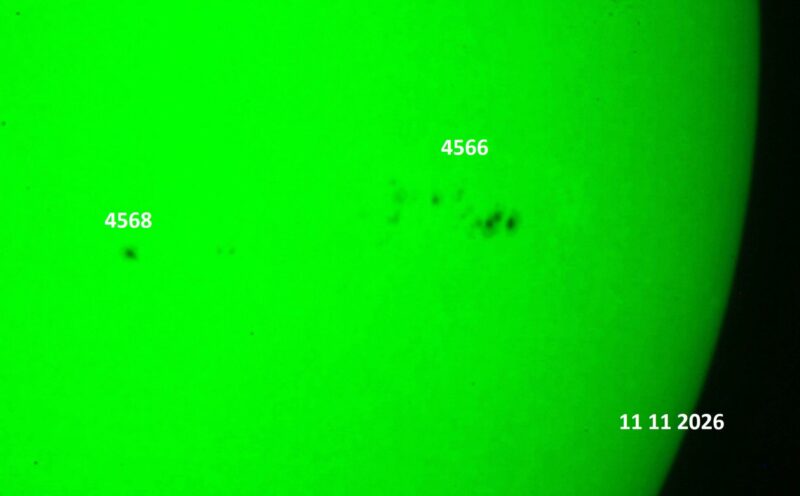
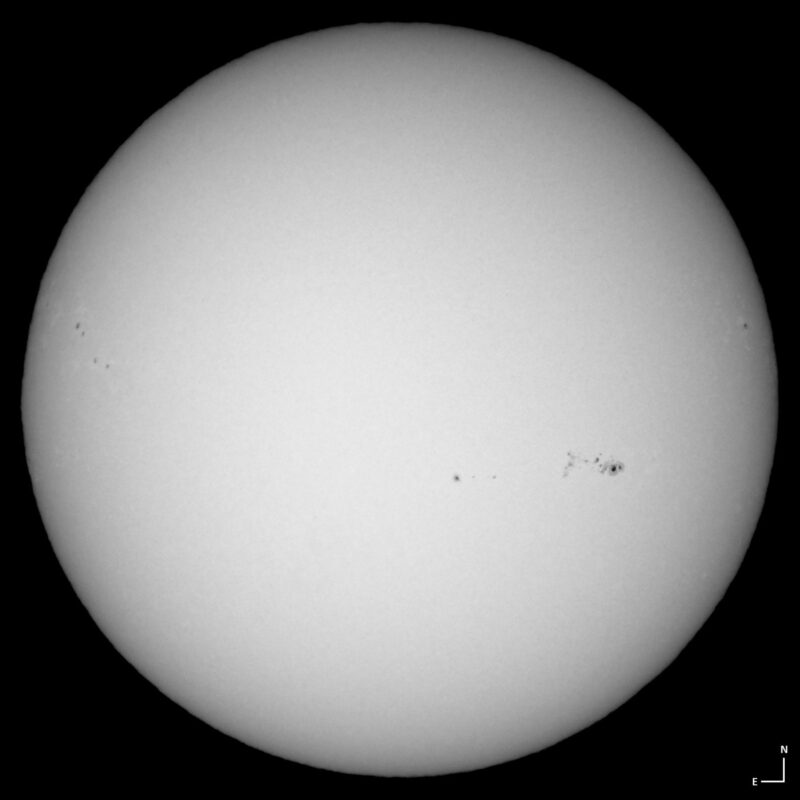
More sun images from our community
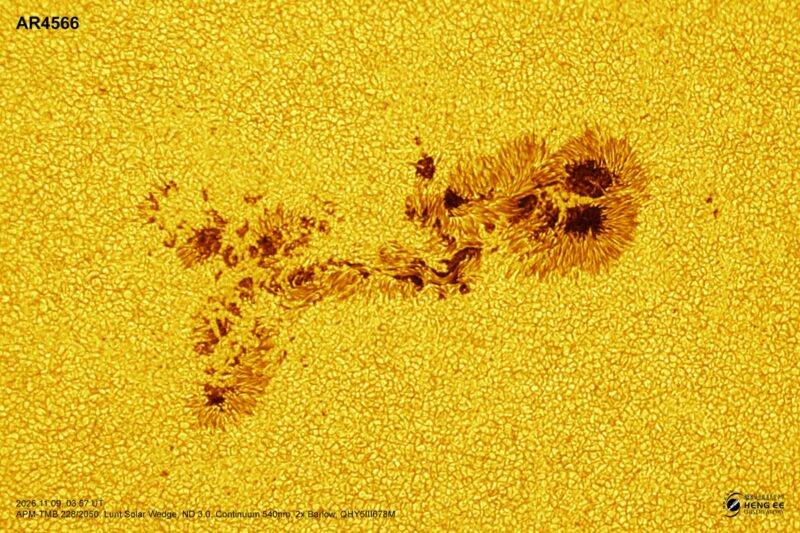
We sometimes feature sun images obtained using hydrogen-alpha filters. Read why.
Bottom line: Sun news November 11, 2026: One year ago today, our sun blasted out a powerful X5.1 flare. It was the 3rd X flare in 3 days! See how different the sun looks today.
Like what you read?
Subscribe and receive daily news delivered to your inbox.
More from
C. Alex Young


Sun activity archive for October 2026

Yes, there’s an aurora season, and it’s here
Sun activity archive for September 2026
Sun activity archive for August 2026