Sun news March 31: Aurora alert! Sun-stuff expected to arrive today

During yesterday morning’s powerful X1.5 flare, the sun launched a chunk of solar material our way. This blob, also known as a coronal mass ejection (CME), is racing toward Earth at an unusually high speed of approximately 1,845 km/s.
It should impact Earth’s magnetic field late today. Forecasters say the impact could trigger G2-G3 (moderate to strong) or even G4 (severe) geomagnetic storming. That could mean auroras dancing as far south as New York, London, Paris and Berlin, and possibly even reaching the mid-Atlantic United States and southern Australia. Clear skies!
Past 24 hours of sun news
(11 UTC March 30 – 11 UTC March 31)
Flare activity: Solar activity returned to low levels over the past 24 hours with only 8 C-class (common) flares.
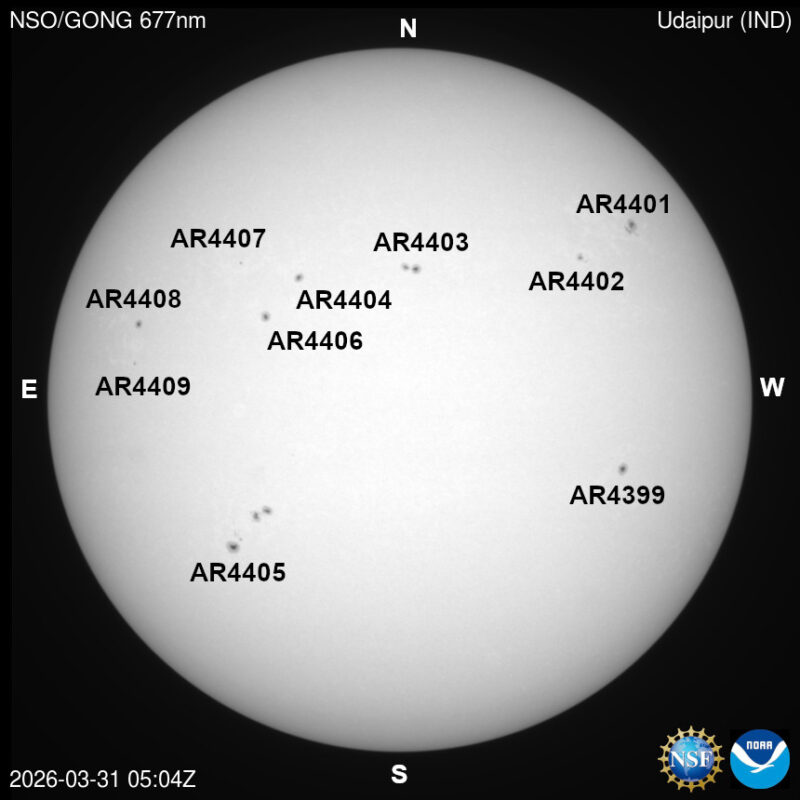
- Strongest flare: C3.1 from active region AR4405 at 12:13 UTC on March 30.
- Lead flare producer: AR4405, the producer of yesterday’s X flare, led flare production again.
Sunspot regions: The Earth-facing solar disk currently displays 10 numbered active regions. A newcomer has joined the group, now numbered AR4409. AR4405 carries a beta-gamma magnetic configuration. The remaining sunspot regions show either alpha or beta configurations.
Blasts from the sun? LASCO C2 captured a partial halo coronal mass ejection (CME) at 3:12 UTC on March 30 after yesterday’s X1.5 flare. Forecasters anticipate an Earth arrival late on March 31, with effects potentially extending through April 1. Kp estimates sit at 6-7, indicating potential for G2 (moderate) and even G3 (strong) geomagnetic storm conditions. Chances for G4 (severe) and even G5 (extreme) levels exist if the Bz arrives strongly southward. Separately, a filament eruption hurled plasma into space at around 1:00 UTC on March 31. The event is associated with a C1.5 flare from AR4403. Modeling and analysis are currently ongoing.
Past 24 hours in space weather
Solar wind: Solar wind speeds averaged at moderate levels throughout the period. The interplanetary magnetic field (IMF) remained weak. The Bz component pointed mostly northward and continues to do so at the time of this writing.
Earth’s magnetic field: Earth’s magnetic field ranged from quiet to unsettled levels during the period (Kp = 2 – 3). At the time of this writing, the Kp index sits slightly below 3.
What’s ahead? Sun–Earth forecast
Flare activity forecast: Forecasters expect solar activity to climb to low-to-moderate levels. The chance for M-class (moderate) flares jumped from 45% yesterday to 55% today. The chance for X-class (strong) flares also rose, climbing from 10% to 15%.
Geomagnetic activity forecast:
- Aurora alert for March 31 through April 1. Aurora hunters, get those cameras ready. Good luck and clear skies!
- March 31: Today is the critical day. The fast CME from the X1.5 flare should arrive at Earth late today. Forecasters anticipate G2 (moderate) geomagnetic storms, but if the CME delivers a strong southward Bz, G3 (strong) to G4 (severe) conditions are possible, with Kp potentially reaching 7–9. Auroras could reach as far south as New York, London, Paris and Berlin. Under ideal Bz conditions, displays could extend to the mid-Atlantic US, southern France and southern Australia. The CME will arrive on top of already-elevated solar wind conditions, which could amplify the geomagnetic response.
- April 1: Effects from the CME passage and solar wind stream may extend through the day. Expect unsettled-to-active conditions (Kp 3–4) early, gradually giving way to quiet-to-unsettled levels (Kp 1–3) by the end of the day as near-ambient conditions return.
- April 2: Expect quiet-to-unsettled conditions as solar wind stream and CME influences fully subside. A chance of G1 (minor) storm intervals exists if the next coronal hole’s fast solar wind stream arrives earlier than expected.
Sun news March 30: X flare could bring huge auroras tomorrow!
Aurora alert! Space weather experts are forecasting major auroral displays tomorrow, after a powerful X flare launched solar material our way early this morning.

The flare was an X1.5, blasted by sunspot region AR4405 at 2:47 UTC today. This eruption hurled a chunk of sun-stuff – a coronal mass ejection (CME) – toward Earth at an unusually high speed of approximately 1,845 km/s. Initial modeling suggests it could slam into Earth’s magnetic field as early as 10:40 UTC tomorrow, March 31.
Analysts say this impact could trigger G3 (strong) to G4 (severe) geomagnetic storming, with a chance for a G5 (extreme) storm! If those predictions hold, auroras could dance as far south as New York, London, Paris, Berlin and possibly even the mid-Atlantic United States and southern Australia.
Past 24 hours of sun news
(11 UTC March 29 – 11 UTC March 30)
Flare activity: Solar activity surged to very high levels over the past 24 hours. The sun produced 8 flares: 1 X-class (strong) and 7 C-class (common).
- Strongest flare: X1.5 from AR4405 at 2:47 UTC on March 30. This powerful eruption triggered an R3 (strong) radio blackout, disrupting high-frequency communications across the Pacific and Asia-Pacific region.
- Lead flare producer: AR4405 dominated the period, producing 3 of the 8 flares, including the X flare.
Sunspot regions: The Earth-facing solar disk displayed nine numbered active regions.
Blasts from the sun? Forecasters identified two CMEs in coronagraph imagery during the period. The first is a significant Earth-directed event, while the second will likely not reach us. A fast CME erupted at 3:24 UTC on March 30 from AR4405, following the X1.5 flare. One model predicts an Earth arrival on March 31 around 10:40 UTC. Kp estimates are 7–9, indicating potential for G3 (strong) to G4 (severe) geomagnetic storm conditions, with the possibility of G5 (extreme) levels if the Bz is strongly southward.
Past 24 hours in space weather
Solar wind: Solar wind speeds climbed as a coronal hole‘s high-speed solar wind stream began connecting with Earth. The interplanetary magnetic field (IMF) strengthened. The Bz component showed a few early southward deflections, opening the door for auroras, but sat mostly near neutral or northward afterward.
Earth’s magnetic field: Earth’s magnetic field ranged from quiet to active levels during the period. The Kp index reached 4 (active) during two intervals: 3–6 UTC and 15–18 UTC on March 29. The early southward Bz deflections drove these active intervals. Outside them, conditions stayed generally quiet to unsettled (Kp 0–3).
Sun news March 29: Quiet sun, but fast solar winds approach Earth
The sun took another breather over the past 24 hours. And flare production dropped to low-to-moderate levels after an earlier M1.3 flare from AR4405. So only C-class flares peppered the disk over the past day. The strongest a C4.1 from AR4404. But the real story is what’s heading our way: a recurrent coronal hole high-speed stream should arrive by late today. It should the door for G1 (minor) geomagnetic storm conditions and potentially keeping aurora watchers in Seattle, Edinburgh, and southern Scandinavia busy into Sunday night. And a pair of older coronal mass ejections (CMEs) from March 25–26 also have modeled Earth-arrival windows today, adding a wild card to the geomagnetic forecast.
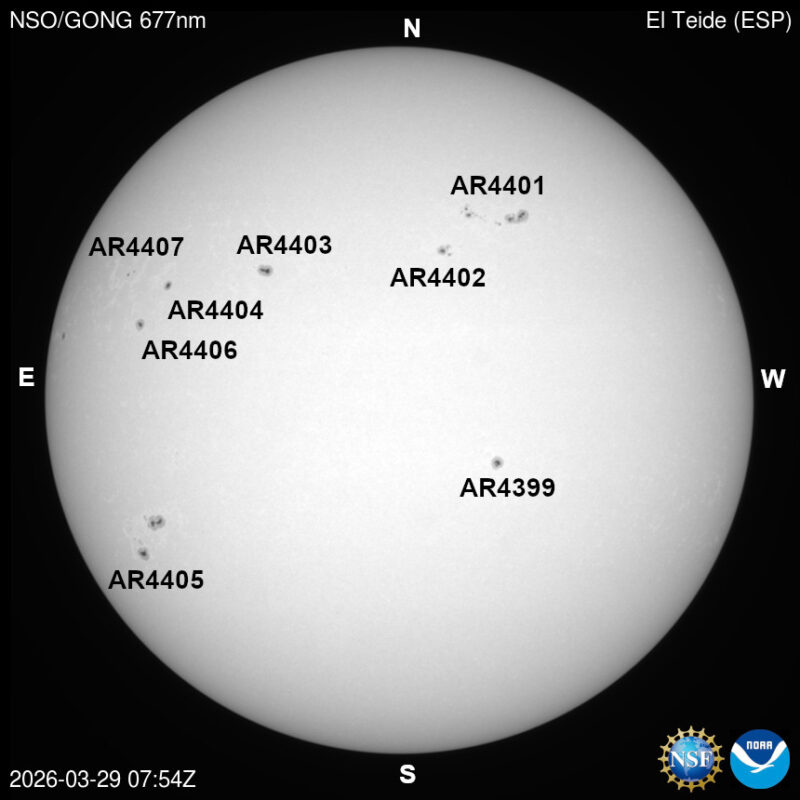
Meanwhile, on the solar disk, 10 numbered sunspot regions are visible. AR4401 and AR4405 retain the most complex magnetic configurations and the highest potential for renewed moderate flaring in the days ahead.
Past 24 hours of sun news
(11 UTC March 28 – 11 UTC March 29)
Flare activity: Solar activity held at low-to-moderate levels. The sun produced 8 C-class flares during the past day.
- Strongest flare: C4.1 from AR4404 at 11:18 UTC on March 28.
- Lead flare producer: AR4405 and AR4404 tied as the top flare producers, each firing multiple C-class events. The newly split AR4407 also showed signs of life with two C-class flares late in the period.
Sunspot regions: The Earth-facing solar disk displayed 10 numbered active regions, plus one unnumbered spot near the northeast limb.
Blasts from the sun? Forecasters catalogued five CMEs during the past day. But none are expected to deliver a direct blow to Earth. Still, two older CMEs from earlier in the week do have modeled Earth-arrival windows today.
Past 24 hours in space weather
Solar wind: Solar wind conditions reflected a mostly nominal slow-wind regime for most of the past day. A brief interval of slightly elevated winds occurred between 05:30 UTC and 08:15 UTC on March 28. Beginning around 20:20 UTC on March 28, a weak enhancement appeared in the interplanetary magnetic field (IMF). Total field strength climbed, and the Bz component dipped southward, briefly opening the door for enhanced coupling between the solar wind and Earth’s magnetosphere. A late-period disturbance might represent an early signal of the approaching coronal hole high-speed stream or a glancing CME interaction.
Earth’s magnetic field: Earth’s magnetic field ranged from quiet-to-unsettled levels overall, with Kp values spanning 1 to 3+. An isolated active interval of Kp 4 struck between 00:00–03:00 UTC on March 28, coinciding with a brief southward Bz excursion. Conditions then settled back to quiet levels for the remainder of the period. No G-scale geomagnetic storm thresholds were crossed.
What’s ahead? Sun–Earth forecast
Flare activity forecast: Forecasters expect solar activity to continue at very low levels. But the chance for M-class (moderate) flares sits at 50% today, and the chance for X-class (strong) flares holds at 10%.
Geomagnetic activity forecast:
- March 29: Expect quiet-to-unsettled conditions early in the day today. Conditions should transition to more disturbed by late in the day. Enhancements from a recurrent positive-polarity coronal hole high-speed stream (CH HSS) should begin arriving by late March 29. Additionally, two older CMEs have modeled arrival windows today. The March 26 CME shock front should arrive around 9 UTC (Kp 3–5). And the March 25 CME should arrive around 20 UTC (Kp 2–4). Combined with the CH HSS onset, a chance of G1 (minor) storm conditions exists, particularly during the second half of the day. Aurora watchers in Seattle, Edinburgh, southern Scandinavia, and similar geomagnetic latitudes should stay alert for possible displays where skies are clear.
- March 30: Forecasters expect G1 (minor) geomagnetic storming as the coronal hole high-speed stream influence peaks. Solar wind speeds should climb above 500 km/s. Aurora may reach Seattle, Minneapolis, Edinburgh, and the Scottish Highlands where skies are clear. If conditions align favorably with sustained southward Bz, brief G2 (moderate) intervals can’t be ruled out.
- March 31: Expect unsettled-to-active conditions to persist as CH HSS effects gradually wane. Isolated Kp 4 periods remain possible early in the day before conditions trend toward quiet levels. Aurora visibility should retreat to higher latitudes: northern Canada, Iceland, and northern Scandinavia.
Sun news March 28: M flare erupts as solar activity ticks upward
The sun shook off a quiet spell overnight. Sunspot region AR4405 – a sprawling beta-class region perched on the southeastern limb – fired an M1.3 flare at 2:13 UTC on March 28. It was the strongest event of the past day and a step up from the low-level C-class activity that dominated the previous day. The moderate flare triggered an R1 (minor) radio blackout, briefly disrupting high-frequency communications over Malaysia.
And, overall, AR4405 was the undisputed troublemaker of the period. It produced seven of the day’s eight flares. Meanwhile, AR4401, a more magnetically complex beta-gamma region sitting near disk center, continued to evolve. It gained maturing penumbra in its intermediate area and maintaining the mixed-magnetic configuration that keeps forecasters watching it closely.
On the space weather side, conditions remained calm. The solar wind drifted back toward ambient levels, and the geomagnetic field stayed quiet throughout. But that calm may not last. A coronal hole high-speed stream should arrive by late March 29, potentially lifting geomagnetic activity to unsettled or active levels. So aurora watchers at high latitudes will have a reason to look up, as we head into the new week.
Past 24 hours of sun news
(11 UTC March 27 – 11 UTC March 28)
Flare activity: Solar activity reached moderate levels during the period. The sun produced 8 flares: 1 M-class and 7 C-class.
- Strongest flare: M1.3 from AR4405 (S22E77), peaking at 02:13 UTC on March 28. It triggered an R1 (minor) radio blackout, briefly affecting HF communications over Malaysia.
- Lead flare producer: AR4405 produced 6 of the 8 flares, including the M1.3 and five C-class events: C4.1 at 10:16 UTC March 27, C3.7 at 10:48 UTC March 27, and C4.0 at 07:31 UTC March 28. Earlier in the period, a C5.4 flare at 10:02 UTC March 27 also came from this region and qualified as a very long-duration event that released energy comparable to an M-class flare.
Sunspot regions: The Earth-facing solar disk displayed nine numbered active regions, with one departing over the southwestern limb.
Blasts from the sun? Forecasters catalogued several CME-related events during the period, but none proved Earth-directed.
Past 24 hours in space weather
Solar wind: Solar wind conditions reflected a return to an ambient-like environment after the decline of a prior coronal hole high-speed stream. Speeds peaked early in the period before gradually declining by the end. The interplanetary magnetic field (IMF) total strength reached moderate values at 02:00 UTC March 27 before settling to lower values. The Bz component fluctuated between northward and southward directions, with the maximum southward excursion recorded at 20:58 UTC March 27. That dip proved too brief and weak to drive significant geomagnetic activity. Overall, conditions resembled the slow solar wind regime.
Earth’s magnetic field: Earth’s magnetic field stayed quiet throughout the period, with the Kp index ranging from 2- to 3+. Conditions did not reach any geomagnetic storm levels. Aurora activity remained at background levels, confined to the typical auroral oval over northern Canada, Alaska, Iceland, and northern Scandinavia.

Sun news March 27: AR4403 calms, as new regions rotate in
Yesterday, active region AR4403 in the sun’s northeast announced its arrival with a powerful M3.9 flare early on March 26 (6:11 UTC). It caused an R1 (minor) radio blackout over the Indian Ocean. Now AR4403 has calmed. And despite seven numbered sunspot groups crowding the visible solar disk (with at least two more rotating into view), the geomagnetic environment remained remarkably tranquil over the past day. It showed only quiet-to-unsettled conditions. But the sun’s eastern limb, or edge – the side now rotating into view – promises more activity soon. At least two new regions are rotating into Earth’s view on the sun’s north and southeastern limb. A faint, slow blast of sun-stuff – a coronal mass ejection, or CME – might graze Earth on March 29. Stay tuned for more updates.
Past 24 hours of sun news
(11 UTC March 26 – 11 UTC March 27)
Flare activity: Solar activity dropped to low levels. The sun produced 11 C-class flares.
- Strongest flare was a tie: C3.6 from AR4403 at 3:01 UTC on March 27 and C3.6 at 6:56 UTC from an unnumbered region on the southeast limb (edge).
- Lead flare producer: The unnumbered region on the southeast limb dominated, producing 8 of the 11 flares recorded over the past day.
Sunspot regions: The Earth-facing solar disk displayed seven numbered active regions, with notable evolution across several groups. Something is happening!
Blasts from the sun? The SOHO spacecraft’s LASCO C2 coronagraph captured a wide, faint, and slow-evolving chunk of sun-stuff – a coronal mass ejection, or CME – from the sun’s north/northwest, starting around 18 UTC on March 25. The source remains unclear. But it might be associated with a slow-dimming region centered near the location N15W05 that evolved alongside a nearby coronal hole. Forecasters anticipate this CME will have minor impacts at Earth. It’s expected to combine with a weak co-rotating interaction region (CIR), forecast to arrive on March 29. Available coronagraph imagery showed no other Earth-directed CMEs over the past day.
Past 24 hours in space weather
Solar wind: The solar wind environment calmed as a coronal hole high-speed stream waned. The total magnetic field (Bt) of the interplanetary magnetic field (IMF) remained low, with the Bz component showing only minor and brief southward deflections. We watch for those southward deflections because they bring the best conditions for auroras.
Earth’s magnetic field: The geomagnetic field held at quiet-to-unsettled levels throughout the last 24 hours, Kp = 1-3.
Sun news March 26: New sunspot region arrives with a bang

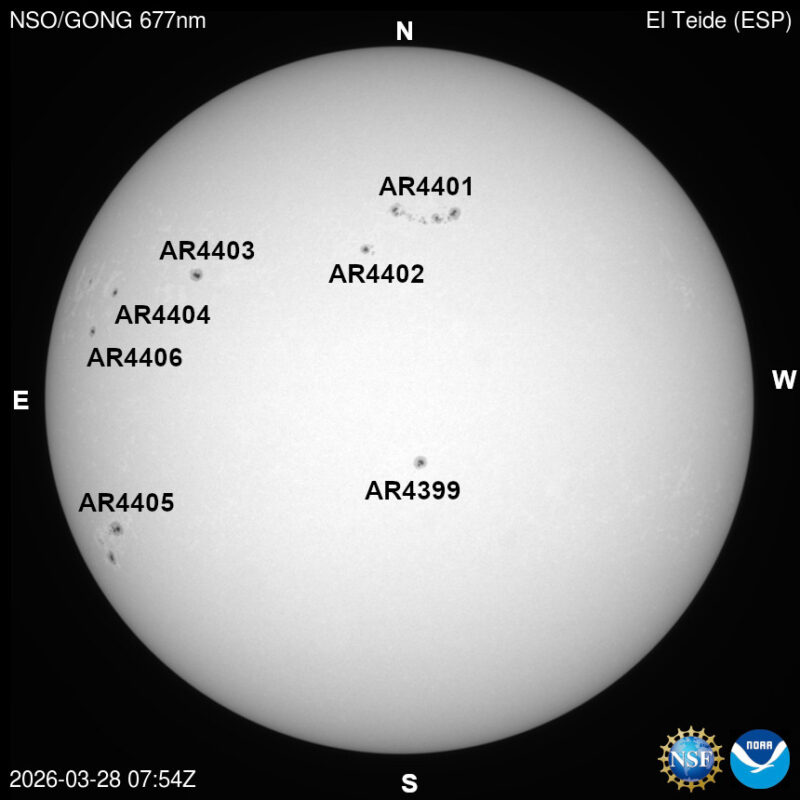
We mentioned yesterday that an explosive region appeared to be on its way from behind the eastern horizon, and it has since arrived with a bang! Now labeled AR4403, this region made its presence known with a powerful M3.9 flare at 6:11 UTC this morning, triggering an R1 (minor) radio blackout over the Indian Ocean. This region is definitely one to watch.
Past 24 hours of sun news
(11 UTC March 25 – 11 UTC March 26)
Flare activity: Solar activity rose to moderate-high levels by the end of the reporting window. The sun produced 8 flares: 1 M-class and 7 C-class.
- Strongest flare: M3.9 from AR4403 at 6:11 UTC on March 26. This was the most energetic event of the period and triggered an R1 (minor) radio blackout, briefly affecting high-frequency communications over the Indian Ocean.
- Lead flare producer: AR4403 produced at least 4 of the 8 flares, including the M3.9 and three C-class events (C2.1 at 13:48 UTC, C2.2 at 13:04 UTC, and C1.7 at 12:07 UTC on March 25). This region had been firing flares beyond the limb before rotating into view and continues to warrant close monitoring.
Sunspot regions: The Earth-facing solar disk displayed seven numbered active regions, with notable evolution across several groups.
Blasts from the sun? Available coronagraph imagery showed no new Earth-directed coronal mass ejections (CMEs) during the period. However, several CMEs and a pending arrival remain noteworthy.
Past 24 hours in space weather
Solar wind: The solar wind environment was dominated by the passage of a CME that arrived at 5:52 UTC on March 25. The CME arrival drove speeds sharply upward, while the total interplanetary magnetic field (IMF) jumped up by 8:35 UTC. The Bz component swung sharply southward early in the passage, opening Earth’s magnetic shield and fueling a G1 (minor) geomagnetic storm, then turned predominantly northward for most of the remaining period. Speeds eased by the end of the window.
Earth’s magnetic field: The geomagnetic field reached G1 (minor) geomagnetic storm levels during the 6–9 UTC interval on March 25, with Kp reaching 5. This coincided with the initial CME passage and the brief southward Bz excursion. Outside these intervals, conditions ranged from quiet to unsettled (Kp 1–3).
Sun news March 25: A huge blast from the northeast

A huge blast of sun-stuff erupted over our star’s northeast horizon at around 19 UTC yesterday evening. The event has been connected to a C7.3 flare recorded on that horizon, although this flare was likely larger in reality, as the sun itself blocked part of the blast. This suggests that a sunspot region is lurking just behind the sun’s northeast limb (edge), and could bring interesting activity to the Earth-facing solar disk when it rotates into view over the coming days. We’ll keep watching to find out the caliber and credentials of this newcomer.
Past 24 hours of sun news
(11 UTC March 24 – 11 UTC March 25)
Flare activity: Solar activity held at low levels, with only 6 C-class flares over the past 24 hours.
- Strongest flare: C7.3 from an incoming, as-yet-unnumbered active region in the northeast at 17:54 UTC on March 24.
- Lead flare producer: A triple tie. Three active regions each fired 2 C-class flares: AR4401, AR4400, and the newcomer in the northeast.
Sunspot regions: The Earth-facing solar disk currently shows 6 numbered active regions. Active region AR4399 retains its beta-delta configuration, giving it the potential for M-class and even X-class flares. AR4401 now carries a beta-gamma configuration. These two active regions are the largest currently in view, and they could deliver a surprise at any moment.
Blasts from the sun? Available coronagraph imagery showed no Earth-directed coronal mass ejections (CMEs) during the period.
Past 24 hours in space weather
Solar wind: Solar wind speeds held steady at moderate levels throughout the period. Speeds dipped early this morning but returned to moderate levels by the time of this writing. The Bz component shifted intermittently between northward and southward orientations with similar intensity in both directions. A southward Bz component favors auroral activity. At the time of this writing, the Bz component points southward.
Earth’s magnetic field: Earth’s magnetic field ranged from unsettled to quiet levels (Kp = 3 – 2). No G1 (minor) geomagnetic storm occurred during the period. At the time of this writing, the Kp index sits just above level 3.
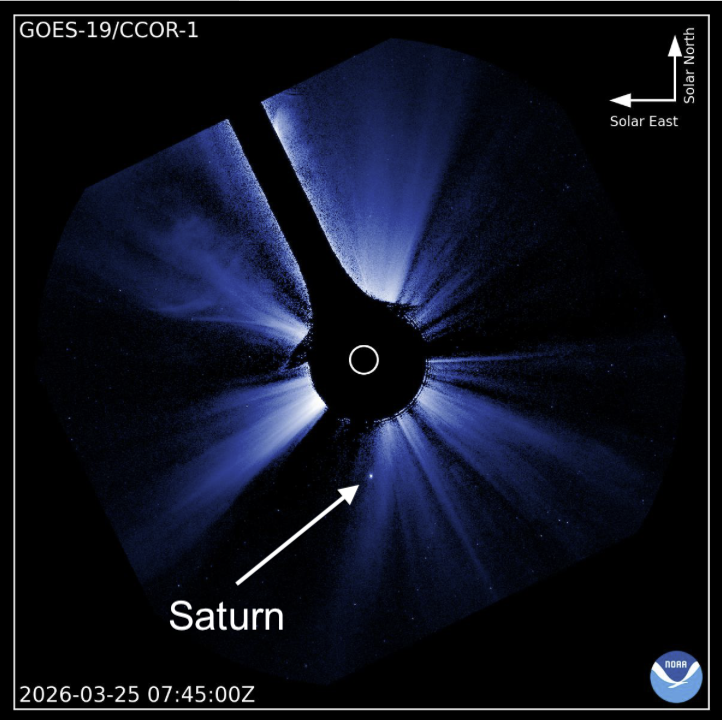
Sun news March 24: Storming eases, but more sun-stuff incoming

Gorgeous auroras danced across northern skies all weekend, fueled by up to G3 (strong) geomagnetic storming. Multiple coronal mass ejection (CME) arrivals plus the onset of a fast solar wind stream drove all of this activity. The Russell-McPherron effect near the equinox likely played a role in the enhancements as well. Now, geomagnetic storming conditions have started to recede, but a couple of blasts of sun-stuff – coronal mass ejections, or CMEs – are still heading toward Earth. If they give our planet glancing blows, as expected, that could bring more G1 (minor) geomagnetic storming from March 25 through 26.
Past 24 hours of sun news
(11 UTC March 23 – 11 UTC March 24)
Flare activity: Solar activity continued at low levels over the past 24 hours. The sun produced 6 C-class (common) flares.
- Strongest flare: C2.0 from AR4401 at 11:15 UTC on March 23.
- Lead flare producer: AR4401 quickly emerged as the lead flare producer, firing 4 C-class flares during the past day.
Sunspot regions: The Earth-facing solar disk displayed 7 numbered active regions. AR4400 and AR4399 both stand as the most magnetically complex regions on the disk, each carrying a beta-delta configurations. AR4401 now shows a beta-gamma configuration. These three active regions are the most likely sources for M-class (moderate) flares in the coming days.
Blasts from the sun? The filament eruption we reported yesterday does carry an Earth-directed component, according to analysis. It may deliver a glancing blow late on March 26. Beyond that, available coronagraph imagery showed no other Earth-directed coronal mass ejections.
Past 24 hours in space weather
Solar wind: Solar wind conditions reflected a transition from waning CME influences to the onset of a coronal hole high-speed solar wind stream. Speeds held steady at moderate levels throughout the period. The Bz component maintained a prolonged southward orientation for most of the period, with a few northward peaks, though the strongest intervals pointed south. A southward Bz component favors auroral activity.
Earth’s magnetic field: The strong geomagnetic storms from the weekend started to recede. Earth’s magnetic field ranged from storming to unsettled levels (Kp = 5 – 3). A G1 (minor) geomagnetic storm struck early in our observation period. Conditions crossed the Kp = 5 threshold at 12 UTC on March 23. At the time of this writing, the Kp index sits at level 4.


Sun news March 23: Auroras blaze as solar winds pour in
Auroras danced across northern skies overnight as Earth’s magnetic field underwent G3 (strong) geomagnetic storming. The culprit: a potent one-two punch of recent coronal mass ejection (CME) arrivals plus the onset of a fast solar wind stream soaring toward Earth from a large coronal hole. As charged particles poured into Earth’s upper atmosphere, vivid auroral displays became visible from mid-latitude locations as far south as New York, London and northern France. The storm is now easing, but forecasters still expect periods of G1–G2 (minor–moderate) storming through today, keeping aurora watchers busy for at least another night.
Past 24 hours of sun news
(11 UTC March 22 – 11 UTC March 23)
Flare activity: Solar activity remained low. The sun produced 9 flares: 5 C-class (common) and 4 B-class (weak).
- Strongest flare: C3.4 from AR4392, peaking at 23:26 UTC on March 22.
- Lead flare producer: AR4392, which fired 4 C-class flares in rapid succession late on March 22: C1.6 at 22:56 UTC, C3.4 at 23:26 UTC, C3.1 at 23:50 UTC and C3.2 at 00:24 UTC on March 23.
Sunspot regions: The Earth-facing solar disk displayed 7 numbered active regions. AR4400 stands as the most magnetically complex region on the disk, with a beta-gamma-delta complexity. This makes AR4400 the most likely source for any M-class (moderate) flare in the coming days.
Blasts from the sun? Forecasters catalogued two CMEs during the period. A third eruption from a filament is now under analysis for a potential Earth-directed component.
Past 24 hours in space weather
Solar wind: Solar wind conditions reflected a transition from waning CME influences to the onset of a coronal hole high-speed solar wind stream. Speeds surged from moderate early in the period to high by around 20:30 UTC on March 22. The Bz component had a prolonged southward orientation from around 6 UTC on March 22, opening Earth’s magnetic field to the incoming fast wind and directly fueling the G3 storming.
Earth’s magnetic field: Earth’s magnetic field endured its most disturbed conditions in recent days, reaching G3 (strong) geomagnetic storm levels (Kp = 7) from 9:00 UTC on March 22 onward. Auroras likely reached a wide swath of mid-latitudes, potentially extending as far south as New York, London and northern France during peak storming intervals.

Sun news March 21-22: Auroras continue after yesterday’s strong storm
Auroras danced across skies from Scotland to the northern U.S. last night. Earth remained under the influence of multiple strikes by chunks of sun-stuff – coronal mass ejections, or CMEs – that left the sun on March 16 and 18. The CMEs drove geomagnetic storming to G3 (strong) levels, with Kp reaching 7 during the opening hours of March 21. Observers reported vivid auroral displays from New York, London, and northern France. As the day progressed yesterday, conditions gradually eased to unsettled-to-active levels. But the respite may be short-lived: a coronal hole high-speed stream should arrive today (March 22), potentially reigniting G2 (moderate) storm conditions. Auroral displays are possible across Edinburgh, Toronto, Chicago, and northern England. Did you see the auroras? Did you take photos? Share them with the EarthSky community.
Read: Russell-McPherron effect gives us an aurora season
Past 24 hours of sun news
(11 UTC March 21 – 11 UTC March 22)
Flare activity: The sun is still taking a breather. Solar activity stayed at low levels, with only one C-class flare over the past day. This modest C1.2 came from newly numbered AR4399 near the sun’s east limb (edge). The sun produced five flares in all in the past day. The other four were B-class. It was a notably quiet day for this downhill side of Solar Cycle 25.
- Strongest flare: C1.2 from AR4399 at 15:58 UTC on March 21.
- Lead flare producer: AR4399 topped the list with the period’s only C-class event plus one B-class flare.
Sunspot regions: The Earth-facing solar disk displayed four numbered active regions plus one unnumbered group, a relatively sparse configuration.
Blasts from the sun? Available coronagraph imagery showed no new Earth-directed coronal mass ejections (CMEs) during the past day.
Past 24 hours in space weather
Solar wind: Solar wind conditions reflected the waning influence of CME passages throughout the period. Speeds remained variable, but elevated. The interplanetary magnetic field (IMF) peaked at a very strong 38 nT at 15:32 UTC on March 21, before declining sharply after 19:00 UTC as CME influence faded. The Bz component swung strongly and turned frequently southward, favoring auroras. After 09:00 UTC on March 21, Bz shifted predominantly northward, effectively closing the door on further strong geomagnetic coupling. By the end of the period, the IMF had relaxed to moderate levels around 27 nT with moderate speeds near 500 km/s.
Earth’s magnetic field: Earth’s magnetic field experienced dramatic conditions just before the current period, then calmed to unsettled and active levels (Kp = 3-4). A G1 (minor) storm interval (Kp 5) followed from 06:00–09:00 UTC on March 22. At the time of this writing (11 UTC on March 22), activity has increased to G2 (moderate) storming (Kp = 6). Auroras are visible in northern Canada and Alaska.
What’s ahead? Sun–Earth forecast
Flare activity forecast: Forecasters expect solar activity to drop to very low levels. The chance for M-class (moderate) flares sits at 10% today, and the chance for X-class (strong) flares holds at a minimum 1%. Still, an X-class flare cannot be ruled out. Active region AR4392 remains the main driver of flare activity, with its beta-gamma magnetic configuration.
Geomagnetic activity forecast:
- March 22: Forecasters expect G2 (moderate) geomagnetic storming as residual CME effects combine with the anticipated arrival of a coronal hole high-speed stream. A slight chance of isolated G3 (strong) storm intervals also exists if the Bz turns deeply southward during the high-speed stream onset. Auroras may reach Toronto, Chicago, Boston, northern England, and Melbourne if G2 conditions materialize, and potentially as far south as New York and London during any G3 intervals.
- March 23: Isolated G1 (minor) storm periods are likely as coronal hole high-speed stream effects continue. We expect predominantly unsettled-to-active (Kp 3–5) conditions. Aurora may reach Seattle, Minneapolis, Edinburgh, and the Scottish Highlands during G1 intervals.
- March 24: Expect conditions to ease to unsettled-to-active levels (Kp 3–4) as the high-speed stream influence slowly wanes. A slight chance of isolated G1 (minor) storm intervals remains.
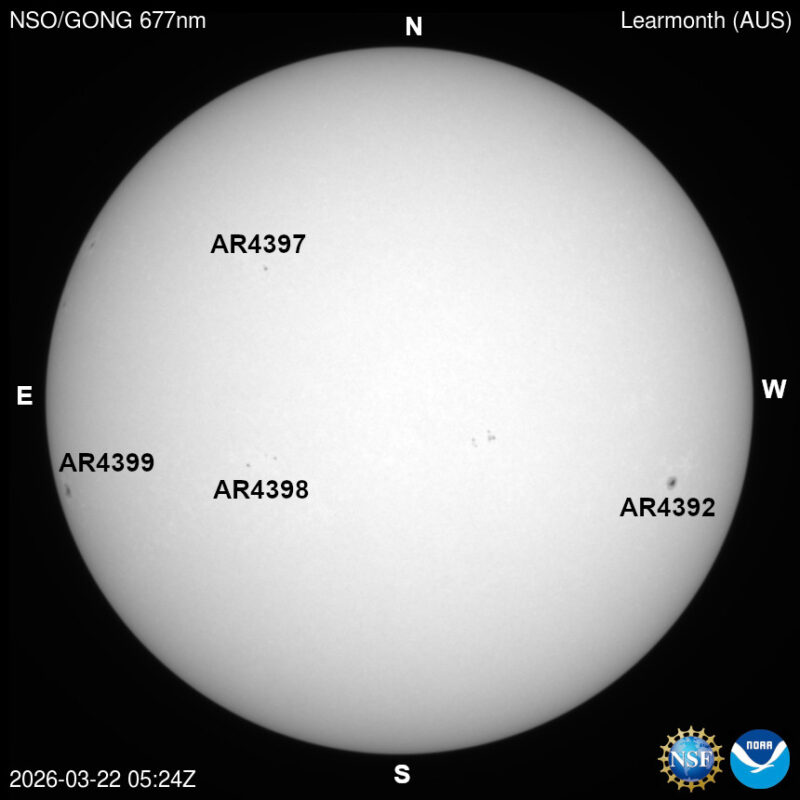
Sun news March 21: Strong geomagnetic storm last night. Auroras!
The expected chunks of solar materials and magnetic fields – called coronal mass ejections, or CMEs – struck Earth yesterday. And they struck strongly! The resulting geomagnetic storms escalated to G3 (strong) levels. And so we had auroral displays across northerly latitudes, seen as far south as the U.S. states of Wyoming and Colorado. Forecasters anticipate these conditions will extend through the weekend. The strong geomagnetic storming received an extra boost from the Russell-McPherron effect: the combination of earthly and solar magnetism with the geometry of the Earth and sun at equinox time.
Read: Russell-McPherron effect gives us an aurora season
Did you see the auroras? Did you take photos? Share them with the EarthSky community.
Past 24 hours of sun news
(11 UTC March 20 – 11 UTC March 21)
Flare activity: Solar activity continued at low levels during the past day. The sun produced only 2 faint B-class flares over the past day.
- Strongest flare: B4.9 at 2:49 UTC on March 21, from an incoming, as-yet-unnumbered active region in the northeast.
- Lead flare producer: A tie. The incoming northeast region and AR4392 each produced 1 B-class flare during the period.
Sunspot regions: The Earth-facing solar disk displays only 2 numbered active regions today. Active region AR4392 retains its beta-gamma magnetic complexity. But it produced only one B-class flare. Active region AR4397 shows a weaker beta configuration.

Blasts from the sun? SOHO’s LASCO C3 coronagraph captured a full-halo coronal mass ejection (CME) at 4 UTC on March 20. The absence of flare activity on the Earth-facing side of the sun confirms the event originated on the far side. This blob of solar stuff is not heading toward Earth.
Past 24 hours in space weather
Solar wind: Solar wind speeds climbed to moderate levels at ~550 km/s this morning. The Bz component kept intermittently switching between northward and southward orientations over the past day. But the strongest peaks pointed southward, particularly from late yesterday into early this morning. At the time of this writing, the Bz component points southward. A southward Bz orientation increases aurora potential.
Earth’s magnetic field: Earth’s magnetic field ranged from unsettled-to-stormy levels during the past day (Kp = 3-7), with storming dominating most of the period. Geomagnetic storms ranged from G1-G2 (minor to moderate) to G3 (strong) and lasted for four consecutive three-hour synoptic periods. Conditions crossed the G2 threshold at 22:12 UTC on March 20 and escalated to G3 at 1:54 UTC on March 21. At the time of this writing, the geomagnetic storm has receded to G1 (minor) levels.
The aurora tonight from Fairbanks, Alaska. Stunning colors!
— Vincent Ledvina (@vincentledvina.bsky.social) 2026-03-21T07:55:36.665Z
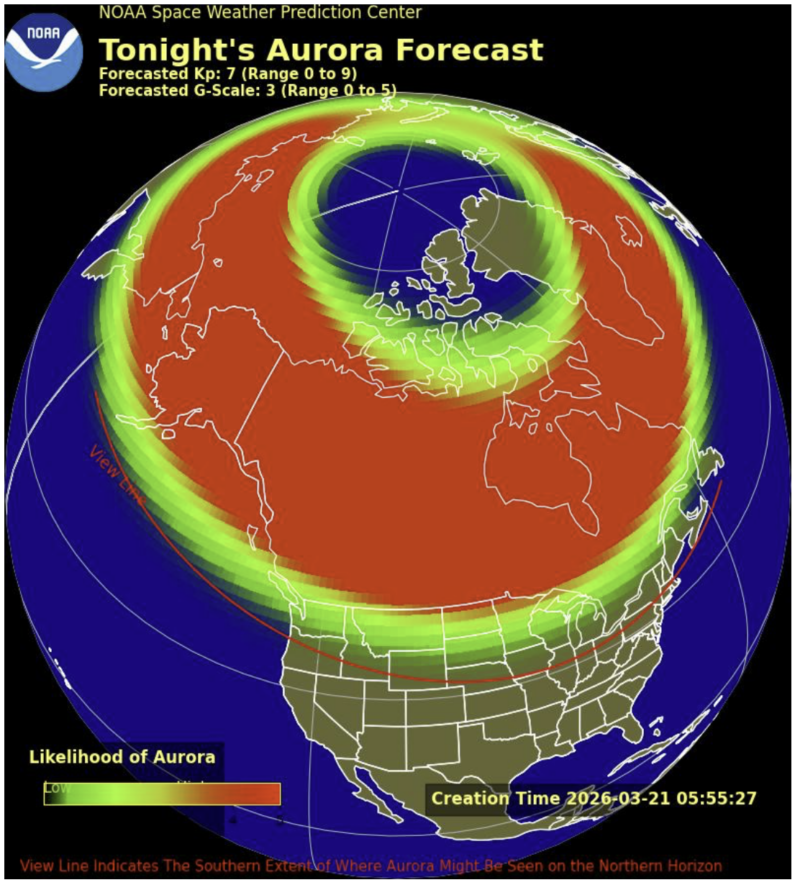
Sun news for March 20-21, 2026. Auroras!
Sun news March 20: Happy March equinox from the sun!


Happy March (vernal) equinox! There is plenty to talk about in solar news today. A new coronal hole has emerged and now sits at a geoeffective position. Fiery prominences tower over the solar northeast near the north pole. Flare activity has dropped to very low levels. But there is one notable absence: no coronal mass ejection (CME) arrival! Or should we say, not yet. The anticipated G1-G2 (minor to moderate) or even G3 (strong) geomagnetic storms have not materialized yet. Forecasters still have a geomagnetic storm alert in place. We will keep watching and bring you the latest solar news. Hang in there.
Past 24 hours of sun news
(11 UTC March 19 – 11 UTC March 20)
Flare activity: Solar activity dropped to very low levels during the last 24 hours. The sun produced only a few faint flares. A total of 3 B-class (weak) flares made up the entire flare output for the period.
- Strongest flare: B7.3 at 22:26 UTC on March 19, from active region AR4392.
- Lead flare producer: AR4397 produced 2 of the 3 B-class flares during the period.
Sunspot regions: The Earth-facing solar disk displays only 2 numbered active regions today. Active region AR4392 retains its beta-gamma magnetic complexity but produced only one B-class flare. Active region AR4397 shows a beta configuration.
Blasts from the sun? Available coronagraph imagery showed no Earth-directed coronal mass ejections (CMEs) during this period.
Past 24 hours in space weather
Solar wind: Solar wind speeds climbed from low levels of ~300 km/s to nominal levels at ~450 km/s this morning. The Bz component stayed mostly northward late yesterday but started shifting southward early this morning. A southward Bz orientation increases aurora potential.
Earth’s magnetic field: Earth’s magnetic field ranged from quiet to unsettled levels during the past day (Kp = 0-3). Geomagnetic activity picked up early this morning. At the time of this writing, the Kp index sits just below level 3.
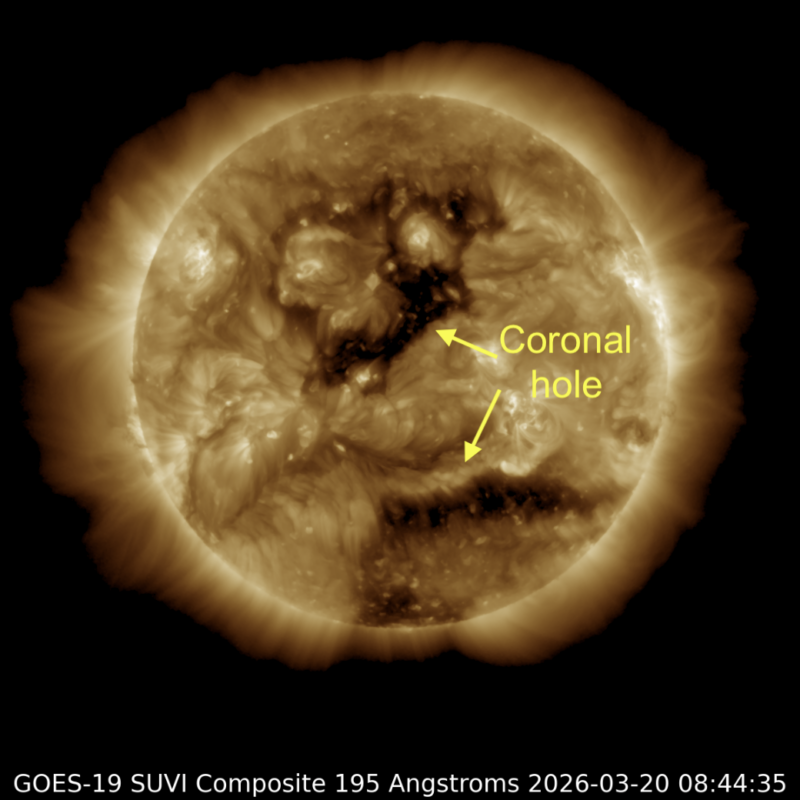
Sun news March 19: 3 blasts of sun-stuff now on the way!
We reported yesterday that two blasts of sun-stuff are heading to Earth … And now a third has joined the queue! The latest of these coronal mass ejections (CMEs) came from the M2.75 flare fired yesterday by sunspot region AR4392, which is facing right at Earth. Analysts expect it to reach us on March 21. When it does, it should find our magnetic field already disturbed. That’s because the first of the three coronal mass ejections is expected to arrive later today, likely triggering G2 (moderate) or even G3 (strong) geomagnetic storms. And that means auroras! Analysts expect auroral displays at mid-northern latitudes, perhaps as far south as the northernmost U.S. states.
Past 24 hours of sun news
(11 UTC March 17 – 11 UTC March 18)
Flare activity: Solar activity dropped down to low levels over the past day. The sun produced a total of 12 flares: 3 C-class (common) and 9 B-class (weak).
- Strongest flare: A C3.6 flare produced at 13:11 UTC on March 18 from active region AR4392.
- Lead flare producer: AR4392 again topped the list, this time producing all 12 flares of the period.
Sunspot regions: Currently the sun displays 3 numbered active regions on its Earth-facing disk. Active region AR4392 has retained its beta-gamma magnetic complexity while the other two active regions on the solar disk show simpler beta configurations. There is a newcomer on the northeast horizon now numbered AR4397.
Blasts from the sun? A coronal mass ejection (CME) is on its way to Earth after the M.75 flare from AR4392 yesterday at 8:30 UTC. Modeling indicates an arrival early on March 21.
Past 24 hours in space weather
Solar wind: Solar wind speeds continued around the normal ~400 km/s background as the influence of a coronal hole high-speed stream (CH HSS) faded. The Bz component stayed mostly northward throughout the period, with only a few faint southward excursions. A southward Bz orientation increases aurora potential.
Earth’s magnetic field: Earth’s magnetic field sat at quiet levels during the past day (Kp = 0-2). The declining solar wind drove the steady drop in activity. At the time of this writing, the Kp index sits above level 0.
Sun news March 18: 2 blasts of sun-stuff on the way to Earth


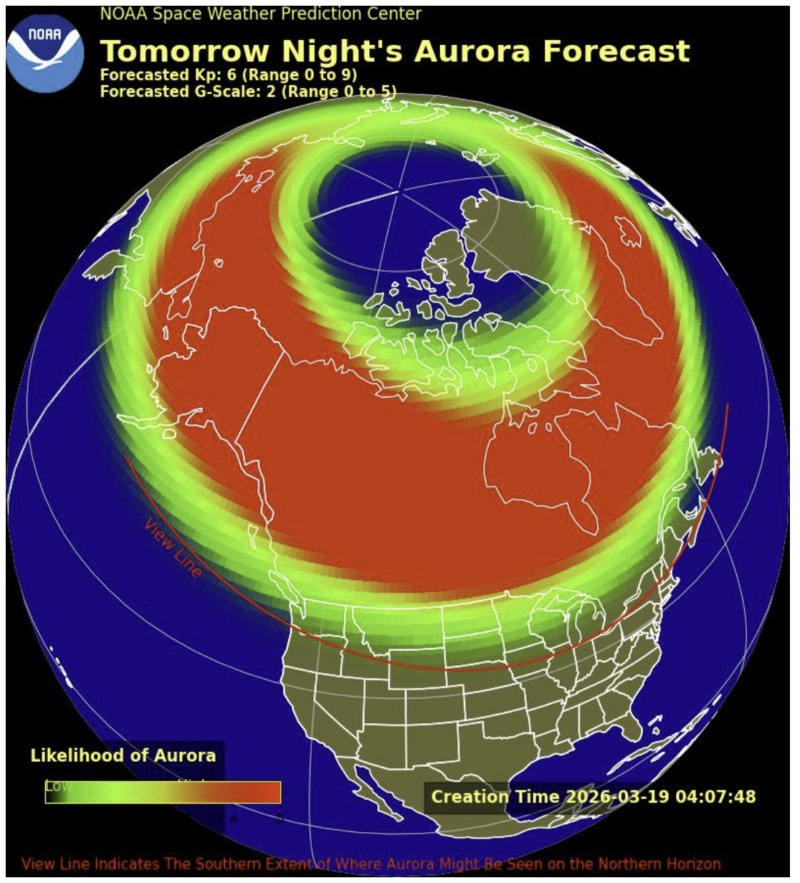
Space weather specialists have confirmed that a large blob of sun-stuff is heading toward Earth, with a second following right behind it! The M2.8 flare we reported on yesterday, fired by sunspot region AR4392 on March 16, hurled the larger coronal mass ejection (CME) directly toward Earth. It’s expected to arrive on March 19, just in time for equinox eve. And a filament eruption at 3 UTC yesterday also hurled solar stuff our way. Specialists say it may deliver a glancing blow on March 21, and its proximity to the bigger CME arriving on March 19 could strengthen its impact. Forecasters expect G2 (moderate) geomagnetic storming, which could trigger auroras. Stay tuned!
Past 24 hours of sun news
(11 UTC March 17 – 11 UTC March 18)
Flare activity: Solar activity held at moderate levels over the past day with the production of another M-class flare. The sun produced a total of 14 flares: 1 M-class (moderate), 8 C-class (common), and 5 B-class (weak).
- Strongest flare: M2.75 at 8:30 UTC on March 18 from active region AR4392. The blast triggered an R1 (minor) radio blackout over the Arabian Sea off the east coast of Somalia.
- Lead flare producer: AR4392 once again topped the list with 5 flares. AR4393 and an incoming, as-yet-unnumbered region in the northeast followed closely behind with 3 flares each.
Sunspot regions: The Earth-facing solar disk currently displays 4 numbered active regions. Active region AR4392 has maintained its promising beta-gamma magnetic complexity. The remaining active regions show simpler beta configurations.
Blasts from the sun? A filament eruption at 3 UTC on March 17 launched a coronal mass ejection (CME) into space. Modeling indicates it may deliver a glancing blow on March 21, but its proximity to the bigger CME arriving at Earth on March 19 could strengthen the combined effects. Forecasters are closely monitoring both events.
Past 24 hours in space weather
Solar wind: Solar wind speeds declined to around the normal ~400 km/s background as the influence of a coronal hole high-speed stream (CH HSS) faded. The Bz component stayed mostly northward throughout the period, with only a few faint southward excursions. A southward Bz orientation increases aurora potential.
Earth’s magnetic field: Earth’s magnetic field sat at quiet levels during the past day (Kp = 0-2). The declining solar wind drove the steady drop in activity. At the time of this writing, the Kp index sits at level 1.
Sun news March 17: Bam! M flare and solar stuff heading our way


The sun has been churning out only faint C and weak B flares for some days. But active region AR4392 sparked an M2.8 flare at 12:15 UTC yesterday. The eruption triggered an R1 (minor) radio blackout over the Atlantic Ocean. And it hurled a big chunk of solar stuff, also known as a coronal mass ejection, or CME, into space. This blob of solar material is heading directly toward Earth. After modeling and analysis, forecasters expect it to arrive on March 19.
One interesting detail: this CME may arrive very close to the vernal equinox. Auroras love equinoxes, especially the vernal equinox. Even the slightest geomagnetic disturbance near an equinox can spark beautiful auroral displays. With this approaching CME, forecasters expect G2 (moderate) geomagnetic storm enhancements.
Read more: It’s aurora season. Why more auroras around the equinoxes?
So your cameras ready! And by the way, our much-loved EarthSky Community Photos is back, after a bot swarm brought it down a day ago. Phew! Please keep sharing your beautiful photos with us.
Past 24 hours of sun news
(11 UTC March 16 – 11 UTC March 17)
Flare activity: Solar activity climbed to moderate levels over the past day with the production of an M-class flare. The sun produced a total of 8 flares: 1 M-class (moderate), 2 C-class (common), and 5 B-class (weak).
- Strongest flare: M2.8 at 12:15 UTC on March 16, from active region AR4392. The eruption triggered an R1 (minor) radio blackout over the Atlantic Ocean.
- Lead flare producer: AR4392 produced 5 of the 8 events, including the M-class flare.
Sunspot regions: The Earth-facing solar disk displayed 4 numbered active regions. Active region AR4392 developed a gamma component in its configuration and now carries a beta-gamma magnetic complexity.
Blasts from the sun? The M2.8 event from AR4392 on March 16 launched a coronal mass ejection (CME) into space. Modeling indicates this chunk of solar material is heading toward Earth, with an estimated arrival on March 19. Available coronagraph imagery showed no other Earth-directed CMEs.
Past 24 hours in space weather
Solar wind: Solar wind speeds continued to wane under the fading influence of a coronal hole high-speed stream (CH HSS). Speeds gradually decreased from peaks near 550 km/s early in the period to approximately 450 km/s by the end, still above the nominal ~400 km/s background. The Bz component stayed mostly northward throughout the period, with only few and faint southward excursions. A southward Bz orientation increases aurora potential.
Earth’s magnetic field: Earth’s magnetic field ranged from quiet to unsettled levels during the past day (Kp = 1-3). The declining solar wind drove the steady drop in activity. At the time of this writing, the Kp index sits at level 1.
Sun news March 16: Waning solar winds keep aurora hopes alive


Aurora watchers at high latitudes enjoyed colorful displays last night, as Earth remained under the influence of a gradually fading coronal hole high-speed stream. These solar winds had been driving geomagnetic activity for several days. Solar wind speeds eased from near 700 km/s down to around 600 km/s last night. But they remained strong enough to push Earth’s magnetic field to active levels (Kp 4) at times, keeping the door open for aurora sightings from places like Anchorage, Reykjavik and across Scandinavia. With the high-speed stream now winding down, forecasters expect geomagnetic activity to settle toward quiet-to-unsettled levels over the coming days, though isolated active periods might persist today.
Did you see auroras this weekend? You might see more tonight. Have photos? We apologize that our community photo page is down! It looks like a swarm of AI bots caused the disruption. Our team is working to get it back online as quickly as possible.
Past 24 hours of sun news
(11 UTC March 15 – 11 UTC March 16)
Flare activity stayed low over the past day. The sun produced a total of 8 flares: 1 C-class (common) and 7 B-class (weak).
- The strongest flare was a C1.1 at 15:09 UTC on March 15, from active region AR4395.
- The lead flare producer was AR4392. It produced 3 of the 8 events.
Sunspot regions: The Earth-facing solar disk displayed 6 numbered active regions, all with relatively simple magnetic configurations.
Blasts from the sun? Forecasters catalogued two coronal mass ejections (CMEs) during the past day, but neither should deliver a significant Earth impact. Available coronagraph imagery showed no new Earth-directed CMEs.
Past 24 hours in space weather
Solar wind conditions reflected the continued, but waning, influence of a coronal hole high-speed stream (CH HSS) that first reached Earth around March 11. Speeds gradually decreased from peaks near 700 km/s early in the past day to approximately 600 km/s by the end. That’s still well above the nominal ~400 km/s background. The Bz component fluctuated between northward and southward directions, with southward excursions periodically opening Earth’s magnetic field to solar wind energy and enhancing aurora potential.
Earth’s magnetic field had activity ranging from quiet to active levels during the past day. The Kp index reached 4 (active) at times, driven by elevated solar wind speeds. The Solar Influences Data Analysis Center reported that conditions briefly touched minor geomagnetic storm levels (G1, Kp 5) between 12 and 15 UTC on March 14. It illustrates the peak intensity of the stream’s influence. During the current 24-hour window, conditions generally ranged from Kp 2–4, with the active intervals reflecting the still-strong but declining solar wind.
What’s ahead? Sun–Earth forecast
Flare activity forecast: Forecasters expect solar activity to continue at low levels, with the chance for M-class (moderate) flares at 15% and the chance for X-class (strong) flares at 1%.
Geomagnetic activity forecast: The positive-polarity coronal hole high-speed stream will continue to wane gradually. And forecasters don’t expect any Earth-directed CMEs. Conditions should slowly settle toward background levels.
- On March 16, expect quiet-to-unsettled conditions (Kp 1–3). Isolated active periods (Kp 4) are still possible as the coronal hole high-speed stream influence lingers. A slight chance of G1 (minor) geomagnetic storm intervals (Kp 5) remains. That could bring auroras to high-latitude locations such as Anchorage, Reykjavik and northern Scandinavia.
- By March 17, expect primarily quiet-to-unsettled conditions (Kp 1–3), with active intervals (Kp 4) becoming less likely as solar wind speeds continue their decline. Aurora visibility should retreat further poleward.
- On March 18, expect quiet-to-unsettled conditions (Kp 1–3) as the CH HSS influence fades toward background levels. Solar wind speeds should approach nominal values. The elevated electron flux may begin to subside.
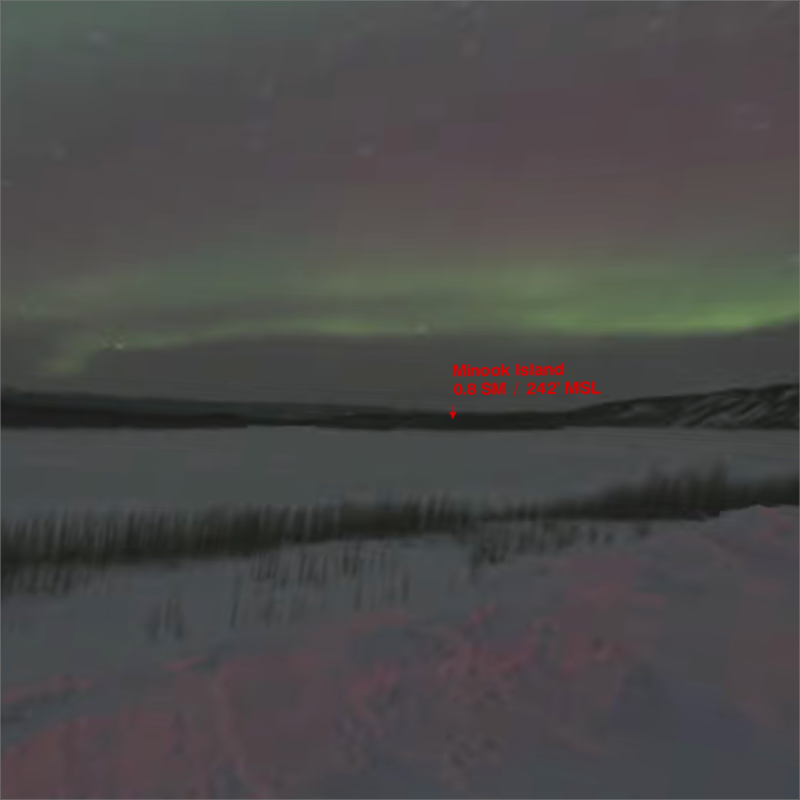
Sun news March 15: Auroras light up skies, as solar wind pours in
Auroras danced across high-latitude skies again last night, as Earth remained under the influence of a powerful coronal hole high-speed stream. The solar wind surged to speeds near 700 km/s, roughly 1.6 million miles per hour. Auroras were seen as far south as Toronto, Chicago, and northern England. Isolated G1 (minor) storming is likely to continue today, with a chance for another G2 burst if a glancing coronal mass ejection (CME) from March 13 clips Earth late on March 15. Have you seen auroras this weekend? Have photos? Get ready for more tonight and share with us!
Past 24 hours of sun news
(11 UTC March 14 – 11 UTC March 15)
Flare activity stayed low over the past day, with only C-class flares and a smattering of B-class events. The exception just arrived in the form of an M1 solar flare from AR4395 in the southeast, peaking at 9:39 UTC on March 15. The sun produced a total of 19 flares during the past day: 1 M-class (moderate), 12 C-class (common), and 1 B-class (weak).
- The strongest flare was an M1 at 9:39 UTC on March 15. It came from active region AR4394 in the southeast quadrant. The event triggered a radio blackout over central Africa.
- The lead flare producer was AR4384 (now at or beyond the western limb). It produced 8 of the 19 events, including 5 C-class flares. Much of this activity originated from just beyond the sun’s west limb, limiting its ability to affect Earth.
Sunspot regions: The Earth-facing solar disk displayed 5 numbered active regions, with the overall picture remaining one of magnetically simple, low-complexity groups.
Blasts from the sun? Forecasters catalogued four coronal mass ejections (CMEs) during the past day, but none should deliver a significant Earth impact. Available coronagraph imagery showed no new Earth-directed CMEs.
Past 24 hours in space weather
Solar wind: Solar wind speeds remained elevated throughout the period under the sustained influence of a large, trans-equatorial coronal hole that has been transiting the central meridian since March 11. Speeds peaked near 700–755 km/s (the highest value recorded at 07:25 UTC on March 14), placing wind conditions at mostly strong levels. The interplanetary magnetic field (IMF) total strength reached a peak of 13 nT before settling to 8–9 nT. The Bz component underwent several prolonged southward deflections, with the most significant reaching 8 to 10 nT, ideal conditions for funneling solar wind energy into Earth’s magnetosphere and fueling auroras.
Earth’s magnetic field: Earth’s magnetic field ranged from unsettled to G2 (Moderate) geomagnetic storm levels, driven by the coronal hole high-speed stream. A G2 (Moderate) storm interval struck from 03:00–06:00 UTC on March 14, with the global Kp index reaching 6. G1 (Minor) storm intervals (Kp 5) hit from 00:00–03:00 UTC and 06:00–09:00 UTC on March 14. At these levels, aurora reached locations such as Seattle, Minneapolis, Edinburgh, and Toronto. The G2 burst potentially extended visibility to Chicago, Boston, and northern England. Conditions eased to unsettled-to-active levels through the remainder of the period.
What’s ahead? Sun–Earth forecast
Flare activity forecast: Forecasters expect solar activity to continue at low levels, with the chance for M-class flares at 15% and the chance for X-class (strong) flares at 1%.
Geomagnetic activity forecast:
- On March 15, expect isolated periods of G1 (Minor) geomagnetic storming are likely as the positive-polarity coronal hole high-speed stream continues. A chance for isolated G2 (Moderate) storming also exists, particularly if the March 13 CME delivers a glancing blow late in the day. Aurora watchers in Seattle, Minneapolis, Edinburgh, and across Scandinavia should keep an eye on the northern sky where skies are clear. If G2 conditions develop, visibility could extend to Toronto, Chicago, and northern England. The UK Met Office notes that activity should ease in coming nights as fast solar wind fades.
- By March 16, expect conditions to gradually wane as the coronal hole high-speed stream influence diminishes. Forecasters predict primarily unsettled-to-active conditions (Kp 3–4), with any lingering storm-level activity giving way. If the March 13 CME carries a more Earth-directed component than models suggest, some residual G1 storming could linger into early March 16. The high-speed stream should energize the radiation belts, pushing the greater-than-2 MeV electron flux to high levels. SIDC forecasts the Ap dropping to 7, indicating a rapid return toward quiet conditions.
- Finally, by March 17, expect geomagnetic activity to settle to quiet-to-unsettled levels (Kp 1–3) as the coronal hole influence fully wanes. The greater-than-2 MeV electron flux might remain at high levels due to residual high-speed stream effects, posing an elevated risk for satellite charging. Forecasters expect the greater-than-10 MeV proton flux to remain at background levels throughout the forecast period.
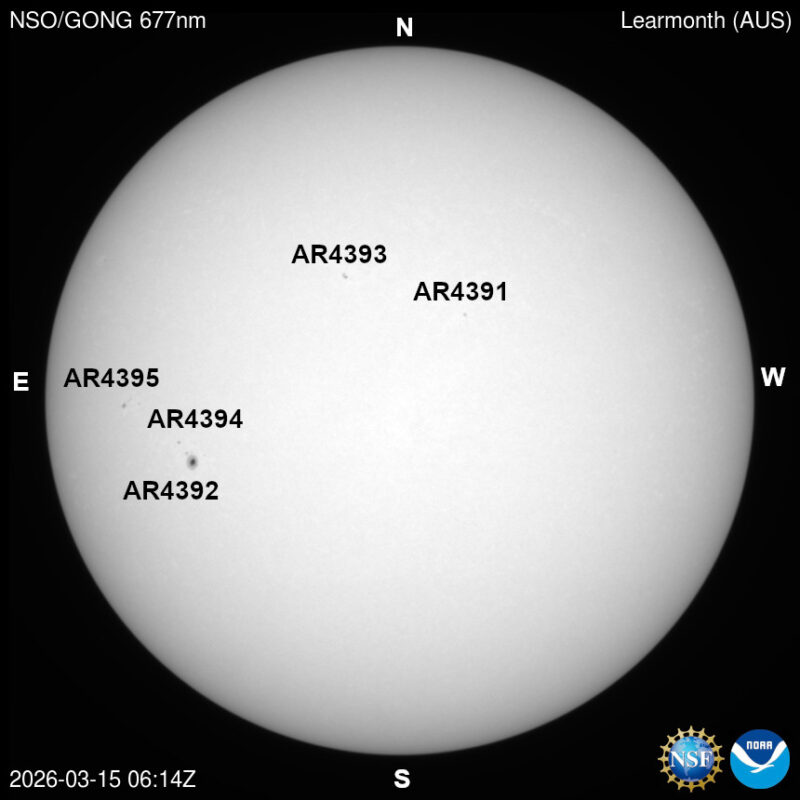
Sun news March 14: Auroras overnight! More possible tonight
Auroras lit up skies at northerly latitudes last night. The expected magnetic turbulence arrived and provoked a stronger geomagnetic storm than anticipated (G2 (moderate) instead of G1 (minor). Observers saw auroras as far south as the states of Nebraska and Wyoming in the U.S. As these conditions continue, more auroral displays are possible tonight. Auroras may be visible from Seattle, Minneapolis, Edinburgh, and northern England at times, with displays potentially reaching Toronto, Chicago, and Boston. At the time of this writing, the magnetic field remains disturbed at G1 (Kp = 5) levels. Did you see the auroras? Took photos? Get ready for more tonight and share with us!
Past 24 hours of sun news
(11 UTC March 13 – 11 UTC March 14)
Flare activity returned to low levels over the past day. The sun produced a total of 13 flares during our observation period: 12 C-class (common) and 1 B-class (weak).
- The strongest flare was C8.9 at 20:23 UTC on March 13. It came from active region AR4392 in the southeast quadrant.
- The lead flare producer was AR4384 in the northwest. It led the period with 10 flares in total: 9 C-class and 1 B-class.
Sunspot regions: The Earth-facing solar disk displayed 8 numbered active regions, though the overall picture remained one of magnetically simple, low-complexity groups.
Blasts from the sun? The huge coronal mass ejection (CME) we spotted yesterday from the sun’s southern hemisphere will pass below and ahead of Earth’s orbit, according to modeling and analysis. Available coronagraph imagery showed no other Earth-directed CMEs.
Past 24 hours in space weather
Solar wind: Solar wind speeds started near background levels, but a co-rotating interaction region (CIR) arrived after approximately 05:00 UTC on March 13, heralding the onset of a coronal hole high-speed stream. By 08:30 UTC on March 13, speeds began climbing sharply, reaching a peak near 700 km/s (moderately fast). Meanwhile, the total interplanetary magnetic field (IMF) strength surged to a peak during the CIR passage, then settled into moderate levels. The Bz component rotated southward around 07:15 UTC on March 13.
Earth’s magnetic field: Earth’s magnetic field was disturbed for three consecutive 3-hour synoptic periods last night – plus one additional period – at G1 storming levels. The large trans-equatorial coronal hole we’ve been tracking drove this activity by sending its fast solar wind toward Earth. This fast wind, combined with a co-rotating interaction region (CIR) on its journey toward Earth. Overall, Earth’s magnetic field ranged from quiet to G2 (moderate) geomagnetic storm levels over the past day.

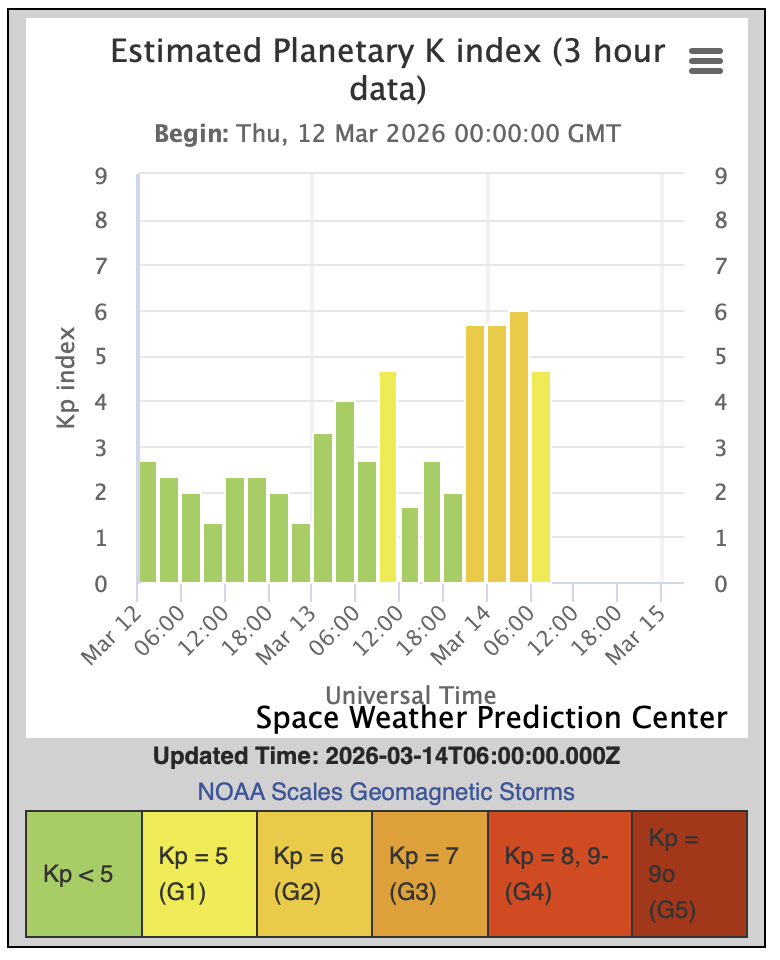
Sun news March 13: Coronal hole poised to stir auroras

The sun maintained a steady, but subdued, rhythm of flares over the past 24 hours. Solar activity is now considered moderate. But the big news is a large coronal hole crossing the sun’s central meridian. Its high-speed solar wind stream should arrive at Earth later today or early Saturday, potentially opening the door for G1 (minor) geomagnetic storms and keeping aurora watchers busy. Adding intrigue, a long solar filament lying across the south-central disk lifted off late in the past day. It launched a coronal mass ejection (CME) that might carry an Earth-directed component. Analysts are reviewing. Stay tuned!
Past 24 hours of sun news
(11 UTC March 12 – 11 UTC March 13)
Flare activity: Solar activity jumped to a moderate level with the production of an M flare. Flare production increased as well with 16 flares in total during the last 24 hours: 1 M-class, 14 C-class flares and one high B-class flare during the past.
- The strongest flare was the M1.2 at 9:55 UTC this morning (March 13). It came from active region AR4384, close to the northwest limb.
- The lead flare producer was an active region emerging in the northwest, as-yet-unnumbered. It led the list of flare producers with 8 C flares. AR4393 produced four flares, 3 C-class and 1 B-class events.
Sunspot regions: The Earth-facing solar disk displayed 6 numbered active regions, though the overall picture remained one of magnetically simple, low-complexity groups.
Blasts from the sun? Forecasters catalogued two coronal mass ejections (CMEs) during the past day. But neither should deliver a direct Earth impact. On the other hand, the CME hurled into space at 21:29 UTC on March 12 is under analysis and modeling to determine any component coming to us at Earth. If a component of this huge CME is found coming to us at Earth, combined with the fast solar wind from the above-noted trans-equatorial coronal hole, it might bring us auroral displays this weekend.
Past 24 hours in space weather
Solar wind: Background solar wind conditions prevailed throughout the past day. The interplanetary magnetic field (IMF) remained weak. The Bz component fluctuated between north and south directions, never sustaining a strong-enough southward orientation to trigger significant auroral activity. Conditions should shift as a coronal hole high-speed stream arrives, likely later today or early on March 14. It should bring stronger, faster solar wind and the potential for sustained southward Bz intervals that favor auroras.
Earth’s magnetic field: Earth’s magnetic field ranged from quiet-to-unsettled levels, with the Kp index reaching a maximum of approximately 3. Conditions did not breach any G-scale geomagnetic storm thresholds. The estimated Ap index for March 11 came in at 11, consistent with quiet-to-unsettled conditions. SIDC predictions place the Ap at 14 for March 13 and 12 for March 14, reflecting the expected uptick from the incoming coronal hole high-speed stream.
Sun news March 12: Quiet sun. Fast solar wind coming



Flare production on the sun stayed low over the past day, with only minor C-class bursts. Available coronagraph imagery showed no Earth-directed coronal mass ejections (CMEs), great burps of solar materials and magnetic fields that can bring auroral displays to us on Earth. But this calm on the sun might herald some earthly fun, because a large coronal hole is crossing the sun’s central meridian right now. And its fast wind should arrive around midday on March 13. That arrival could open the door for G1 (minor) geomagnetic storm conditions. Auroras could become visible from high-latitude locations such as Seattle, Minneapolis, Edinburgh, the Scottish Highlands, Reykjavik, and Hobart (Tasmania) during local nighttime hours.
Past 24 hours of sun news
(11 UTC March 11 – 11 UTC March 12)
Flare activity: Solar activity remained at low levels. The sun produced 8 flares: 2 C-class and 6 B-class.
- The strongest flare over the past day was a C3.2 from AR4392, peaking at 8:31 UTC on March 12.
- The lead flare producer in the past day was AR4381. It produced 5 of the 8 events (including one C-class and four B-class flares) despite approaching the sun’s western limb. AR4392 contributed the period’s strongest flare.
Sunspot regions: The Earth-facing solar disk displayed 7 numbered active regions, though the overall picture remained one of magnetically simple, low-complexity groups.
Blasts from the sun? Available coronagraph imagery showed no Earth-directed coronal mass ejections (CMEs) during the past day.
Past 24 hours in space weather
Solar wind: Solar wind conditions reflected the waning tail of a coronal hole high-speed stream. Speeds started elevated through 9:20 UTC on March 11, before gradually declining to a more ambient level for the remainder of the period. The interplanetary magnetic field (IMF) total strength held relatively steady at a weak-to-moderate level. The Bz component oscillated gently between north and south. It occasionally dipped southward, but never sustained a strong-enough southward orientation to drive significant geomagnetic activity.
Earth’s magnetic field: Earth’s magnetic field settled into mostly quiet conditions after briefly touching active levels (Kp 4) early on March 11. Over the past day, Earth’s magnetic field ranged from quiet-to-active levels. The Kp index reached 4 (active) during two 3-hour windows between 15–18 UTC on March 10 and 3-6 UTC on March 11. Then it settled back to quiet-to-unsettled levels (Kp 2–3) for the remainder of the reporting window.

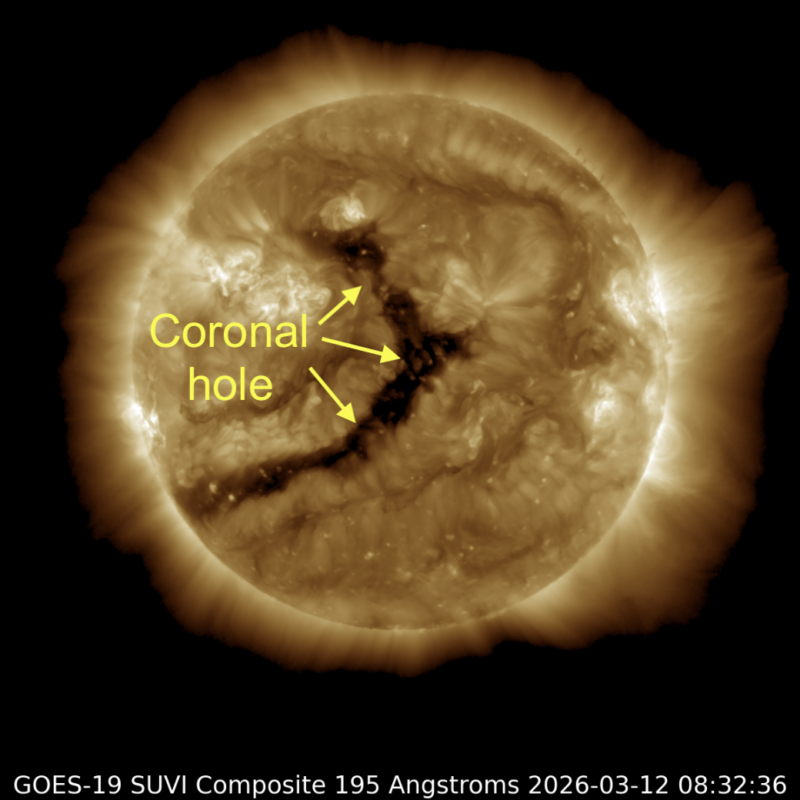
Sun news March 11: Watch a chunk of sun ejected into space
The image below shows a prominence detaching from the sun. Why does it detach? Solar prominences (aka filaments) are held in place by strong, loopy magnetic fields. They’re like invisible “rubber bands,” holding the plasma against the sun. When these magnetic loops become unstable or “snap” (a process called magnetic reconnection), the plasma isn’t anchored anymore. It’s hurled into space. Eruptive prominences often become the bright core of much-larger coronal mass ejections or CMEs. In studies by sun scientists, it’s been found that approximately 70% of all CMEs are associated with eruptive prominences.
Past 24 hours of sun news
(11 UTC March 10 – 11 UTC March 11)
Flare activity: Solar activity is low with only C-class (common) and B-class (weak) flares. Over the past day, the sun produced a total of 6 flares: 5 Cs and 1 B flares.
- The strongest flare was a C4.7 from AR4381 at 18:45 UTC on March 10.
- The lead flare producer was AR4381. It produced 4 events including the period’s strongest. Meanwhile, AR4389 contributed 3 flares and continues to show activity as it rotates into a more geoeffective position.
Sunspot regions: The Earth-facing solar disk displayed 5 numbered active regions, all with relatively simple magnetic configurations.
Blasts from the sun? Multiple coronal mass ejections (CMEs) were observed in the past 48 hours, but none appear to be headed directly toward Earth.
Past 24 hours in space weather
Solar wind: Something nudged Earth’s magnetic field over the past day. And so solar wind speeds climbed and the total interplanetary magnetic field (IMF) jumped, signs of a weak transient influence rippling past our planet. The Bz component swung between north and south directions, and during those southward dips the Kp index climbed to 3.67, pushing conditions to active levels for a few three-hour windows. It wasn’t enough to excite geomagnetic storms. But the unsettled field was a reminder that even a quiet sun can surprise.
Earth’s magnetic field: Earth’s magnetic field ranged from quiet to active levels. The Kp index reached 3.67 (unsettled to active) during the March 10 15:00–18:00 UTC and March 11 03:00–06:00 UTC windows, with most readings in the Kp 2–3 range. No G1/G2/G3/G4/G5 geomagnetic storm thresholds were reached.


Sun news March 10: Large new coronal hole! Waiting on the solar wind
A new coronal hole is rotating into a geoeffective position so that its high-speed solar wind could soon buffet Earth. Meanwhile, near-Earth space remained under the fading influence of another coronal hole high-speed stream. And, at present, the solar wind has eased as the interplanetary magnetic field stayed weak and changeable. That kept geomagnetic conditions mostly quiet to unsettled, with only brief, low-level conditions for auroras at high latitudes. At the same time, forecasters are continuing to watch for any subtle, glancing influence from the March 6 coronal mass ejection (CME), with model guidance placing the most likely arrival window early today (March 10).
Past 24 hours of sun news
(11 UTC March 9 – 11 UTC March 10)
Flare activity: Solar activity is low with only C-class (common) and B-class (weak) flares. Over the past day, the sun produced a total of 9 flares: 7 Cs and 2 B flares.
- Strongest flare was a C7.9 from AR4387 at 20:21 UTC on March 9.
- Lead flare producer: AR4387 produced multiple flares, including the period’s peak C7.9, remaining the primary driver of X-ray (strong) activity.
Sunspot regions: The Earth-facing solar disk displayed 7 numbered active regions, with additional new activity rotating onto the northeast limb (classification pending due to foreshortening).
Blasts from the sun? No new Earth-directed coronal mass ejection was observed leaving the sun during the past day.
Past 24 hours in space weather
Solar wind speeds decreased as coronal hole fast solar wind influence waned. The interplanetary magnetic field stayed weak. The Bz component fluctuated between northward and southward directions; brief southward turns can “open the door” for energy transfer into near-Earth space, increasing chances for auroras.
Earth’s magnetic field: Earth’s magnetic field ranged from quiet-to-unsettled levels, with Kp generally in the 1–3 range.
Sun news March 9: A new large coronal hole emerges from the east


A new large coronal hole has emerged from the eastern horizon. As it moves into a geoeffective position in the next days, the fast solar wind it produces will be sent our way at Earth, disturbing our magnetic field and potentially triggering auroras at high latitudes. Meanwhile, the large coronal hole that caused auroras over the weekend is now moving closer to the northwestern solar horizon, soon to be carried out of sight by the sun’s rotation.
Past 24 hours of sun news
(11 UTC March 8 – 11 UTC March 9)
Flare activity: Solar activity is low with only C-class (common) and B-class (weak) flares. Over the past day, the sun produced a total of 8 flares: 7 Cs and 1 B flares.
- Strongest flare was a C2.5 produced at 15:07 UTC on March 8. The flare came from sunspot region AR4387 in the northeast.
- Lead flare producer: AR4387 and AR4381 both blasted out 4 flares each.
Sunspot regions: The side of the sun we see from Earth now shows 5 numbered active regions. One is a newcomer coming in from the east, now numbered AR4387. All sunspot regions show either an alpha or beta configuration, meaning a low potential for flares.
Blasts from the sun? Experts didn’t observe any Earth-bound coronal mass ejections (CMEs) in available coronagraph imagery during the past 24 hours.
Past 24 hours in space weather
Solar wind: Solar wind speeds kept at moderate levels during the past day, associated with a Kp = 4 disturbance. The interplanetary magnetic field (IMF) kept at moderate levels. The Bz component was shifting from northward to southward during the period. The strongest peaks were southward, which is favorable for auroras.
Earth’s magnetic field: Earth’s magnetic field ranged from quiet to active levels during the past day (Kp = 1-4). The Kp index is slightly above 1 at the time of this writing.

Sun news March 8: Gorgeous auroras last night. More tonight?
Fast solar wind from a large coronal hole has been pumping up Earth’s magnetic field. And so we’ve had auroras at high latitudes. Last night, an anticipated G1 (minor) geomagnetic storm arrived and brought gorgeous auroral displays that lasted for almost four hours (with Kp = 4 – 5 geomagnetic activity). And more G1 storming levels are expected. Conditions for auroras at high latitudes might extend through this weekend. Aurora chasers, cameras ready!
Past 24 hours of sun news
(11 UTC March 7 – 11 UTC March 8)
Flare activity: Solar activity keeps low with only C-class (common) and B-class (weak) flares. Over the past day the sun produced a total of 5 flares: 2 C flares and 3 B flares.
- Strongest flare was a C1.2 produced at 4:43 UTC on March 8. The flare was produced in the northeast quadrant by an incoming region that has not been numbered yet.
- Lead flare producer was this incoming region (not yet numbered). It produced three flares; the 2 Cs of the period plus one of the B flares.
Sunspot regions: Currently, the side of the sun we see from Earth shows 4 numbered active regions. But there are sunspots regions coming from the east. They have not been assigned numbers, but already can be seen flaring, almost from the sun’s far side in the east. All sunspot regions show either an alpha or beta configurations, indicating a low potential for flares.
Blasts from the sun? Experts didn’t observe any earthbound coronal mass ejections (CMEs) in available coronagraph imagery during the last 24 hours.
Past 24 hours in space weather
Solar wind: Solar wind speeds increased to moderate levels, associated with a Kp = 5 disturbance. The interplanetary magnetic field (IMF) kept at moderate-high levels during the period. The Bz component intermittently was shifting from north to southward during most of the period. The strongest peaks and more frequent were southward, favorable for auroras. At the time of this writing the Bz component is south-oriented.
Earth’s magnetic field: Earth’s magnetic field reached quiet-to-active levels during the past day (Kp = 1 – 5). It seems the anticipated G1 (minor) geomagnetic storm arrived last night. Kp = 5 threshold reached at 2:42 UTC on March 8. The Kp index shows at level 4 at the time of this writing.

Sun news March 7: The sun snoozing this weekend, so far
The sun is taking a break this weekend, so far, with only one faint flares, two C-class (common) and one B-class (weak) flares. But it still looks fiery in its corona, or outer atmosphere, as we can see by the image below. Meanwhile, at Earth, the fast solar wind sent in our direction by a large coronal hole might pump Earth’s magnetic field up to active levels. Last night, the anticipated G1 (minor) geomagnetic storm arrived in the form of a Kp = 4 enhancement that lasted for one three-hour synoptic period. These conditions might be extended through this weekend as fast solar wind is streaming our way. Aurora chasers, stay on the hunt!
Past 24 hours of sun news
(11 UTC March 6 – 11 UTC March 7)
Flare activity: Solar activity was low over the last past day. The sun produced only 3 flares: 2 C-class (common) and 1 B-class (weak).
- Strongest flare was a C1.2 sparked at 13:42 UTC on March 6. An incoming region in the sun’s northeast – -yet-unnumbered – produced it.
- Lead flare producer over the past day was tied: sunspot region AR4378 and this incoming region. They produced one flare each.
Sunspot regions: The Earth-facing side of our star currently shows 5 numbered active regions. All sunspot regions show a beta configuration, indicating a low potential for flares. AR4386 exhibited a slight development.
Blasts from the sun? Experts observed a coronal mass ejection (CME) at 4:28 UTC on March 6. The CME is associated with a filament eruption. Modeling and analysis show a component heading our way at Earth, possibly to provide a glancing blow around March 10.
Past 24 hours in space weather
Solar wind: Solar wind speeds continued at low levels during the first half of this period to increase to low-moderate levels early this morning, associated with a Kp = 4 disturbance. The interplanetary magnetic field (IMF) increased to moderate-high early this morning. The Bz component was southward during most of the period. Some peaks shifted northward, in particular early this morning, but the strongest peaks were southward. At the end of the period it was southward. A southward Bz is more favorable for auroras.
Earth’s magnetic field: Earth’s magnetic field reached quiet-to-active levels during the past day (Kp = 1 – 4). The anticipated G1 (minor) geomagnetic storm arrived in the form of a Kp = 4 only. Kp4 threshold reached at 2:06 UTC on March 7 and stayed there for one three-hour synoptic period. The Kp index shows at level 3 at the time of this writing.

Sun news March 6: Auroral displays possible tonight
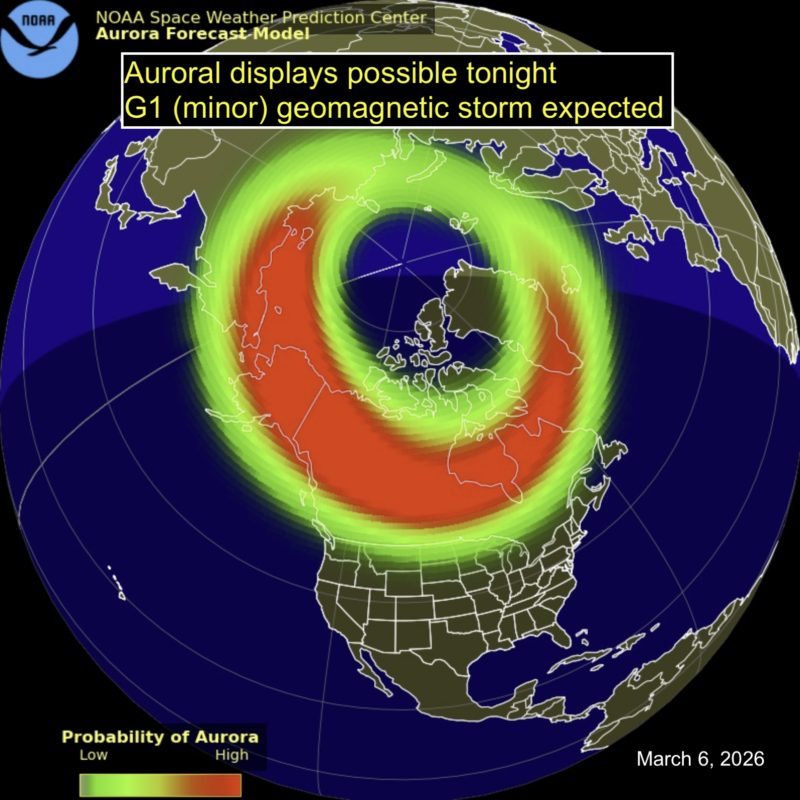
Auroral displays are possible tonight! The large coronal hole – a cooler, less dense region in the sun’s outer atmosphere – that we reported yesterday is sending its fast solar wind in our direction. Early arrival tonight might bring conditions for auroras at northerly latitudes, such as the U.S. states of Maine and Wisconsin. A portion of the large coronal hole now located at a geoeffective position; that is, it’s located on the Earth-facing sun in such a way that its fast solar wind is streaming our way. These conditions may be extended through this weekend. Clear skies and good luck, aurora chasers!
Past 24 hours of sun news
(11 UTC March 5 – 11 UTC March 6)
Flare activity: Solar activity continued low during the last 24 hours with 7 flares produced: 4 C-class (common) and 3 B-class (weak).
- Strongest flare was a C2.0 at 22:42 UTC on March 5 blasted out by active region AR4381 in the northeast.
- Lead flare producer: Sunspot region AR4381 topped the list as flare producer with 5 flares: 4 C flare and 1 B flare.
Sunspot regions: The Earth-facing side of our star currently shows 5 numbered active regions. There is a newcomer – now labeled AR4385 – in the southeast. All sunspot regions show a beta configuration.
Blasts from the sun? The sun didn’t produce any Earth-directed coronal mass ejections (CMEs) during the past day.
Past 24 hours in space weather
Solar wind: Solar wind speeds continued at low levels while the interplanetary magnetic field (IMF) turned moderate late yesterday to return to weak levels early today. The Bz component showed northward during most of the period. At the end of the period it was northward. A southward Bz is more favorable for auroras.
Earth’s magnetic field: Earth’s magnetic field ranged from quiet to unsettled during the past day (Kp = 0 – 3). The Kp index is slightly below level 2 at the time of this writing.
Sun news March 5: Large coronal hole sending solar wind our way
A large coronal hole – a cooler, less dense region in the sun’s outer atmosphere – has emerged from the northeast of our star. A portion of it is now located at a geoeffective position, meaning that the fast solar wind streaming from it is heading toward Earth. Solar wind streams are one of the key drivers of space weather and auroras on Earth, so experts are monitoring closely to see if a light show could be on the way.
Past 24 hours of sun news
(11 UTC March 4 – 11 UTC March 5)
Flare activity: Solar activity was low over the past day. The sun only produced 4 flares: 2 C-class (common) and 2 B-class (weak).
- Strongest flare was a C1.9 from active region AR4383 in the northwest. The event occurred at 7:12 UTC on March 5.
- Lead flare producer: Sunspot region AR4378 became the lead flare producer with 2 flares: 1 C flare and 1 B flare.
Sunspot regions: Today, the Earth-facing solar disk shows 5 numbered active regions. AR4378 is the largest.
Blasts from the sun? The sun did not produce any Earth-directed coronal mass ejections (CMEs) during the past day.
Past 24 hours in space weather
Solar wind: Solar wind speeds decreased to low levels. The interplanetary magnetic field (IMF) has been weak. The Bz component kept intermittently shifting from north to south. The strongest peaks were northward. A southward Bz is more favorable for auroras.
Earth’s magnetic field: Earth’s magnetic field kept quiet over the past day. The Kp index is slightly below level 2 at the time of this writing.
Sun news March 4: Sunspot number drops to new low


After the sun went 3 days without a single visible sunspot last month, we’ve been eager to find out February’s sunspot number, which measures long-term solar activity. And, sure enough, NOAA announced today that February’s sunspot number was the lowest we’ve seen since Solar Cycle 25’s peak in August 2024. The value was 78.1, just a hair lower than May 2025’s 78.5, and far below August 2024’s value of 216. Still, specialists haven’t said that solar maximum is over just yet. So stay tuned!
Past 24 hours of sun news
(11 UTC March 3 – 11 UTC March 4)
Flare activity: Solar activity remained low over the past day, with the sun producing a total of 13 flares: 12 C-class (common) and 1 B-class (weak).
- Strongest flare was a C4.1 from active region AR4384 in the northeast, sparked at 3:01 UTC on March 4.
- Lead flare producer: The newcomer sunspot region AR4384 remains the lead producer, this time with 9 flares in total: 8 C flares and 1 B flare.
Sunspot regions: 4 numbered active regions currently populate the Earth-facing solar disk.
Blasts from the sun? We observed no Earth-directed coronal mass ejections (CMEs) in available coronagraph imagery during the past day.
Past 24 hours in space weather
Solar wind: Solar wind speeds continued from low to low-moderate levels during this period. The interplanetary magnetic field (IMF) decreased to weak levels. Meanwhile, the Bz component kept shifting from northward to southward, with similar strength in both orientations. A southward Bz is more favorable for auroras.
Earth’s magnetic field: Earth’s magnetic field ranged from quiet to active over the past day. A G1 (minor) geomagnetic storm was observed, starting at 22:48 UTC on March 3. The Kp index has returned to a level 2 at the time of this writing.
Sun news March 3: Spectacular prominences in the north

Fiery activity continues to the north of the solar disk. The huge filament eruption in the northeast we reported on yesterday morning has now come to a spectacular end, releasing a huge amount of plasma into space. As this prominence was far to the north, initial analysis suggests the ejected sun-stuff is not heading our way. After this blast, the sun produced a similar eruption in the northwest at around 21 UTC. Take a look at the second eruption below.
Past 24 hours of sun news
(11 UTC March 2 – 11 UTC March 3)
Flare activity: Solar activity remains at low levels, with 8 C-class (common) flares over the past day.
- Strongest flare was a C3.0 from active region AR4381 in the northeast, blasted out at 0:30 UTC on March 3.
- Lead flare producer: The newcomer sunspot region AR4384 remains the lead producer, this time with 4 C flares.
Sunspot regions: Today the Earth-viewed side of the solar disk shows 5 numbered active regions, all with beta magnetic configurations.
Blasts from the sun? We observed no Earth-directed coronal mass ejections (CMEs) in available coronagraph imagery during the past day.
Past 24 hours in space weather
Solar wind: Solar wind speeds increased from low to low-moderate levels during the period. The interplanetary magnetic field (IMF) also increased from weak to moderate. Meanwhile, the Bz component shifted from northward to southward, with strong peaks in both directions this morning. A southward Bz is more favorable for auroras.
Earth’s magnetic field: Earth’s magnetic field kept quiet during the period, remaining at Kp = 1 or 2. The Kp index shows a level 2 at the time of this writing.
Sun news March 2: Huge prominence near the solar north pole
This morning, a lifting filament in the northeast finally erupted in a huge, fiery prominence. This rope of solar material started to show instability around 15 UTC yesterday. The eruption has been slow, lasting hours to finally peak at 9 UTC this morning. Most of the sun-stuff formed an arc and returned back to the sun, but at the time of this writing (11 UTC) the eruption is still going. When it’s fully over, we’ll be able to establish whether or not any of the sun-stuff was ejected into space.
Past 24 hours of sun news
(11 UTC March 1 – 11 UTC March 2)
Flare activity: Solar activity continued at low levels with only C-class (common) flares over the past 24 hours. Flare production increased, though, with a total 18 C flares unleashed during the period.
- Strongest flare was a C4.5 from active region AR4384 in the northeast, produced at 4:38 UTC on March 2.
- Lead flare producer was the newcomer sunspot region AR4384 with 10 C flares. It was followed by AR4381, which produced 8 C flares. No other active regions fired any flares.
Sunspot regions: Currently our sun shows 6 numbered active regions on its Earth-facing side. Three of these are freshly numbered newcomers. All these active regions have beta magnetic configurations.
Blasts from the sun? No Earth-directed coronal mass ejections (CMEs) observed in available coronagraph imagery during the past day.
Past 24 hours in space weather
Solar wind: Solar wind speeds decreased to low levels. The interplanetary magnetic field (IMF) remained weak. Meanwhile, the Bz component was oriented southward late yesterday, but has had strong northward peaks this morning. A southward Bz is more favorable for auroras.
Earth’s magnetic field: Earth’s magnetic field kept quiet during the period, remaining at Kp = 1 or 2. The coronal mass ejection (CME) hurled by the sun on February 25 didn’t arrive as expected, or at least didn’t produce any significant turbulence.



Sun news March 1: Solar southeast replies with a strong jet
Yesterday, we reported a fiery prominence that blasted out from beyond the sun’s southeast limb, or edge. Over the past day, we saw a strong jet almost mirroring this activity, in the sun’s southwest. Keep it coming, sun king! Plus … today our star increased its flare production, with 17 total flares. But, alas, all were C flares.
Past 24 hours of sun news
(11 UTC February 28 – 11 UTC March 1)
Flare activity: Solar activity is still low. But we saw more flares over the past day than the day before, 17 flares in contrast to 12. All flares in the past day were C-class (common) flares.
- Strongest flare was a C6.1 from AR4380 active region in the southeast, produced at 2:06 UTC on February 28.
- Lead flare producer was sunspot region AR4381 and an as-yet-unnumbered newcomer in the northeast. Each produced 5 C flares. AR4380 in the northeast followed, with 4 C flares.
Sunspot regions: Today the Earth-facing side of our sun shows 3 numbered active regions as AR4379 decayed to plage. But there is a newcomer on the northeast as-yet-unnumbered. AR4380 lost its gamma configuration and today all numbered active region on the Earth-viewed solar disk show a beta magnetic classification.
Blasts from the sun? Available coronagraph imagery showed no Earth-directed coronal mass ejections (CMEs) during the past day.
Past 24 hours in space weather
Solar wind: Solar wind speeds at moderate-low levels for most of the period. The interplanetary magnetic field (IMF) continued weak. Meanwhile, the Bz component was mostly southward oriented, but we saw some peaks northward in particular early this morning. The Bz component ended this period around 11 UTC today a strong peak south oriented, which favors for auroras.
Earth’s magnetic field: Earth’s magnetic field was quiet to unsettled levels, Kp = 1 – 3. The Kp index sits slightly above level 2 at the time of this writing.
What’s ahead? Sun–Earth forecast
Flare activity forecast: Specialists anticipate the chances for M-class (moderate) flares to continue at 25% and the same as for chances of an X-class flare to occur at 5%. Active regions AR4380 and AR4378 still are the main drivers of these predictions, but AR4380 is the largest in extension.
Geomagnetic activity forecast:
- March 1 – 2, expect active levels of geomagnetic disturbance due to the arrival of the coronal mass ejection (CME) that the sun hurled on February 25. Earth’s magnetic field might reach storming levels with slight chances of a G1 (minor) geomagnetic storm.
- March 2, a return to quiet-to-unsettled levels might occur as effects of a CME wane and conditions are ruled by fast solar wind from a coronal hole.
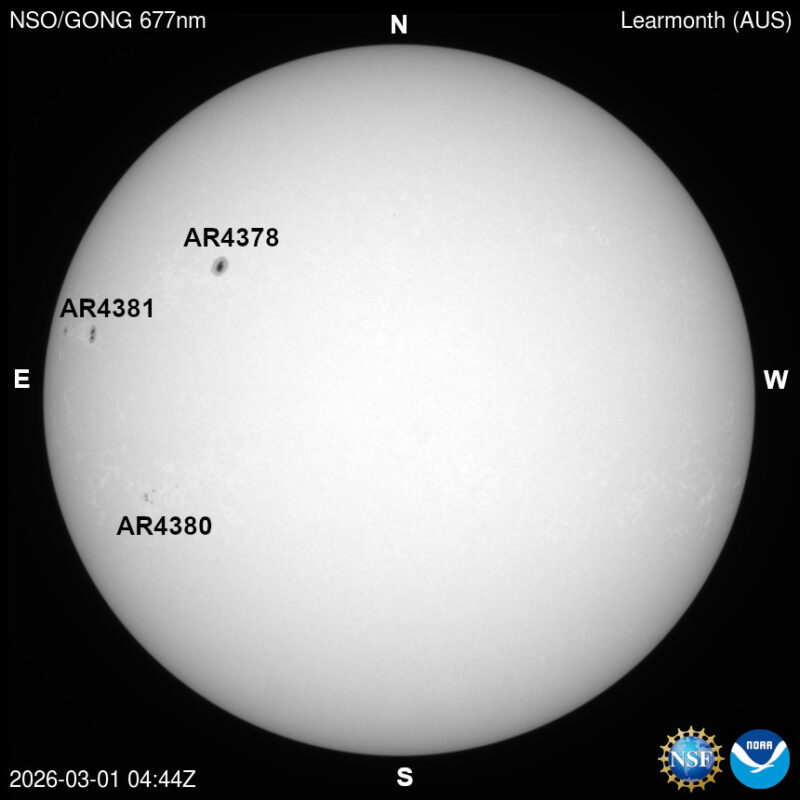
Like what you read?
Subscribe and receive daily news delivered to your inbox.
More from
C. Alex Young


Sun news: Sun blast sweeps Earth, sparking auroras

Sun activity archive for July 2026
Sun activity archive for June 2026
Sun activity archive for May 2026