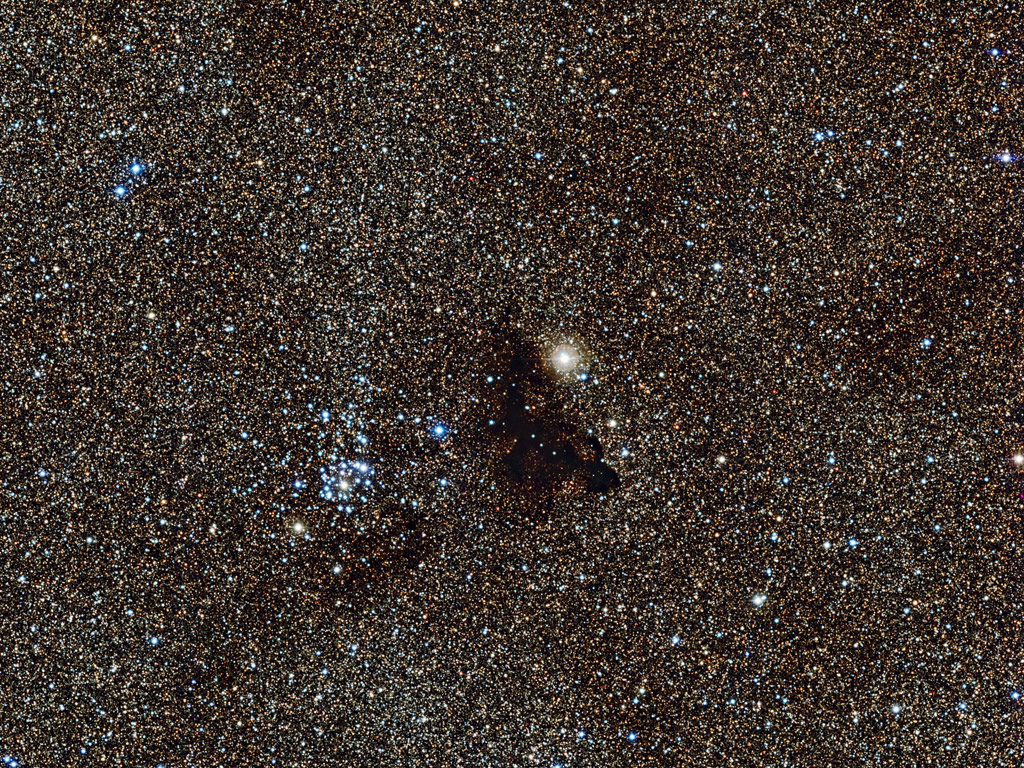
The European Southern Observatory (ESO) released an awesome photo and video today (February 13, 2013) of the Large Sagittarius Star Cloud, which is located toward the center of our Milky Way galaxy. You can see the Sagittarius Star Cloud with your eye alone on a dark night in northern summer. The ESO video starts with a view of the spectacular Milky Way, our home galaxy in space. As we zoom in towards the center we see the star cloud …
In the midst of this cloud, there are many smaller features. One is the bright star cluster NGC 6520 and a much smaller dark feature called Barnard 86 – a place where new stars are forming. See them in the video, and also in the photo below.
The bright cluster is NGC 6520 and the dark area next to it is called Barnard 86. Both are located in the midst of the Large Sagittarius Star Cloud, in the direction toward the center of our Milky Way galaxy. View larger.
Bottom line: ESO video of the Large Sagittarius Star Cloud shows star clusters and star-forming regions in space.
Chris Comfort, Technology Manager, oversees EarthSky's systems and infrastructure, and the development and maintenance of EarthSky.org. He loves working with a company dedicated to nature and science. His favorite thing about EarthSky? The wonderful images of nature coming in from EarthSky's global photographic community.
Deborah Byrd (asteroid 3505 Byrd) helps edit EarthSky.org and is a frequent host of EarthSky videos. Deborah created the EarthSky radio series in 1991 and founded EarthSky.org in 1994. Prior to that, she had worked for the University of Texas McDonald Observatory since 1976, and created and produced their Star Date radio series. She has won a galaxy of awards from the broadcasting and science communities, including having an asteroid named in her honor in 1990, a Public Service Award from the National Science Board in 2003, and the Education Prize from the American Astronomical Society in 2020. A science communicator and educator since 1976, Byrd believes in science as a force for good in the world and a vital tool for the 21st century. "Being an EarthSky editor is like hosting a big global party for cool nature-lovers," she says.
Like what you read? Subscribe and receive daily news delivered to your inbox.
Thank you! Your submission has been received!
Oops! Something went wrong while submitting the form.