



- Searching for evidence of life on planets around other stars is difficult. A single detection of a certain chemical in an atmosphere or an unusual radio wave could signal life. But that result might be ambiguous and hard to verify.
- Scientists could instead look for patterns across groups of planets in distant solar systems, researchers in Japan suggest.
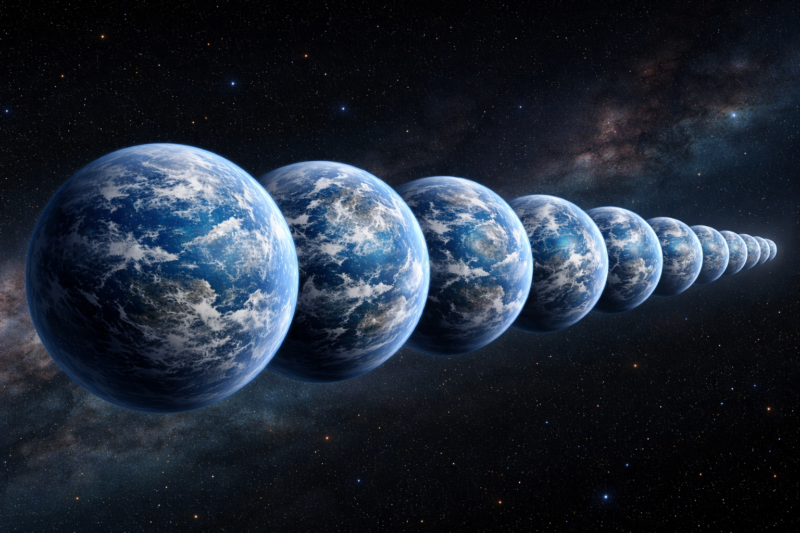
- Similar patterns on multiple planets might suggest that life has spread from one planet to its neighbors. Perhaps life itself has transformed conditions on the new planet, to make it more amenable. So similar patterns across groups of planets could be an alien life sign.
Suspiciously similar planets could be a sign of alien life
Scientists searching for life beyond Earth might listen for non-natural radio signals coming from space. Or they might focus on looking at starlight bounced from a distant planet, to try to learn the makeup of the planet’s atmosphere. Or – as described on April 15, 2026 by researchers in Japan – they might look for signs of life in groups of planets that are suspiciously similar.
The scientists said that similar patterns across a group of planets might suggest that life has spread from its home planet to neighboring planets. And life itself might have transformed the new worlds to accommodate its needs.
The current methods of looking for life through biosignatures (chemical or physical signs of life) or technosignatures (signs of alien technology) can be ambiguous. So a signature found among a cluster of planets would be stronger evidence than a single detection on one planet alone, these scientists say.
The new model suggests that if life can spread between planets and affect their observable properties, then detecting this could be a robust signature of life, with few false positives.
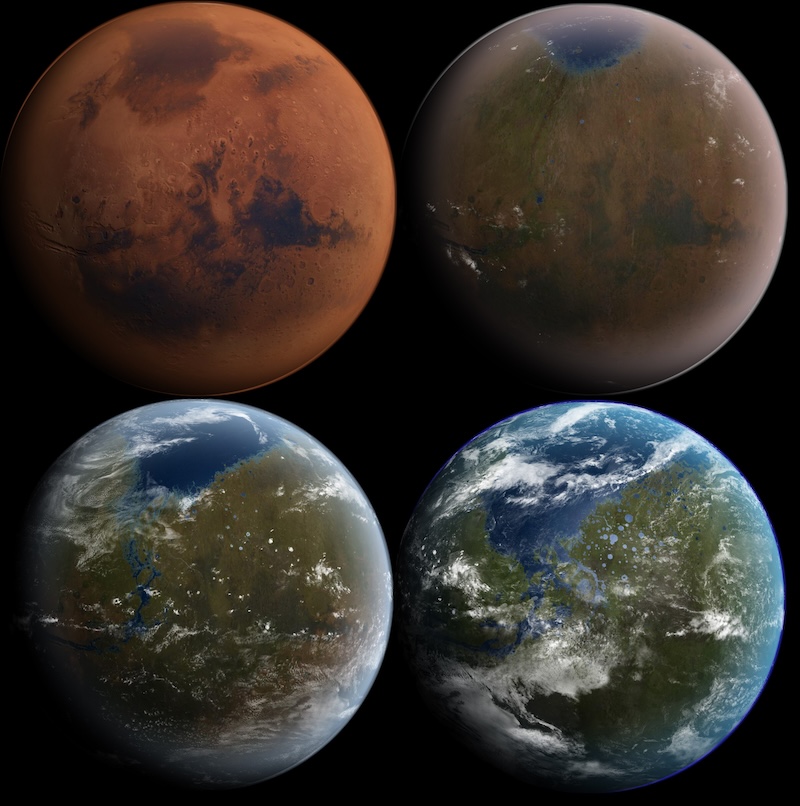
Astronomers use the word panspermia when speaking of life spreading between worlds. And the concept of altering a planet to suit an alien lifeform is called terraforming. Microbes that traveled via panspermia to another planet could alter the planet’s atmosphere or surface naturally. And an advanced alien civilization could terraform nearby planets artificially. Even humans have contemplated how we could someday terraform Mars to make it more habitable and earthlike.
Harrison B. Smith at the Earth-Life Science Institute, Institute of Science Tokyo, and Lana Sinapayen at Sony Computer Science Laboratories and National Institute for Basic Biology in Japan are the authors of the new study. They published their peer-reviewed findings in The Astrophysical Journal on April 9, 2026.
Our paper on detecting terraformed planets is finally published: doi.org/10.3847/1538…Context: we wanted a method to detect life in the universe that does not depend on any particular chemistry or hyperspecific definitions of life1/n#Astrobiology #ALife
— Lana Sinapayen (@sinalana.eurosky.social) 2026-04-10T01:21:28.458Z
An agnostic approach
The researchers are taking what they call an agnostic approach. That’s what they consider one not bound to any particular hypotheses or beliefs about alien life. So this approach seeks to overcome the limitations of of possible detections on single planets. Simple biosignatures are susceptible to false positives. Technosignatures are less susceptible, but they make strong assumptions about what kind of life could produce them.
Instead, the new approach seeks to find possible life signatures across multiple planets at a time. The signature could affect the observable properties of the planets in a similar way. Notably, this would be a stronger potential signature than on one single planet alone.
Basically, the approach is based on the assumption that life could spread between planets naturally. This is panspermia, where microbes or other cells could escape one planet – such as through an asteroid impact – and spread to other nearby planets.
In either of those two scenarios, life could alter the characteristics of the planets in similar ways. The statistical correlations between planet locations and their observable traits would be detectable.
A broad definition of life
Sinapayen described the process on Bluesky, saying:
We wanted a method to detect life in the universe that does not depend on any particular chemistry or hyperspecific definitions of life. So we started with the broadest definition we could think of: Life self-replicates and mutates.
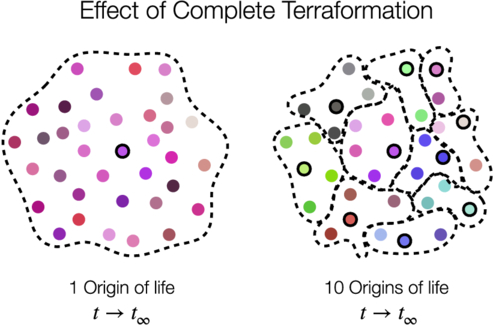
If a form of life landed upon a new planet and survived, it would change the environment on that planet in a way that makes it closer to the origin planet; think of trees producing oxygen, for example. That would be true whether the lifeform is a bacteria, a whole ecosystem, or characters from Andy Weir’s books.
Our question: Without knowing whether any single planet has life on it, could you at least detect that some planets seem suspiciously related? The answer (through simulations): under some conditions, you can make that detection with high certainty and no false positives. You can say ‘there is an X percent chance terraformation is happening’ and point to the planets that are driving that percentage up.
‘Something must be happening’
Sinapayen continued:
The best part is that it’s not just ‘oh, these planets look similar, something must be happening.’ Our method specifically picks out planets that seem to have an ‘ancestor to descendant’ relationship through ‘self replication with mutation.’ Because when life replicates with mutation in physical space, on average the parents and children will be closer both in space and in characteristics than the parents and the grandchildren, for example. So you’re looking for a correlation of location and characteristics, not just characteristics.


Planets most likely to host life
The researchers also developed a new method to determine which planets might be the most likely to be habitable or host life. They did so by clustering planets based on their observable characteristics and spatial relationships. This provided clues as to which groups of planets had a high probability of being influenced by life. Smith said:
By focusing on how life spreads and interacts with environments, we can search for it without needing a perfect definition or a single definitive signal.
Sinapayen added:
Even if life elsewhere is fundamentally different from life on Earth, its large-scale effects, such as spreading and modifying planets, may still leave detectable traces. That’s what makes this approach compelling.
Bottom line: A new study from Japan suggests we could search for a sign of alien life by looking for a group of planets that are suspiciously similar. Alien life that spreads to neighboring planets would likely transform each new planet to be like their home planet.
Source: An Agnostic Biosignature Based on Modeling Panspermia and Terraforming
Via Earth-Life Science Institute
Read more: Lifeforms can planet-hop on asteroids and survive
Like what you read?
Subscribe and receive daily news delivered to your inbox.
More from
Paul Scott Anderson


Caves on the moon are target of new NASA mission

2nd-generation planet: Was this world born around a dead star?
Weirdest cloud on Mars formed via ‘exotic physics’
Did formaldehyde on ancient Mars help kickstart life?



