



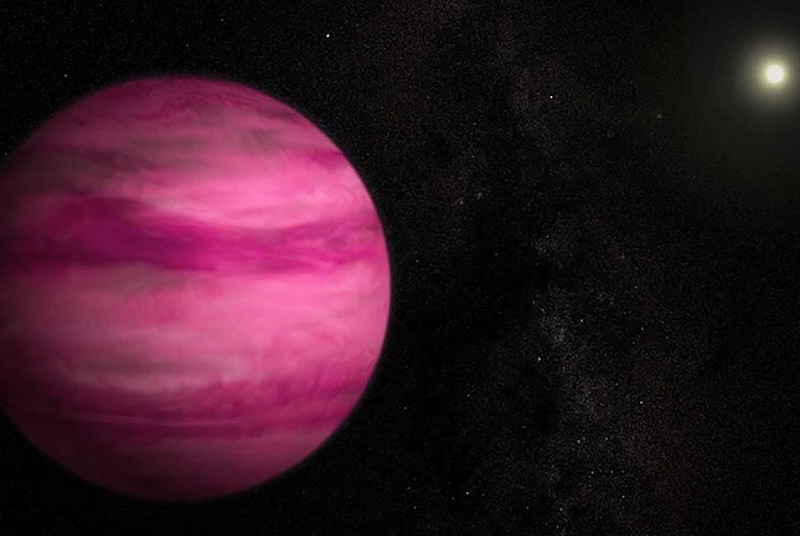
- GJ504b is a gas giant exoplanet about 57 light-years from Earth. It’s called the Pink Planet due to its rosy color.
- The Pink Planet’s exotic atmosphere has clouds composed of salt, new Webb space telescope observations have revealed.
- The Pink Planet lies near the boundary between planets and brown dwarfs. Scientists still aren’t sure how it formed.
The Pink Planet with salty clouds
GJ504b is a gas giant planet orbiting a sun-like star about 57 light-years from Earth. It is huge, 25 times the mass of Jupiter. And it has a rosy color, leading astronomers to nickname it the Pink Planet.
The Pink Planet has been difficult for astronomers to study. It’s cold and dim, meaning it appears as just a very faint dot in most telescopes. But now, the James Webb Space Telescope has taken a closer look and found something surprising.
A team of researchers said on June 18, 2026, that salty clouds wrap around this world. Scientists had theorized that salty clouds could exist in the atmospheres of cold planets like this one. But this is some of the first direct evidence.
Cold planets like GJ504b are too dim to study with ground-based telescopes. So these new observations are an important step in being able to find out more about them.
The researchers published their peer-reviewed results in The Astronomical Journal on June 18, 2026.
Is the Pink Planet really a planet?
Astronomers first discovered the Pink Planet back in 2013. But is it really a planet? At 25 times the mass of Jupiter, it’s so massive that it comes close to the dividing line between planets and brown dwarfs. Brown dwarfs are typically larger than planets, but smaller than stars. They are called “failed stars” because they don’t have quite enough nuclear energy inside to ignite into actual stars.
Because of this, astronomers technically refer to the Pink Planet as a “planetary-mass companion.”
The Pink Planet is a cold world
The planet is dim due to its distance from Earth and its temperature. Hot planets, like hot Jupiters, are easier to directly image. And so far, most directly imaged exoplanets have been about 1,000 to 2,000 degrees Fahrenheit (540 to 1,100 degrees Celsius). But the Pink Planet is much cooler, only about 550 degrees Fahrenheit (290 degrees Celsius). That’s still hot by human standards, of course, but a lot cooler than the other hot planets.
In fact, the Pink Planet is the coldest exoplanet ever found so far by ground-based telescopes. Lead author Aneesh Baburaj at Northwestern University in Evanston, Illinois, said:
The Pink Planet is the coldest companion ever discovered using ground-based instruments. Many teams all around the world performed follow-up observations to study its light, but it was too faint for ground-based instruments. That made it a perfect target for JWST. When we finally obtained its spectrum, it immediately looked interesting. But once we started digging deeper into the data, we realized it was not like anything we have analyzed before.
Why is the Pink Planet so relatively cold? Scientists say it’s its age. Hot giant planets like this are born scorching hot. But they cool down as they get older. And scientists estimate that the Pink Planet is between 2.5 billion and 4 billion years old. Plenty of time to cool down.
How do you reveal a world so faint?
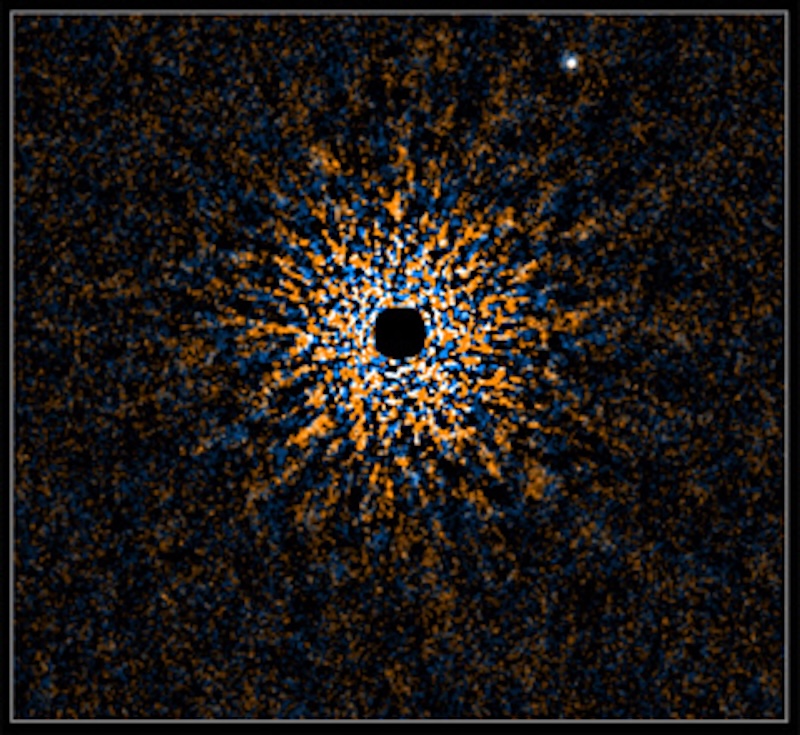
So studying the Pink Planet with ground-based telescopes is not an easy task. But that’s where the James Webb Space Telescope comes in. It is much better at gathering the faint light from the planet. The glare from its nearby star still gets in the way though. So the researchers used advanced data-processing techniques to remove much of that glare.
By doing so, scientists could finally see the spectrum of the planet’s atmosphere. That’s where light is broken down into its individual component colors. Each color indicates a different element in the atmosphere. The results were way better than any previous attempts to analyze the Pink Planet’s atmosphere. Baburaj said:
In the past, other astronomers observed the companion for an entire night with some of the biggest telescopes in the world to obtain a spectrum. And they could not see the object. With JWST, our entire observation took around two hours, and we were successful.

Discovering the Pink Planet’s salty clouds
When they analyzed the atmosphere of the Pink Planet, the researchers found something unexpected. It has clouds composed of salt. The first results showed evidence for water vapor, methane, carbon dioxide, ammonia and other molecules. But that didn’t fully match the atmosphere that the computer simulations came up with. The simulations matched the observations only when there were other “physically implausible features” in the atmosphere. Why?
The reason was clouds. The researchers tried adding clouds to the computer model of the atmosphere. They added three different kinds of clouds, and found that the “unusual features” vanished. They were no longer needed to explain the observations. But what did explain them was clouds, and one type of cloud in particular: salt. As Baburaj explained:
We ran simulations with clouds, and the results aligned with what we know about cold planets. We tried three different types of clouds, and salt clouds fit best. When we accounted for salt clouds, it subdued the signature of molecules hidden deeper in the companion’s atmosphere. Then, the results became physically possible.
This is the first time we’ve found that salt clouds are critical to explaining the spectrum of an object. It’s a good reminder to account for clouds in our models.
Metals and the origin of the Pink Planet
Another finding is that the planet’s atmosphere is unusually rich in heavy elements, or metals.
The salt clouds explain the atmospheric observations. But they still don’t explain how the Pink Planet formed. Did it form like a planet or a small star? Only additional observations of this exotic pink world will help to answer that question.
Bottom line: New observations by the Webb space telescope of the giant exoplanet GJ504b – aka the Pink Planet – show that it has clouds made of salt.
Read more: Colorful life on exoplanets might be lurking in clouds
Read more: See colorful giant exoplanets in astonishing new Webb images
Like what you read?
Subscribe and receive daily news delivered to your inbox.
More from
Paul Scott Anderson


Lucy mission to Trojan asteroids: 5 years of discoveries

Surprising colors of white dwarf stars revealed for 1st time
Caves on the moon are target of new NASA mission
2nd-generation planet: Was this world born around a dead star?



