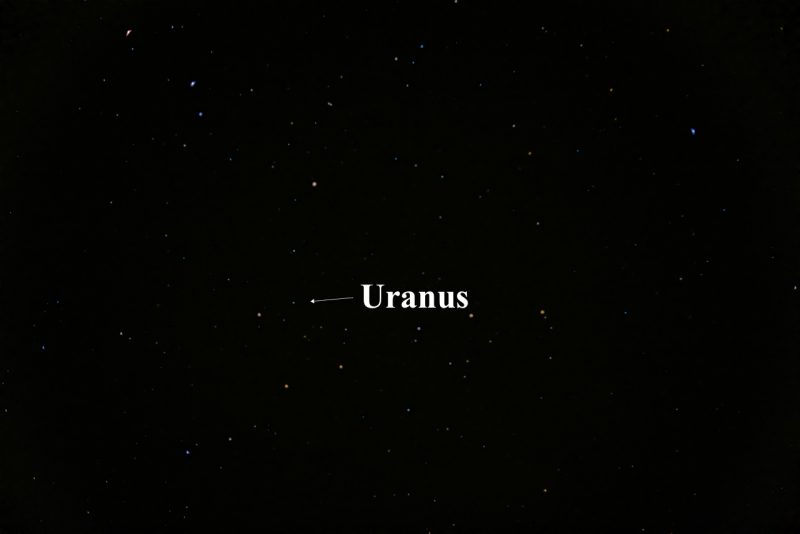
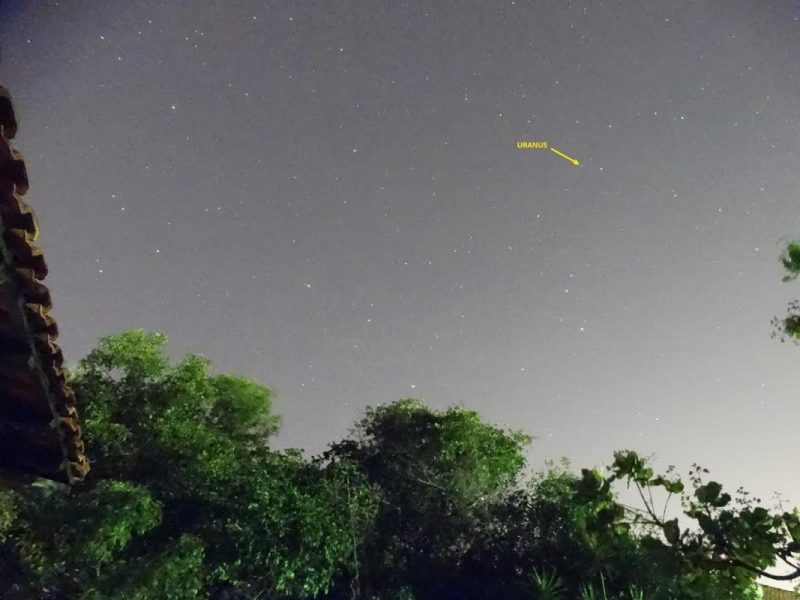
View larger. | Uranus on October 20, 2017 by Greg Redfern in Virginia. He wrote: “Uranus was visible to my unaided eye but much more colorful in the picture. It took 157 minutes for the light from Uranus to reach my eyes and camera.” Thank you, Greg.View larger. | Helio C. Vital in Saquarema, Brazil caught Uranus onthe night of its opposition, October 19. He wrote: “Captured only 6.5 hours ater its opposition. I used my Sony Cyber-Shot DSC-HX300 camera at ISO 3200 and 20-sec exposure time to photograph it from Saquarema (Lat:-22.92o, Long.;-42.51o). Thanks, Helio!”
Bottom line: Photos of planet Uranus taken around its October 19, 2017 opposition. At opposition, Uranus is opposite the sun and at its most visible from Earth. It’ll be at its best – barely visible to the eye – for the remainder of 2017.
Deborah Byrd (asteroid 3505 Byrd) helps edit EarthSky.org and is a frequent host of EarthSky videos. Deborah created the EarthSky radio series in 1991 and founded EarthSky.org in 1994. Prior to that, she had worked for the University of Texas McDonald Observatory since 1976, and created and produced their Star Date radio series. She has won a galaxy of awards from the broadcasting and science communities, including having an asteroid named in her honor in 1990, a Public Service Award from the National Science Board in 2003, and the Education Prize from the American Astronomical Society in 2020. A science communicator and educator since 1976, Byrd believes in science as a force for good in the world and a vital tool for the 21st century. "Being an EarthSky editor is like hosting a big global party for cool nature-lovers," she says.
Like what you read? Subscribe and receive daily news delivered to your inbox.
Thank you! Your submission has been received!
Oops! Something went wrong while submitting the form.