
Update: As of September 28, 2025, the nova turned a pinkish hue but is rapidly fading.
New nova might be visible to the unaided eye
In an “observing alerts” forum of the American Association of Variable Star Observers (AAVSO), observers on September 22, 2025, reported a new nova – a bright stellar explosion – in the direction of the southern constellation Centaurus. The nova was reported as magnitude 6, or just on the edge of visibility to the eye. So it might be just in reach of the unaided eye from a dark-sky site.
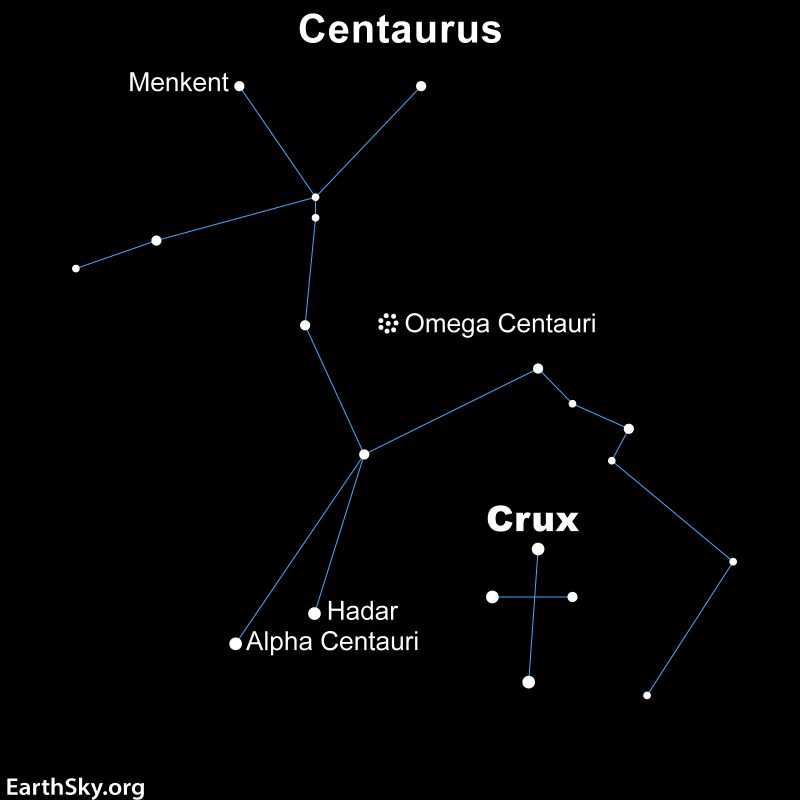
The coordinates of the nova in Centaurus are RA = 14 37 21.77 Dec = -58 47 40.0. This location on the sky is quite close to the famous star Alpha Centauri, closest star system to our sun at 4.3 light-years. This does not mean, of course, that the nova is connected to Alpha Centauri in any way, or that it’s close to our neighborhood of space. We don’t yet know how far away it lies. It just means the nova is in the same direction of sky as Alpha Centauri.
The constellation Centaurus the Centaur lies in Southern Hemisphere skies. It sits so far south that if you live above 25 degrees north latitude, you won’t be able to see it.
The observer report at the AAVSO website says that John Seach discovered this nova. Amazingly, John Seach discovered a second nova the preceding night in the constellation Sagittarius the Archer, at magnitude 10.2. Seach reported on X that both novas are now confirmed.
More info on the nova
The nova was only very recently discovered, so information and images are still sparse. Starting on September 22, 2025, the Central Bureau for Astronomical Telegrams had a few reports of the nova, too. The first reads:
Possible new nova in Centaurus. Discovered by John Seach, Grafton, NSW, Australia. Object visible on 3 images taken with DSLR with 40 mm f/1.4 lens. No object identified at position on 3 images taken with same instrument on September 21. 3660 UT, limiting magnitude 11.0. No minor planet at position …
Another report reads:
A low-resolution optical spectrum shows strong broad hydrogen Balmer emissions, indicative of a classical nova. Observer Rob Kaufman, Bright, Victoria, Australia.
The name for this transient object is V1935 Centauri or PNV J14372177-5847400.
??????????????PNV J14372177-5847400cbat.eps.harvard.edu/unconf/follo…6.2???????????????????????????????????????
— ?????????????? (@localgroupjp.bsky.social) 2025-09-23T01:16:24.714Z
The nova in Sagittarius
The nova in Sagittarius is much dimmer to see with the unaided eye. The Central Bureau for Astronomical Telegrams said John Seach discovered that nova on September 21. Seach shared his image of the nova on X.
The astronomical telegram said:
Within half an hour of Seach’s posting his discovery to the TOCP, Tadashi Kojima (Tsumagoi, Gunma-ken, Japan) posted his own independent discovery of this variable (unfiltered mag 10.5).
The name of this nova is now V 7994 Sagittarii.
What exactly is a nova?
A nova always involves two closely-orbiting stars. One is a tiny, dense white dwarf about the size of Earth. And the companion star may be similar in mass to our sun. The white dwarf’s powerful gravity siphons material (mostly hydrogen) away from its companion over thousands of years. The hot gas forms a disk around the dwarf, which funnels the material down to the star’s surface. In time, the pilfered gas is compacted and heated until it ignites in a massive thermonuclear blast a million times brighter than the light of both stars combined.
To our eyes the explosion looks like a brand-new star in the night sky. Previously, the pair was there for a long, long time, but too faint to call attention to itself.
Good news … The dwarf typically survives the blast and begins anew to gather more hydrogen for the next eruption. When you know what’s behind that single pinpoint of light, it’s a marvel!

Bottom line: It appears there’s a new nova – or guest star – in the southern constellation of Centaurus. The nova could be visible with your eyes alone from a dark-sky site.
Like what you read?
Subscribe and receive daily news delivered to your inbox.
More from
Kelly Kizer Whitt


Visible planets and night sky guide for October

Why does anything exist? New theory emerges
Euclid was mapping the universe. Then it found a comet
Auriga the Charioteer and bright Capella on October evenings