Is Comet SWAN disintegrating?
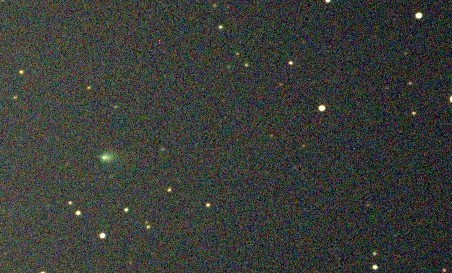
There’s been a new comet speeding toward the sun, visible with binoculars in the morning sky. But recent reports are that the comet, C/2025 F2 SWAN, might be breaking up as it nears the sun. Over the last few days, observers have seen the new comet fading, and it appears to have lost its tail. Although further observations may confirm if the comet has disintegrated, right now it is not looking good.
Mike Olason, who photographed the celestial visitor from Tucson, Arizona, said:
On the morning of April 17 the tail disappeared with just a little fan tail above the coma.
Andrey Nikolenko of Odessa, Ukraine, seems to be in agreement. Andrey shared an image of Comet SWAN and said:
C/2025 F2 (SWAN) seems to have faded a lot.
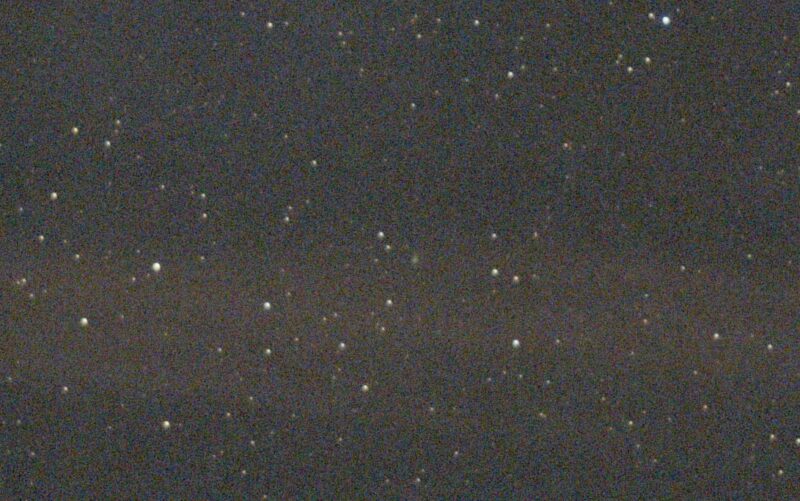
Gideon Van Buitenen, who keeps an excellent comet website, listed the comet as disintegrated. Those recent observations show the comet disintegrated around April 16-17.

The new comet discovery
SWAN, an instrument aboard the European Space Agency’s SOHO spacecraft that studies the sun, first detected the comet, hence its name. On April 8, 2025, comet SWAN25F was officially designated as C/2025 F2 (SWAN) by the Minor Planet Center. The new comet was independently co-discovered by Vladimir Bezugly from Ukraine and Michael Mattiazzo from Australia. Both comet hunters detected the moving object on March 29 by examining the latest images taken by the spacecraft.
How to see the comet
Still want to try to see what might be the last of the comet? Look toward the east-northeastern horizon just before sunrise with binoculars or a telescope. If the comet survives its closest approach to the sun – which is now looking sketchy – it might be visible during sunset. Comets are erratic and unpredictable. So if it does survive, just how bright it will be remains uncertain
Closest approach to Earth and to the sun will occur on the same day, on May 1, 2025. Although perhaps the comet will just be a husk of its former self by then. The comet will be passing at around 31 million miles (50 million km) from the sun, or just inside planet Mercury’s average orbit.
Recent outburst and brightness variations
The comet was already giving observers some trouble in early April. Astronomer Mike Olason, who has been monitoring the celestial visitor from Tucson, Arizona, said:
For those who have wondered why the comet has been so hard to observe the past few mornings, it is because the comet has faded a magnitude since reaching its brightest point several days ago.
Comet hunter Nick James reported that he detected activity or recent brightness peaks on the mornings of April 6 and 8.
Those changes on the brightness of the comet might have been due to sudden eruptions caused by pockets of ice.


Tracking the new comet
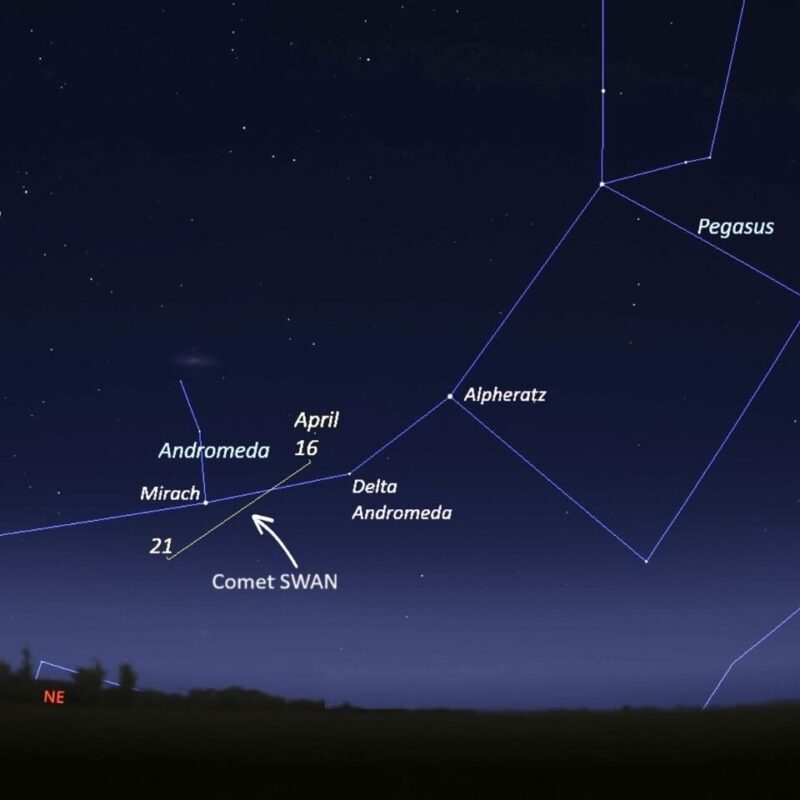
During the first days of April, the comet was inside the Great Square of Pegasus the Flying Horse. And now it has just left Andromeda the Chained Lady and is in Pisces the Fish.
If, somehow, it has not truly disintegrated, here are your latest observing tips. Look northeast for Comet SWAN in the morning sky until about April 25, when it will be too near the bright sun to see. Then try looking northwest in the evening sky between May 1 and 8. The sun just below the horizon will make these challenging observations.

A once-in-a-lifetime event
While refining the orbit of comet C/2025 F2 (SWAN) as observations show the different positions in the sky, astronomers can determine where the celestial visitor should have been before. And they were successful in finding the comet as an extremely faint object in “pre-discovery” images as far back as September 2024. That’s even though it was just discovered a few days ago.
By comparing the location of the comet during both previous and recent observations, calculations indicate the newly found comet completes an orbit around the sun every 2.1 million years!
This means the visibility of comet C/2025 F2 (SWAN) is a once-in-a-lifetime event.
More on Comet SWAN
The new comet appeared as a small green sphere, which means its coma – or cometary atmosphere – has reactive molecules called diatomic carbon (C2). These appear green when sunlight illuminates the celestial visitor.
Originally, long-exposure images also showed a faint tail that extended for more than two moon diameters.

Images of the new comet


Did you capture an image of Comet SWAN? Submit it to us.
Bottom line: The new Comet SWAN is approaching the sun. But is that causing the ball of ice and dust to disintegrate? Get the latest updates on the comet here.
Like what you read?
Subscribe and receive daily news delivered to your inbox.
More from
Eddie Irizarry


Mission to save Swift spacecraft fails, will crash back to Earth

Large asteroid safely passed Earth on June 27
Watch sungrazing Comet MAPS break up near the sun
The best comets of 2026: Here’s what to watch for