Science matters. Wonder matters. You matter.
Join our 2025 Donation Campaign today.
If you like Comet SWAN, you’ll love Comet Lemmon, which is forecast to become even brighter than SWAN! Read about Comet Lemmon here. And don’t forget about our interstellar comet, 3I/ATLAS. October 2025 is a great month for comets!
New comet soars into the sky
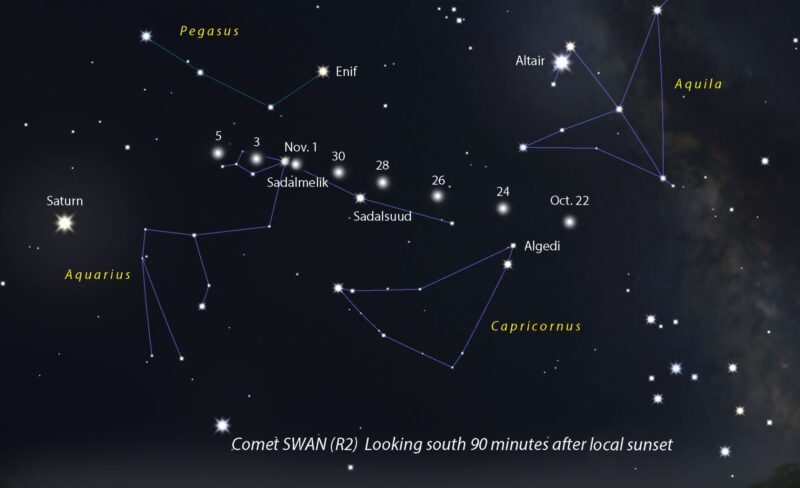
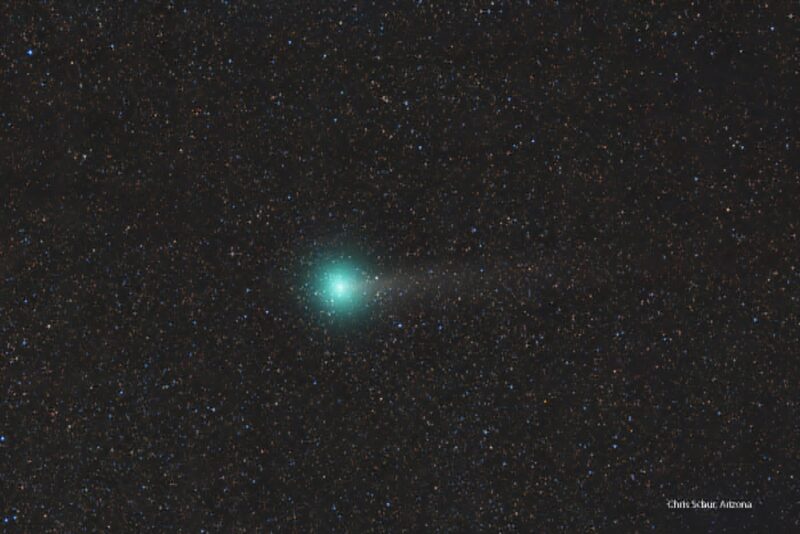
Comet C/2025 R2 (SWAN) – confirmed in September 2025 in images from the SOHO spacecraft’s SWAN camera – is still shining at about 6th magnitude. That’s just within the limit for visibility with the unaided eye. This comet is within reach of ordinary binoculars, especially under dark skies. Plus, you might also be able to pick up the comet in long-exposure photographs.
To see the comet, look southward when true darkness falls, say, about 90 minutes after sunset. This comet started out being visible mainly to observers in the Southern Hemisphere. It has now passed closest to Earth (around October 19). And it’s about as bright as we’re going to see it now, as it gradually moves away from the sun and Earth.
More facts about the new comet
The Solar Wind Anisotropies (SWAN) instrument on the SOHO spacecraft confirmed this comet on September 12.
The International Astronomical Union gave the comet its official name: C/2025 R2 (SWAN). It was originally and temporarily designated SWAN25B.
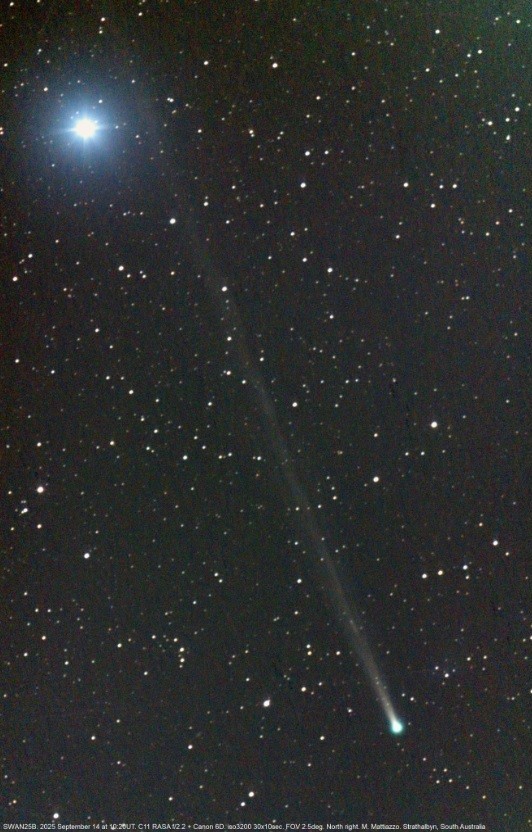
When SWAN passed Spica

More on the comet’s path
By tracking its path, NASA/JPL has been able to determine an orbit for comet C/2025 R2 (SWAN). It suggests this comet completes an orbit around the sun every 22,554 years!
This means that if you are able to see the new comet C/2025 R2 (SWAN) using binoculars or with a camera, this will be a once-in-a-lifetime sighting. If the comet survives this pass, it will return around the year 24,579.
Some images of the comet
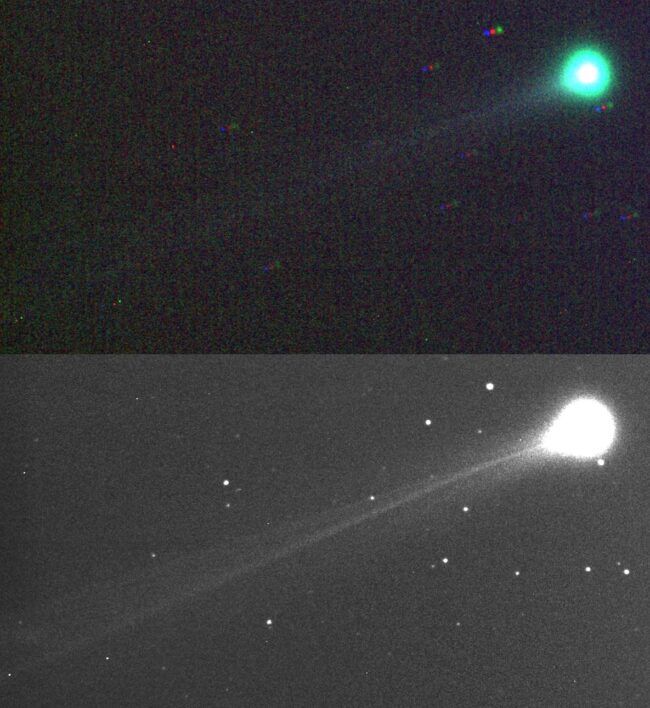
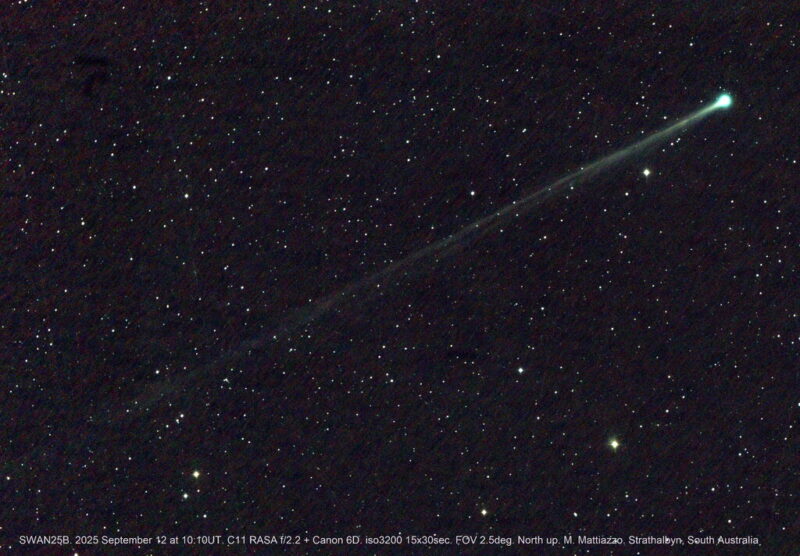
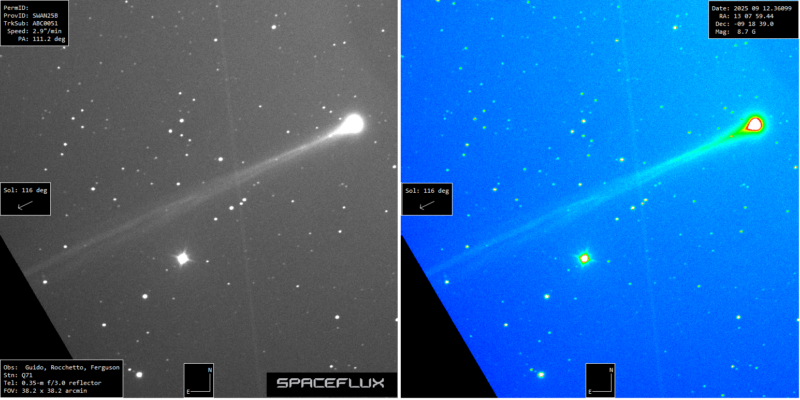 Comet SWAN R2 is already shining (relatively) brightly, though it’s close to the sun. Image via E. Guido/ M. Rocchetto/ J. Ferguson/ Spaceflux/ X. Used with permission.
Early observations of the new comet
Comet hunter Vladimir Bezugly detected the new comet in recent SWAN images. Meanwhile, comet astrophotographers are capturing nice images of the new celestial visitor. Comet expert Michael Mattiazzo said:
I was able to visually see it this morning (September 12) using 15 x 70 binoculars from Australia.
Martin Mašek of the Institute of Physics of the Czech Academy of Sciences, at the Cherenkov Telescope Array site near Cerro Paranal, also confirmed the new comet on the ICQ Comet Observations Facebook page. Mašek said:
I was very pleasantly surprised by such a bright comet with a long tail. I originally expected to be searching for a small, faint patch.
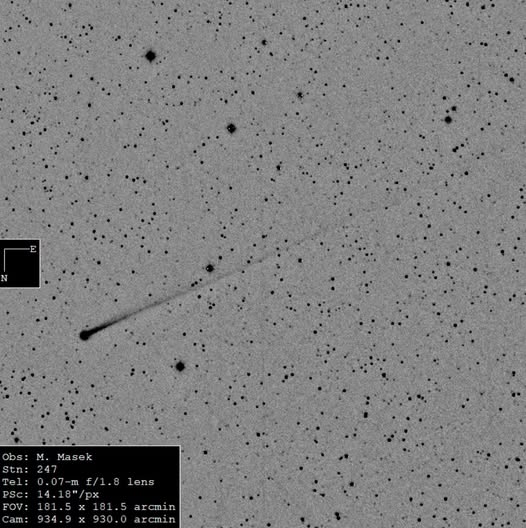
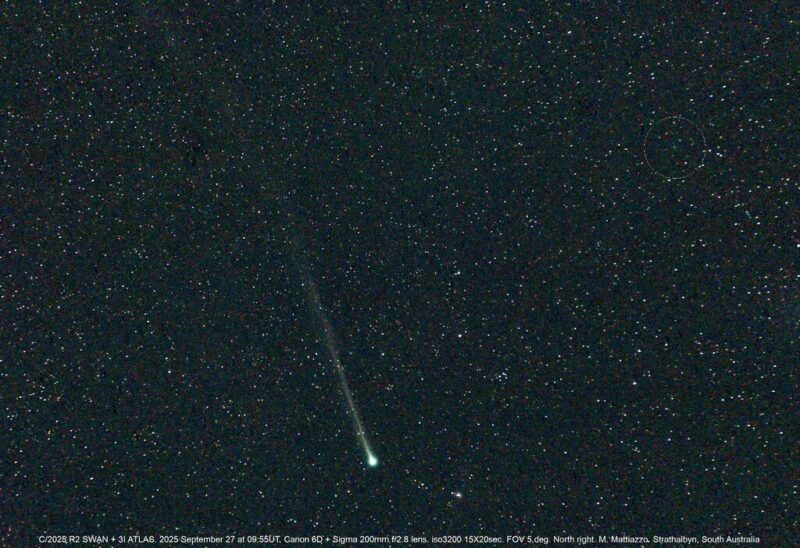
So why haven’t we seen this bright comet before now? The new comet was apparently behind, or too close to the area where we see the sun, and perhaps has appeared just after its perihelion. However, scientists are still comparing observations of the comet to determine its exact trajectory.
Bottom line: As of October 22, new comet C/2025 R2 (SWAN) is still shining at 6th magnitude, meaning it’s within the limit for viewing with the unaided eye. But binoculars will show it better!
Like what you read?
Subscribe and receive daily news delivered to your inbox.
More from
Eddie Irizarry


Mission to save Swift spacecraft fails, will crash back to Earth

Large asteroid safely passed Earth on June 27
Watch sungrazing Comet MAPS break up near the sun
The best comets of 2026: Here’s what to watch for