



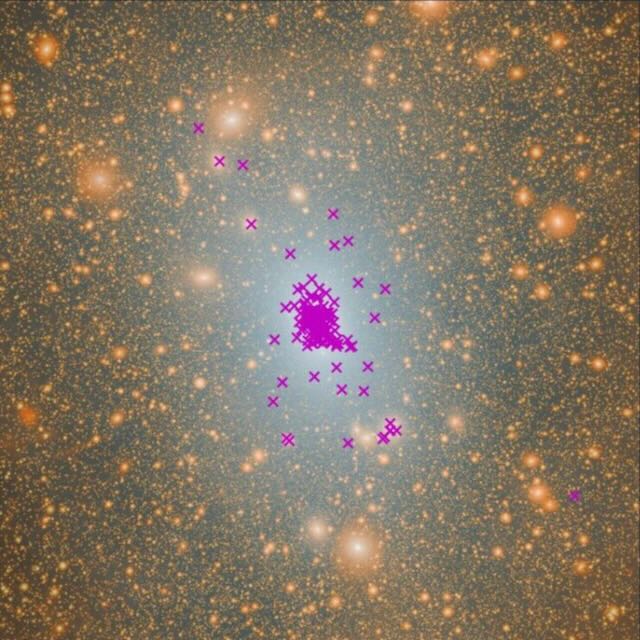
- The Milky Way galaxy could have 80 to 100 more satellites galaxies than we’ve found so far, say scientists at Durham University in the U.K.
- If true, these small galaxies would be a step forward for the prevailing cosmological model of our universe.
- One of the flaws of the prevailing model has been the lack of more satellite galaxies around the Milky Way.
The Royal Astronomical Society published this original story on July 11, 2025. Edits by EarthSky.
Is the Milky Way teeming with satellite galaxies?
We know of about 60 small galaxies near our home galaxy, the Milky Way. Many are thought to orbit the Milky Way and so are considered satellites. The Large and Small Magellanic Clouds are the only ones visible to the eye. But scientists have been perplexed by this number of small galaxies. The Milky Way should have many more satellite galaxies, according to the prevailing model of our universe, called the Lambda Cold Dark Matter model ((LCDM). Now, cosmologists at Durham University in the U.K. have used a new technique combining the high-resolution supercomputer simulations, alongside what they called “novel” mathematical modeling, to predict the existence of missing “orphan” galaxies. Their findings suggest that there should be 80 or perhaps up to 100 more satellite galaxies surrounding our home galaxy than we’ve found, orbiting at close distances.
If telescopes can spot these galaxies, then it’ll provide strong support for the Lambda Cold Dark Matter model, the model that underlies our cosmology, our understanding of the large-scale structure of the universe and how galaxies form.
Scientists will present this ongoing research on July 11, 2025, at the Royal Astronomical Society’s National Astronomy Meeting at Durham University.

A cold dark matter model of our universe
The research is based on the LCDM model where ordinary matter in the form of atoms represents only 5% of the universe’s total content. Meanwhile, about 25% is cold dark matter (CDM) and the remaining 70% is dark energy.
In this model, galaxies form in the center of gigantic clumps of dark matter called halos. Most galaxies in the universe are low-mass dwarf galaxies. And the majority of which are satellites orbiting around a more massive galaxy, such as our Milky Way.
The existence of these enigmatic objects has long posed challenges to LCDM, aka the standard model of cosmology. According to LCDM theory, many more Milky Way companion galaxies should exist than cosmological simulations have so far produced, or astronomers have been able to see.
The new research shows the Milky Way’s missing satellites are extremely faint galaxies stripped almost entirely of their parent dark matter halos by the gravity of the Milky Way’s halo. These so-called “orphan” galaxies are lost in most simulations. But they should have survived in the real universe.

More satellites should exist
Using their new technique, the Durham researchers were able to track the abundance, distribution and properties of these Milky Way orphan galaxies. They show many more Milky Way satellites should exist. And scientists should be able to observe them with new advances in telescopes and instruments. That includes the Rubin Observatory LSST camera (which recently saw its first light). These instruments will give astronomers the ability to detect faint objects, bringing them into our view for the first time.
Lead researcher Isabel Santos-Santos, in the Institute for Computational Cosmology, Department of Physics, Durham University, said:
We know the Milky Way has some 60 confirmed companion satellite galaxies. But we think there should be dozens more of these faint galaxies orbiting around the Milky Way at close distances.
If our predictions are right, it adds more weight to the Lambda Cold Dark Matter theory of the formation and evolution of structure in the universe. Observational astronomers are using our predictions as a benchmark with which to compare the new data they are obtaining.
One day soon we may be able to see these ‘missing’ galaxies, which would be hugely exciting and could tell us more about how the universe came to be as we see it today.

Aiming to understand our universe
The concept of LCDM is the cornerstone of our understanding of the universe. It has led to the Standard Model of Cosmology and is the most widely accepted model for describing the universe’s evolution and structure on large scales.
The model has passed multiple tests. However, recently, puzzling observational data on dwarf galaxies have presented a challenge.
The Durham researchers said even the best existing cosmological simulations (which include gas and star formation, in addition to dark matter) do not have the resolution needed to study galaxies as faint as those astronomers are starting to discover close to the Milky Way.
These simulations also lack the precision required to follow the evolution of the small dark matter halos that host the dwarf galaxies as they orbit around the Milky Way over billions of years.
So this leads to the artificial disruption of some halos, leaving galaxies “orphaned.” Although the simulations lose the halos of “orphan” galaxies, such galaxies should survive in the real universe.
Modeling the Milky Way
The Durham researchers combined cosmological supercomputer simulations with analytical models to overcome these numerical issues.
This included the Aquarius simulation, which the Virgo Consortium produced. Currently, Aquarius is the highest resolution simulation of a Milky Way dark matter halo ever created. Astronomers use it to understand the fine-scale structure predicted around the Milky Way.
It also included the GALFORM model, a cutting-edge code developed at Durham over the past two decades. This model follows the detailed physical processes responsible for the formation and evolution of galaxies.
Their results showed that halos of dark matter, which may host a satellite galaxy, have been orbiting around the central Milky Way halo for most of the age of the universe. And this has lead to the stripping of their dark matter and stellar mass, rendering them extremely small and faint.
As a result, the research predicts the total number of satellite galaxies – of any brightness – likely to exist around the Milky Way is around 80 or potentially up to 100 more than currently known.
Discovering satellites galaxies would boost the LCDM theory
The research puts particular emphasis on the approximately 30 newly discovered tiny Milky Way satellite candidates that are extremely faint and small. Scientists are unclear if these are dwarf galaxies embedded in a dark matter halo or globular clusters, collections of self-gravitating stars. The Durham researchers argue that these objects could be a subset of the faint population of satellite galaxies they predict should exist.
Co-researcher Carlos Frenk, of the Institute for Computational Cosmology, Department of Physics, Durham University, said:
If the population of very faint satellites that we are predicting is discovered with new data, it would be a remarkable success of the LCDM theory of galaxy formation.
It would also provide a clear illustration of the power of physics and mathematics. Using the laws of physics, solved using a large supercomputer, and mathematical modeling we can make precise predictions that astronomers, equipped with new, powerful telescopes, can test. It doesn’t get much better than this.
Bottom line: Astronomers used new models and simulations of the Milky Way to show our galaxy should have 80 to 100 more satellite galaxies than we’ve spotted.
Source: The contribution of “orphan” galaxies to the ultrafaint population of MW satellites
Like what you read?
Subscribe and receive daily news delivered to your inbox.
More from
EarthSky Voices


Why leaves change color in the autumn

How a helium leak in an exoplanet atmosphere hints at life
Would a Yellowstone supervolcano eruption end humanity now?
Neptune discovered on this date 180 years ago



