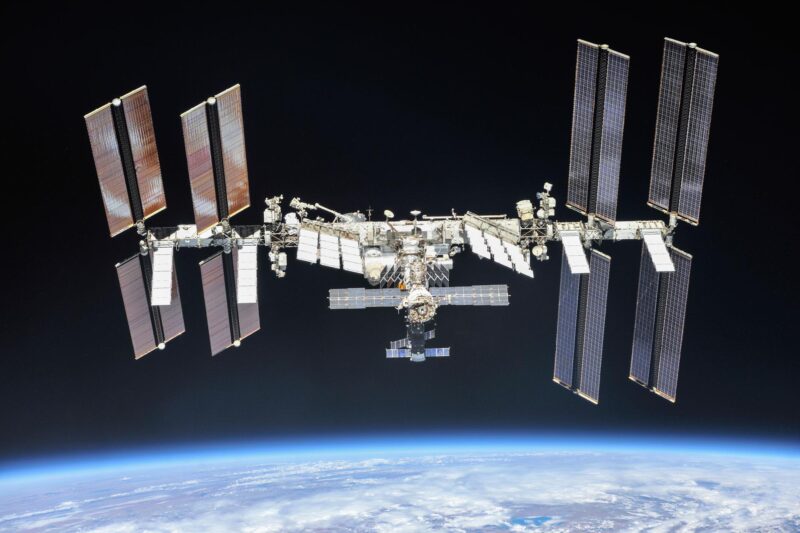
ISS leak worsens, as astronauts shelter then return
At 13:04 UTC on June 5, 2026, NASA ordered astronauts aboard the International Space Station (ISS) to put on their spacesuits, take shelter and prepare for evacuation. The instruction came as Russian crewmembers attempted to repair 2 worsening air leaks on their side of the station.
Less than two hours later, Mission Control said the sheltering astronauts – two U.S. astronauts, a French astronaut and a Russian cosmonaut – could exit the “safe haven” of their Crew Dragon escape craft. That’s because the repair attempt had been paused to allow new measurements to be assessed, NASA said.
Air is leaking from a transfer tunnel module on the Russian side of the ISS, known as PrK. It’s been a known issue since 2019, and NASA and Russia’s space agency Roscosmos have long been debating the cause and potential fixes. NASA officials reportedly said in a late-2024 meeting that the leak could lead to “a catastrophic failure.”
As reported by Reuters, Roscosmos said on Friday, June 5, that their cosmonauts had fixed one of the two leaks. The second leak remains. Roscomos said:
The situation poses no threat to the safety of the crew or on-board systems. The pressure aboard the ISS is stable and being maintained at the intended level.
This week, the ISS leak was seen as worsening
NASA spokesperson Bethany Stevens wrote on X Friday that:
The cracks have always been a concern that NASA watches very closely.
And a senior NASA official, speaking on the condition of anonymity, told Reuters that the leaks worsened on Monday, escalating from a pound (.45 kg) of air per day to two pounds (.9 kg).
That’s what drove this repair attempt and the evacuation precautions. Stevens continued:
Following new leaks, Roscosmos has elected to proceed with a more extensive repair operation on Friday, June 5. Out of an abundance of caution, NASA has directed all four of the agency’s SpaceX Crew-12 members and NASA astronaut Chris Williams to assume an elevated safety posture in the Dragon spacecraft while the repair is underway.
But within a few hours, the repair attempt was paused. Stevens explained in a follow-up post:
Roscosmos has paused Friday’s structural repair efforts inside the Zvezda service module transfer tunnel, known as PrK, as more measurements and data is assessed. Given this development, NASA has instructed the crew members inside the Dragon spacecraft to end the safe haven procedures and return to planned operations aboard the International Space Station. We look forward to working with Roscosmos on a collaborative approach to address the leaks.
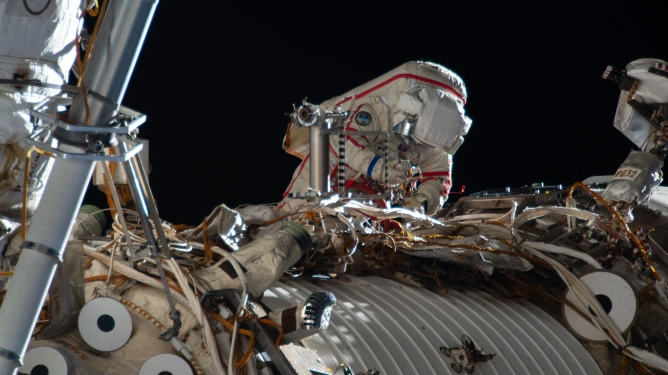
When will ISS be deorbited?
The assembly of the International Space Station officially began on November 20, 1998, with the launch of its first module, a Russian-built control module named Zarya. It has been continuously inhabited for over 25 years.
As of now, 2031 remains the targeted year for the controlled deorbit of the aging space station.
The current operational plan transitions the station out of service at the end of December 2030, with the actual descent and destructive reentry through Earth’s atmosphere scheduled to take place in early 2031.
NASA and its international partners have already actively set this plan into motion:
- The deorbit vehicle: NASA officially selected SpaceX to develop and build the specialized “U.S. Deorbit Vehicle” (a heavily modified Dragon spacecraft). This vehicle will dock with the ISS and use massive amounts of propellant to safely guide the station down over an open ocean area.
- Why not sooner? Despite the recent escalation of the air leaks in the Russian Zvezda module’s PrK tunnel, NASA and Roscosmos management maintain that the structural risks are manageable. They plan to continue operating the station safely for the remainder of the decade while commercial replacements are built.
- Go on to 2032? While some members of Congress have occasionally floated the idea of extending operations until 2032 to prevent a gap in low-Earth orbit research, the official international agreement and technical timeline firmly target 2031 for the final splashdown.
Bottom line: The International Space Station has a leak. On Friday, NASA told the astronauts to shelter and prepare for an evacuation. What happened? Read about the ISS leak.
Read more: Could the space station leak lead to ‘catastrophic failure’?
Like what you read?
Subscribe and receive daily news delivered to your inbox.
More from
Will Triggs


Hurricane Nolo is now Typhoon Nolo. Where is it going next?

Starship reaches Earth orbit for 1st time
Back-to-back Venezuela earthquakes kill at least 164
NASA announces Artemis 3 astronauts: See them here