Slow solar wind is oddly fast, first Proba-3 data reveals
Thanks to a new sun-observing spacecraft, scientists are finally able to study how solar material moves through the sun’s entire corona, or outer atmosphere. And they’ve found that the elusive stream of particles known as the slow solar wind is moving strangely quickly. In fact, it’s accelerating up to five times faster than previously thought.
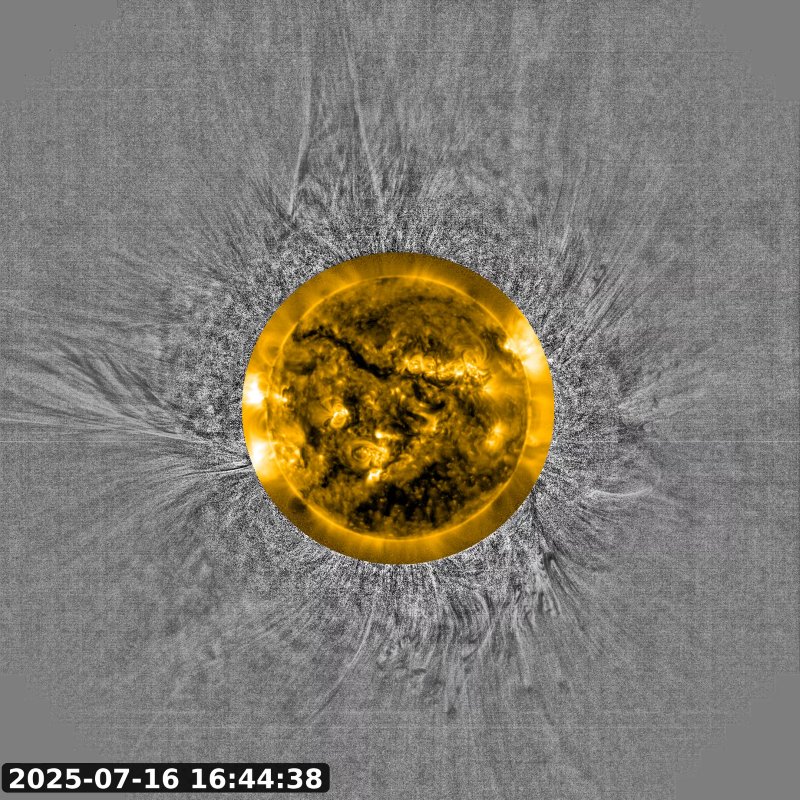
The European Space Agency’s remarkable new Proba-3 spacecraft made the discovery. This space telescope consists of two entirely separate satellites. They fly in millimeter-precise formation for hours at a time to create artificial solar eclipses. Launched in December 2024, Proba-3 has already produced more than 50 of these eclipses. And each one has allowed astronomers a glimpse of the sun’s difficult-to-observe inner corona.
And now, analysis of the early data has provided a first scientific discovery for Proba-3. The European Space Agency announced the finding on April 13, 2026, after the researchers published their peer-reviewed paper in The Astrophysical Journal Letters on March 9, 2026.

Tracking the solar winds
At any given moment, the sun is firing charged particles in all directions. This is the solar wind, and the outer layer of the sun’s atmosphere, or corona, releases these particles.
So-called fast solar wind streams at high speeds – often over 800 km/s – from coronal holes, which are less dense parts of the corona. These smooth, powerful currents can trigger geomagnetic storms and auroras when they collide with Earth’s magnetic field.
The rest of the solar wind, then, is the slow solar wind. It leaves the sun at around 400 km/s. Unlike fast solar wind, slow solar wind is gusty and variable. That makes it harder for scientists to pin down how it moves and what produces it.
Researchers think slow solar wind arises from magnetic field lines on the sun chaotically connecting, twisting and disconnecting. But it has been tricky to measure how it accelerates as it moves through the corona. That’s because a portion of the corona has long been hidden from our view. Now, Proba-3 has changed that.
See the movement in the corona that Proba-3 captured in this video.
Filling in the coronal gaps
Many of humanity’s sun-observing spacecraft image the very lowest parts of the corona. They do so by taking in only extreme ultraviolet light. And several spacecraft study the wispy outer corona by using an occulting disk to block out the sun’s glare. But the space between these two regions – the inner corona – is much trickier to examine.
Why? Because to view the region so close to the sun’s surface without its light interfering, you need a huge gap between your telescope and your occulting disk. That’s why we can usually only see this region during total solar eclipses from Earth, when our natural occulting disk – the moon – is over 238,000 miles (383,000 kilometers) away.
A single spacecraft can’t get much distance between its telescope and occulter. That’s why Proba-3’s occulting disk is on an entirely separate spacecraft. That disk blocks out the sun for its sister spacecraft from 492 feet (150 meters) away.
To provide its invaluable view of the inner corona, these two satellites have to maintain millimeter-perfect alignment as they soar through space. Read more about this mind-blowing technological feat here.
EarthSky’s Will Triggs explains how Proba-3 works in this short video.
Slow solar wind isn’t as slow as we thought
Proba-3 allows scientists to see down to just 70,000 km (43,500 mi) from the sun’s surface. The camera captures one or two images per minute, which are stitched together to reveal never-before-seen movement of solar wind structures in the inner corona. Joe Zender, ESA’s Proba-3 project scientist, said:
These intricate movements have never been observed in optical wavelengths so low in the sun’s inner corona.
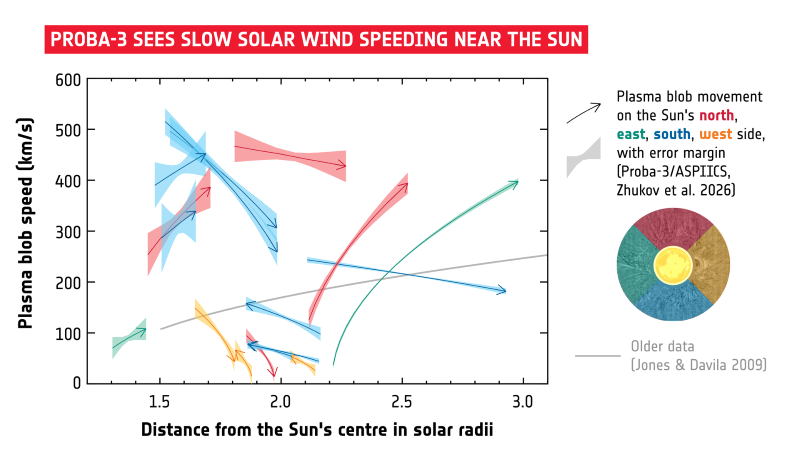
One thing evident from the data is just how chaotic and varied the slow solar wind is at this altitude. Andrei Zhukov, lead author of the study, said:
Slow solar wind is naturally not uniform, involving lots of small-scale structures in the sun’s magnetic field that we can see thanks to ASPIICS [the imager on Proba-3].
But the truly surprising finding is that slow solar wind gusts in the inner corona are moving up to five times faster than expected. Previous studies suggested that slow solar wind close to the sun’s surface should only have reached speeds of around 100 km/s. Instead, the researchers tracked plasma moving at 250-500 km/s. One km/s is more than 2,200 mph.
How it has reached such a high speed so early in its journey out from the sun remains to be determined. Zender said:
This first dataset is just the beginning of the much longer journey to fully understand what’s happening. Now it’s up to theoretical experts to compare this to models of the magnetic field and plasma acceleration in the sun’s corona.
Bottom line: Early data from the Proba-3 spacecraft has revealed that slow solar wind travels much faster than expected in the sun’s inner corona.
Read more: First images from Proba-3, the 2-part sun observer
Like what you read?
Subscribe and receive daily news delivered to your inbox.
More from
Will Triggs


Hurricane Nolo is now Typhoon Nolo. Where is it going next?

Starship reaches Earth orbit for 1st time
Back-to-back Venezuela earthquakes kill at least 164
NASA announces Artemis 3 astronauts: See them here