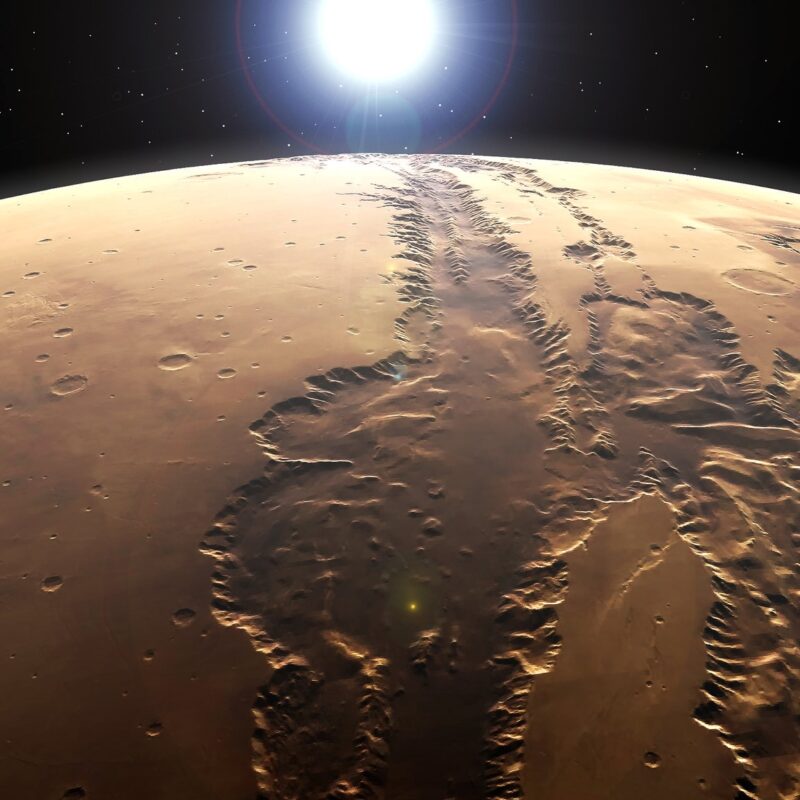
Is the Mars Grand Canyon still tectonically active? Scientists say yes
Mars might be smaller than Earth, but its landscape features are overachievers. The red planet is home to both the largest volcano (Olympus Mons) and the largest canyon system (Valles Marineris) in the solar system. Valles Marineris is dubbed the Grand Canyon of Mars. It stretches more than 2,500 miles (4,000 km) long, nine times longer than the Grand Canyon on Earth. It’s also about 20 times wider and five times deeper than Earth’s Grand Canyon. On October 19, 2026, scientists with Columbia University and Imperial College London said Valles Marineris is still tectonically active, billions of years after it formed.
NASA’s InSight lander recently captured seismic data of a marsquake. The new research found the quake occurred 12 to 25 miles (20 to 40 km) beneath Valles Marineris. Rocks slipping along a fault deep in the red planet’s crust triggered the quake. But Mars does not have tectonic plates sliding around on the surface like Earth does. So the quakes today are happening along ancient fault lines on Mars.
The researchers published their peer-reviewed findings in the journal Nature Communications on October 15, 2026.
Tectonics on Mars versus Earth
Earth’s shaking, rattling and rolling is thanks to the tectonic plates that slide around on the upper mantle. The plates push, pull and slide against each other. Sometimes they get stuck and friction builds up. Eventually the stress snaps in an earthquake.
But quakes on Mars are different. Scientists describe Mars’ crust as similar to an outer shell that behaves like a single, slowly cooling lid. As Mars continues to cool from its early years, the crust shrinks and cracks. This activity forms faults that slip and cause seismic rumbles. And some of these faults, formed billions of years ago, can still slip and shift.
Finding a recent marsquake
On August 25, 2021, the InSight lander detected a quake from its location in Elysium Planitia, on the opposite side of Mars from Valles Marineris. At first, researchers didn’t know if the seismic activity was from a quake. That’s because tremors on Mars can also be from landslides or meteorite impacts.
But then researchers found the quake, named S0976a, had traveled through Mars’ core. Its epicenter was somewhere in the western Valles Marineris region. But its exact location and cause remained obscure.
The new research pinpoints the epicenter at 12 to 25 miles (20 to 40 km) beneath Valles Marineris. The researchers have now been able to learn about not just Mars’ core, but the trigger for the quake. Co-author Doyeon Kim of Imperial College London said:
S0976a has turned out to be an extraordinary event, playing an important role in our understanding of the red planet.
Its waves traveled through the core and helped us investigate the deepest part of Mars, and now they are telling us what happened at the source itself. From a single marsquake, we can learn both about the center of the planet and about an active fault beneath one of its most remarkable landscapes.
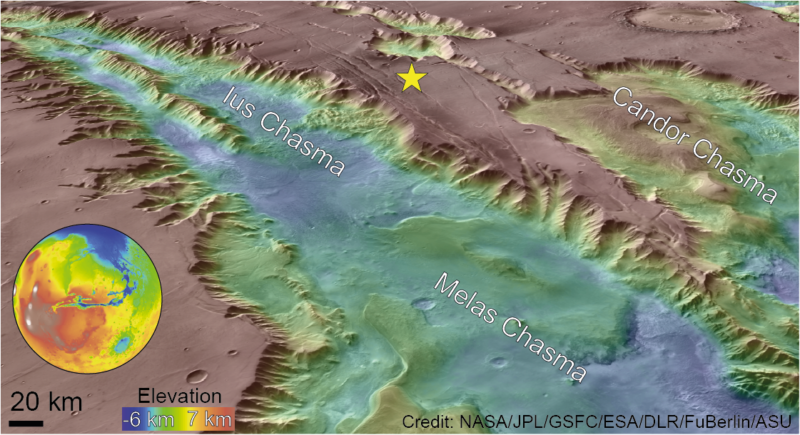
Grand Canyon of Mars: home to ancient fault and modern stress
The team was able to analyze the seismic waves, including their amplitudes and direction. Then they could reconstruct what must have happened to cause the quake. They said a strike-slip marsquake event was the most likely cause. This happens when two chunks of crust move horizontally past one another along a steep fault with a deep root. In this case, the quake was miles below ground. It created what would be equal to a magnitude 5 quake on Earth.
Lead author Jung-Hun Song of Imperial College London said:
What makes the result compelling is that several completely different types of evidence point in the same direction. The seismic waves tell us that there was a sideways sliding motion on a fault well below the surface, while the geology seen from orbit shows a region crossed by long-lived fault systems.
Song added:
What we see is that this is not just a ‘dead’ fossil landscape, as faults deep beneath the canyon can still slip and generate marsquakes, long after the geological processes that originally formed them have ceased.
Sadly, InSight lander ceased operations in 2022 due to too much dust accumulating on its solar panels. No active lander is currently recording new marsquakes on the surface of Mars. Perhaps we won’t discover the next marsquake until astronauts feel the red planet shake beneath them.
Bottom line: Researchers said the red planet is still tectonically active today. A team found the epicenter and cause of a marsquake at the Grand Canyon of Mars.
Source: Active crustal straining and fault reactivation at Valles Marineris
Like what you read?
Subscribe and receive daily news delivered to your inbox.
More from
Kelly Kizer Whitt


Visible planets and night sky guide for October

Why does anything exist? New theory emerges
Euclid was mapping the universe. Then it found a comet
Auriga the Charioteer and bright Capella on October evenings