



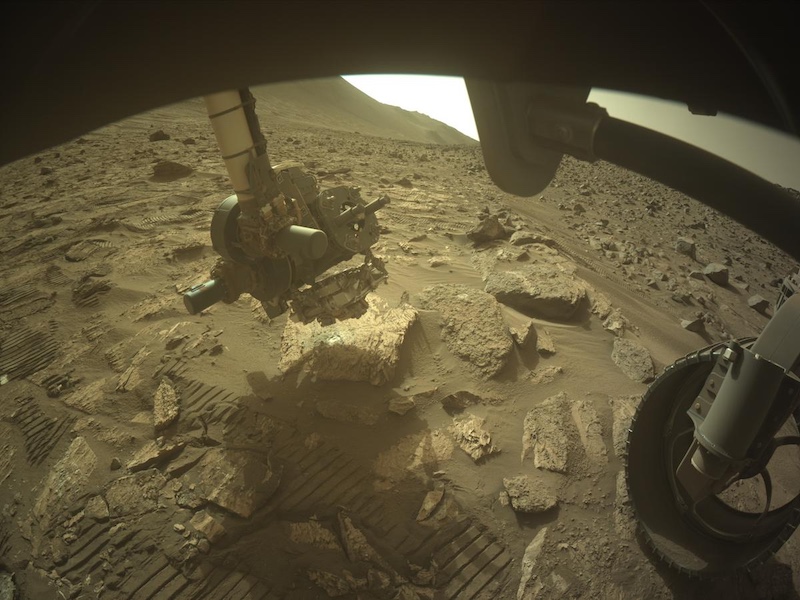
- Complex carbon molecules have been found in rocks by the Perseverance rover on Mars. These are the same rocks where the rover found the “leopard spots and poppy seeds” markings – possible signs of ancient life – in 2024.
- The carbon is remarkably well-preserved, and only microns below the surface of the rocks.
- The complex carbon discovery makes the previous findings all the more intriguing. Is this evidence of ancient life on Mars?
Support science … and wonder. Donate to EarthSky and be part of something big.
Complex carbon in Mars rocks
In 2024, NASA announced the discovery of unusual leopard spots and poppy seeds on some mudstone rocks on Mars. The markings, found by the Perseverance rover, are similar to ones made by microbial life on Earth. Chemical analysis of the rocks supported this possibility as well. It wasn’t proof of past life … but it was definitely tantalizing. Now, there is new evidence that maybe – just maybe – those spots do have a biological origin.
An international team of researchers said on June 24, 2026, that another study of the data has revealed complex carbon molecules in the same rocks. On Earth, complex carbon molecules are a key ingredient – and by-product – of life.
Lead author Ashley Murphy at the Planetary Science Institute said:
While the specific formation mechanism [of the complex carbon] remains unknown, this is still one of the most exciting findings to date.
The researchers published their peer-reviewed results in Science Advances on June 24, 2026.
For the first time, scientists have identified intact complex organic carbon at multiple sites on the surface of Mars, thanks to the Perseverance rover. ?eos.org/research-and…
Organic carbon was confirmed in two Bright Angel rocks on Mars, just microns beneath the surface—the shallowest detection of macromolecular carbon there. Its origin remains unknown. doi.org/hb8m7c
— Science X / Phys.org (@sciencex.bsky.social) 2026-06-24T18:10:23-04:00
Carbon revealed in Martian mudstones
Perseverance found the intriguing mudstone rocks – one called Cheyava Falls – in 2024. It was located in the Bright Angel rock outcrop. It had small, dark rings that resembled leopard spots, and other small dots that looked like poppy seeds. Its appearance and chemical composition suggested that these features could have been produced by microbes.
Now, new analysis of the data adds to that possible evidence. The researchers found complex carbon molecules – called macromolecular carbon (MMC) – in two of the same mudstones. The fact that the carbon is in the very same location as the other suspected biosignatures makes it all the more intriguing.
And notably, these rocks are within an ancient riverbed. Indeed, billions of years ago, rivers fed into the lake that used to be in Jezero crater.
The researchers used the rover’s Raman spectrometer to map each rock’s distribution of organic matter.

Well-preserved organics
The carbon was also relatively intact and not too weathered. That could mean it was only recently exposed to the surface. Or it might be fairly resistant to radiation and oxidation. And the carbon is very close to the surface of the rocks. In fact, only microns beneath the surface. That’s thinner than a sheet of paper.
The fact that carbon is so well preserved so close to the surface of the rocks is remarkable. As Murphy explained:
The Martian surface environment includes radiation and chemical oxidants that are destructive to organics, and terrestrial laboratory simulations have shown that the survival time of organics in Martian-like conditions – especially at or near the surface – depends on factors such as the type of organic molecule and the surrounding minerals. The MMC detected in the Bright Angel mudstones is either resistant to degradation and/or has been sufficiently shielded by other minerals, such as clays or iron-rich Martian soil.
Organic material common on Mars
The discovery of the carbon also helps to show that organic material is common on Mars. Over 2,000 miles (3,200 km) away, the Curiosity rover has also found similar organics, from the simple to the more complex. It means that such organics aren’t just local to Jezero crater where Perseverance is. Murphy said:
It is encouraging for Martian habitability. This indicates that billions of years ago, organics may have been more than just locally present and may have been more widely available in ancient lakes and rivers on Mars.

And in the case of Curiosity’s organics, scientists recently said that:
As the non-biological sources they considered could not fully explain the abundance of organic compounds, it is therefore reasonable to hypothesize that living things could have formed them.
Is the carbon in Mars rocks evidence of ancient life?
Unfortunately, we still don’t know if the carbon and other spots are the result of ancient microbial life. The rovers don’t have the equipment to make a final determination. That will likely require the samples taken to be returned to Earth for study. But right now, the Mars Sample Return mission is still in limbo. That mission would return the sample taken from the Cheyava Falls rocks.
The findings are suggestive of ancient microbial life, but don’t quite prove it yet. There could still be a non-life explanation. But unless those samples can be brought back to Earth, we might never know for sure.
Bottom line: Scientists have found complex carbon in Mars rocks that the Perseverance rover has studied. They’re the same rocks found in 2024 to contain hints of life.
Via Planetary Science Institute
Read more:
Ancient life on Mars? Rover finds intriguing ‘leopard spots’
Life on Mars? Odd rings and spots tantalize scientists
Green spots in rocks on Mars intrigue rover scientists
Like what you read?
Subscribe and receive daily news delivered to your inbox.
More from
Paul Scott Anderson


Weirdest cloud on Mars formed via ‘exotic physics’

Did formaldehyde on ancient Mars help kickstart life?
Black holes could have planets, new simulations suggest
Is this an alien radio signal from a super-Earth exoplanet?



