



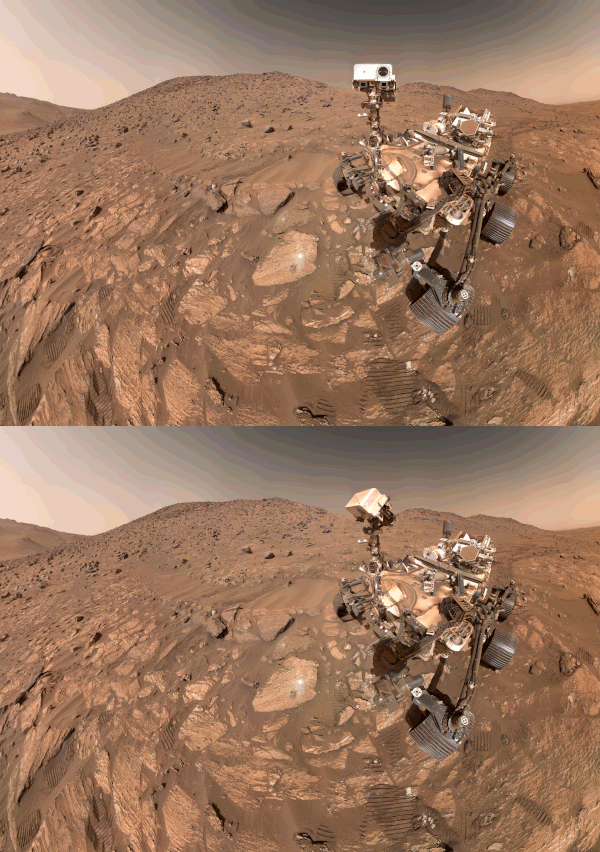
Mars rock as a potential biosignature
NASA scientists gathered for a press conference this morning (September 10, 2025) to discuss a Mars rock they call Sapphire Canyon. The Perseverance rover drilled this rock sample from a place on Mars thought to be an ancient river delta. The rock is peppered with black spots that the scientists call poppy seeds and lighter spots with dark rims they call leopard spots. There were smiles all around as NASA said they have “no other good explanation” for what created these spots except biological processes.
So it’s not yet confirmed, but signs point to life.
Nicola (Nicky) Fox is the associate administrator for NASA’s Science Mission Directorate. Fox said:
We think they are potentially made by some form of ancient life. It’s a signature. A sort of leftover sign. It’s not life itself … Nothing that’s currently there. It could be made by ancient life. … It’s the equivalent of seeing leftover fossils. This certainly is not the final answer.
And Katie Stack Morgan, the Deputy Project Scientist of the Mars 2020 rover mission, cautioned:
The discovery of a potential biosignature … requires further work to confirm.
So the search for life beyond Earth continues. What would it take for scientists to say that, yes, Mars once definitely showed signs of life? And, if we were to find conclusive evidence for life on the planet next door – one of the nearest worlds to Earth, and one of the closest places we could possibly look – does that discovery mean our universe is teeming with life?

Perseverance rover on Mars
The Perseverance rover touched down in Mars’ Jezero crater in February 2021. Scientists chose Jezero Crater because the area appears to have been a lake a few billion years ago. They knew it is possible this Mars lake once was habitable, at least by Mars microbes, and if so, it might still hold evidence of that ancient life. Ken Farley at Caltech in Pasadena, California, is the project scientist for the Perseverance mission. He said:
We picked Jezero crater as a landing site because orbital imagery showed a delta: clear evidence that a large lake once filled the crater. A lake is a potentially habitable environment, and delta rocks are a great environment for entombing signs of ancient life as fossils in the geologic record. After thorough exploration, we’ve pieced together the crater’s geologic history, charting its lake and river phase from beginning to end.
Perseverance has been collecting rocks from the ancient lakebed and the attached delta for the past few years. It has been taking some onsite measurements and images of the rocks while also collecting specimens for a possible future return mission. This Mars Sample Return mission is still in the concept phase, embroiled with budget issues. But as of July 2025, Perseverance has already filled 33 tubes of the 38 samples it has available to store for a future pick-up mission.
Read: Here’s what ‘habitable’ means to astronomers
Sapphire Canyon is sample 25
The 25th sample Perseverance collected is Sapphire Canyon, drilled from Cheyava Falls in Neretva Vallis. The sample is notable for various reasons. For one, it’s covered in small black spots that scientists call poppy seeds. But it also has larger spots, lighter in the center with dark borders, that scientists call leopard spots. Notably, back in 2024 when NASA announced the discovery of the rock, it said Sapphire Canyon:
possesses qualities that fit the definition of a possible indicator of ancient life.
Why is that? Well, first, Perseverance used its SHERLOC instrument to analyze the rock. It found organic compounds. Those are carbon-based molecules that are the building blocks of life on Earth. But it is not yet, however, proof of life on Mars.
Secondly, those spots could be a sign of chemical reactions due to microbial life. We’ve seen similar markings on earthly rocks. And on Earth, those patterns are often associated with biology. They are, essentially, the fossilized record of microbes living in the subsurface.
What’s new?
If you’re a regular reader of EarthSky, this information doesn’t sound new to you. So, what was the press conference for? Basically, today we learned there is a new study on these spots that has been peer-reviewed. And while the most likely answer to what created these spots is processes with a biological origin, life has not been confirmed on Mars. But NASA and scientists are excited about the results so far. Now, the next step to confirm it would be to bring home a sample. Will NASA greenlight the Mars Sample Return mission? That remains to be seen.
In fact, the scientists of the new paper write, in the last sentence of their abstract (emphasis mine):
Ultimately, we conclude that analysis of the core sample collected from this unit using high-sensitivity instrumentation on Earth will enable the measurements required to determine the origin of the minerals, organics and textures it contains.
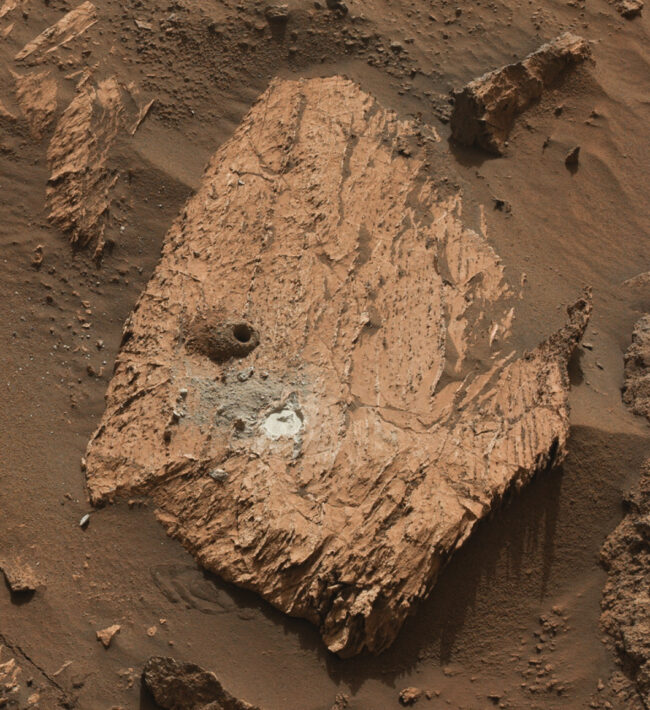
Bottom line: NASA said at a press conference on September 10, 2025, that a Mars rock explored by the Perseverance rover is a potential biosignature. Markings on the rock might be a sign of ancient life.
Source: Redox-driven mineral and organic associations in Jezero Crater, Mars
Like what you read?
Subscribe and receive daily news delivered to your inbox.
More from
Kelly Kizer Whitt


Arizona’s Chiricahua poised to become 64th US National Park

Visible planets and night sky guide for October
Another satellite breakup raises concerns about space junk
Smile mission releases its stunning 1st aurora footage!



