



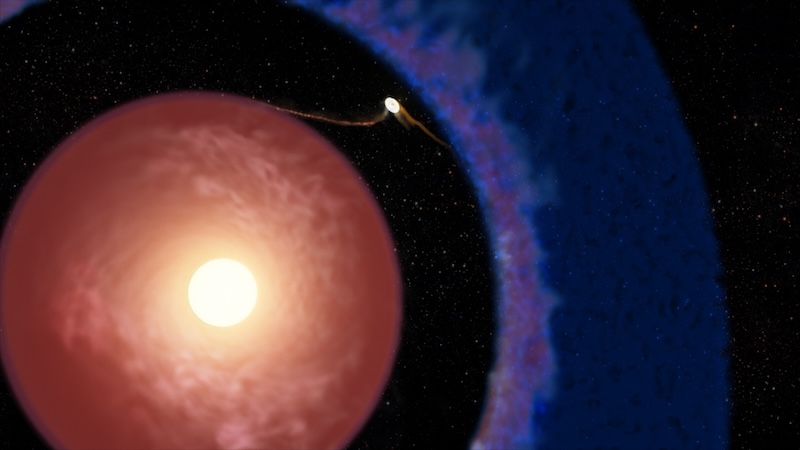
- Planets start their lives as “babies,” just like we do. Now scientists have discovered the youngest-known exoplanet so far, Elias 2-24 b.
- Elias 2-24 b is less than a million years old, making it a definite cosmic infant.
- The planet is still wrapped in the disk of dust and gas that surrounds its star.
A baby exoplanet
Astronomers have discovered exoplanets — worlds orbiting other stars — in a wide range of sizes, masses and ages. That includes some planets that are very young, still forming in the disks of debris around their stars. Now, researchers have found the youngest-known exoplanet so far.
The research team said on September 16, 2026, that the baby planet — called Elias 2-24 b — is less than a million years old. And it is about twice as massive as Jupiter and 450 light-years from Earth.
Andrea Bernardi, a doctoral candidate at the Universidad Diego Portales in Chile, led the study that found the new baby exoplanet. The study focused on archival observations of seven stars that were observed by the W.M. Keck Observatory in Hawaii. All of these stars are young, with disks of ice, dust and rocky debris still surrounding them. In fact, it is in these protoplanetary disks that new planets are born.
Until now, four other planets have held the record for youngest-known planets. Co-author Lucas Cieza at the Instituto de Estudios Astrofísicos in Chile said:
Our planet-formation models already struggled to explain the previous record holders for the youngest known planet — a four-way tie between two planets orbiting the star PDS 70 and two planets orbiting the star WISPIT 2 — which are all more than 5 million years old. Elias 2-24 b shows us that even our best planet-formation models are still missing some important processes.
The peer-reviewed findings were published in The Astrophysical Journal Letters on September 16, 2026.
Planets in the gaps
Protoplanetary disks will often have gaps within them. It’s baby planets that create these gaps as they gravitationally collect ice, dust and rock from the disk material around them while forming. And just like people, they grow over time and get bigger. Eventually, they become full planets.
The researchers used the coronagraph on the Keck telescope to block out the light coming from the stars. Then they can search for fainter planets. Bernardi said:
The planets should be found within the gaps, since they are carving them. And that’s exactly where we found Elias 2-24 b.
Most of the exoplanets that astronomers discover are already billions of years old. Newborn planets are more difficult to identify. That’s because they are still surrounded by a lot of dust or a long way out from their star. As Cieza explained:
The galaxy churns out new stars and planets continuously, so there are many in every stage of evolution. That means we can see the entire process in theory, but there is a large gap in what most telescopes can detect. We are mostly blind to these baby planets right now.
This is an artist’s animation of Elias 2-24 b. It shows the exoplanet still growing within the disk of gas and dust surrounding its young host star. Material from the disk is actively accreting onto the Jupiter-mass planet. The planet created a prominent gap in the disk. Video via W. M. Keck Observatory/ Adam Makarenko.

Solving a decades-old mystery
About 10 years ago, ALMA (Atacama Large Millimeter/submillimeter Array) in Chile had observed Elias 2-24 b. The telescope had detected a gap in the protoplanetary disk, and what seemed to be a tiny dot of light within it. But, at the time, astronomers weren’t sure what that dot was. Was it a planet? It behaved like a forming planet.
But according to current planet formation theories, it takes about 5 million years for a Jupiter-sized planet to form at Jupiter’s distance from the sun (more than five times the distance of Earth from the sun). Yet the dot was about 55 times farther from its star than Earth is from the sun.
Therefore, researchers looked for previous possible detections of the dot in the Keck Observatory Archive. And they found it, in observations from 2018 and 2020. This allowed the researchers to analyze the dot’s motion over time. And indeed, it moved like a planet would. Bernardi said:
We usually hear about telescopes working separately, but this confirmation was possible only by using multiple telescopes together. Elias 2-24 b is at the limit of what current telescopes can detect, but with new instruments like NASA’s Nancy Grace Roman Space Telescope, such detections should become easier.

A new era of discovery
So the discovery bodes well for future detections of newborn planets, as Cieza noted:
This is just the beginning of a new era of discovery. It’s incredible that with modern technology, we are actually able to see planet formation in action, and Roman will take planet hunting to the next level.
Last year, scientists said that another baby exoplanet, TOI 1227 b, is slowly losing its atmosphere. The atmosphere will be completely gone in about a billion years and the planet will shrink to about 1/10 of its current size.
Bottom line: Astronomers have discovered the youngest-known exoplanet so far, Elias 2-24 b. The baby exoplanet is twice the mass of Jupiter and 450 light-years away.
Read more: This baby exoplanet is shrinking toward a sad destiny
Read more: Astronomers spot 2 planets forming around young star
Like what you read?
Subscribe and receive daily news delivered to your inbox.
More from
Paul Scott Anderson


2nd-generation planet: Was this world born around a dead star?

Weirdest cloud on Mars formed via ‘exotic physics’
Did formaldehyde on ancient Mars help kickstart life?
Black holes could have planets, new simulations suggest



