Asteroid Apophis was briefly considered the most dangerous known asteroid. Now we know it won’t hit Earth in 2029, or 2036, or at any time in this century. Still, its close flyby on April 13, 2029, will be one of the most remarkable astronomical events in recorded history. Let this conversation with planetary astronomer Richard Binzel separate myth from reality. Dr. Binzel is an MIT astronomer and one of the world’s leading experts on near-Earth asteroids. He is the inventor of the Torino Asteroid Hazard Scale, which astronomers use to communicate with each other about asteroids. Hear what Rick has to say in the player above or on YouTube. EarthSky’s Deborah Byrd is host.
Support science … support wonder. Donate to EarthSky and be part of something big.
Apophis was scary … briefly
The large asteroid 99942 Apophis will pass about 1/10th of a lunar distance – sweeping only about 20,000 miles (about 30,000 km) above Earth’s surface – on April 13, 2029. It’s so big and will pass so closely that we’ll be able to see it with the eye alone. When it was first discovered in 2004, Apophis scared people. You might still see some scary stories about it online. But Apophis won’t strike Earth in 2029, or at any close pass during this century. Now scientists are eagerly awaiting this asteroid. They say it’s an amazing scientific opportunity. Here’s the updated story on what scientists expect to learn at the amazing pass of Apophis in 2029.
And, by the way, you pronounce Apophis as uh-pah’-fs.
The 2029 pass and planetary defense
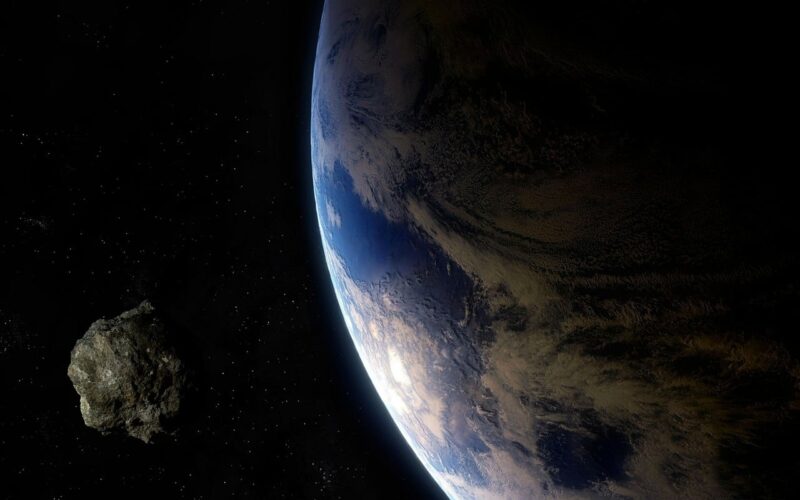
Apophis is a space rock about 1,100 feet (340 meters) across. We often year it call stadium-sized. If you stood it on one end, it’d be about as tall as the Empire State Building in New York City.
Astronomers have spent the years since Apophis’ discovery in 2004 tracking its orbit. Whenever possible, they’ve also been pinging it with radar. They now know its distance from the center of Earth at the 2029 pass to within 3 kilometers (1.9 miles), according to asteroid expert Richard Binzel of MIT. Calculations in recent years have proven the asteroid will glide safely past Earth in both 2029 and 2036, and for the rest of this century.

In 2029, Apophis should pass at a nominal distance of 19,662 miles (31,643 km) from the Earth’s surface. That’s in contrast to the moon’s average distance of about 238,000 miles (384,000 km). And it’s below the orbit of geosynchronous satellites, which need to be 22,236 miles (35,786 km) above Earth’s surface.
What do we know about the upcoming close pass of Apophis?
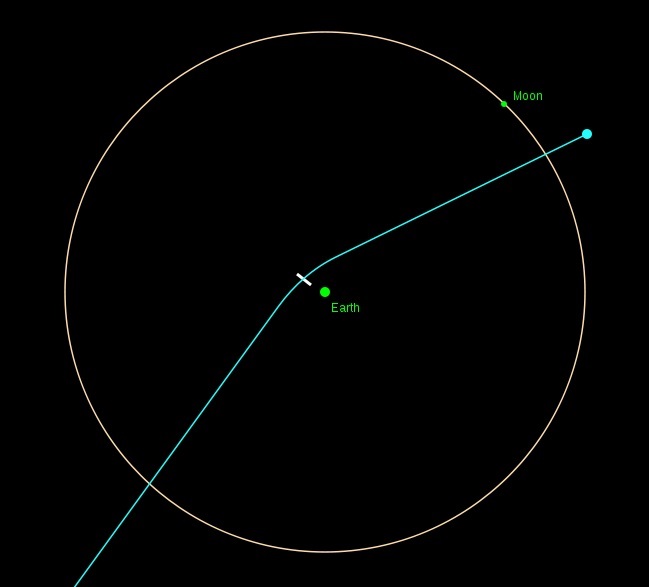
We know that, as the asteroid encounters Earth in 2029, Earth’s gravity will affect it. We know, for example, that the pass will bend the orbit of Apophis slightly. And we know that Earth’s tidal forces – caused by the fact that the pull of gravity increases as the distance between Earth and a space object decreases – will act on the asteroid. That is, gravity will pull harder on the near side of the asteroid than the far side. So we might expect Apophis to be squeezed and stretched ever so slightly – but perhaps in a way that’s measurable, as it passes by Earth.
At the 2029 pass, the pull of Earth’s gravity might cause asteroid-quakes on Apophis. It might cause vibrations, which seismometers could measure. Or it might mean boulders or regolith on the asteroid’s surface are affected, even moved in some way.
Why do astronomers care about this? The fact is that we still don’t know much about the internal structure of Apophis or any other asteroid. And – in the unlikely event that an asteroid ever is headed our way – the asteroid’s internal structure is something we’d want to understand.
The upcoming pass of Apophis in 2029 might aid in our understanding. That is the hope! And it’s why astronomers held a 2026 workshop on Apophis in Padua, Italy.
Who will see Apophis pass?
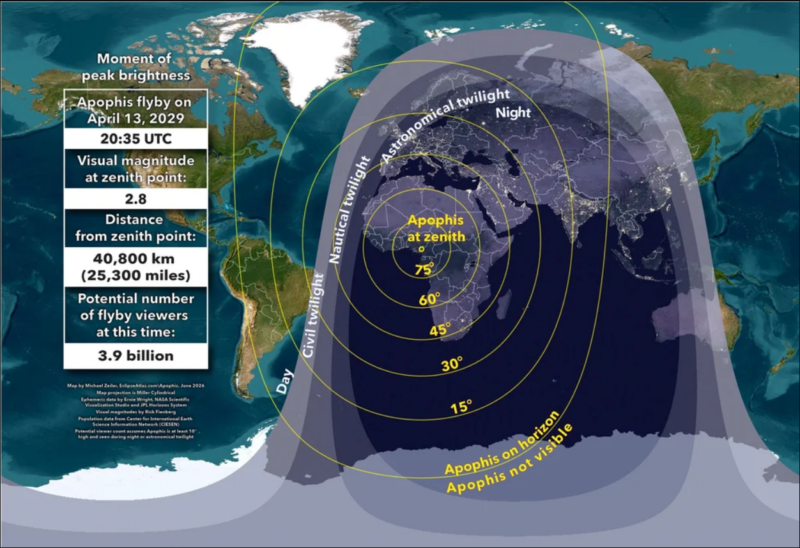
Apophis is the first asteroid in human history whose visible passage near Earth – bright enough to see with the eye alone – is known about for years in advance. At its closest in 2029, it’ll shine at about 2nd magnitude. That’s about as bright as stars in the Big Dipper. At its closest, it’ll look like a slowly moving star in the night sky, moving across the sky at about one moon-diameter every minute.
But you’ll have to be on the night side of Earth, when Apophis passes, to see it pass in 2029. If you’re in Australia, southern Asia, southern Europe, or Africa, you’ll have a front-row seat to see this asteroid when it’s at its brightest. As the asteroid moves farther from the Earth and dims, it might become visible in eastern South America. As evening falls along the east coast of North America, the asteroid will be a telescopic object located in a part of the sky about 15 degrees north of the Pleiades. An ephemeris for the asteroid is here.
At first, Apophis scared people!
Astronomers at Kitt Peak National Observatory near Tuscon, Arizona, discovered Apophis on the evening of June 19, 2004. The team of Dave Tholen, Fabrizio Bernardi and the late Roy Tucker were searching for asteroids low in the western sky. They were specifically looking for objects in the direction of the sun. The asteroid they found was originally designated 2004 MN4. It was 57 degrees from the sun, unusually close for an asteroid.

But astronomers quickly recognized this asteroid was different from most. It orbits the sun in less than one Earth year (Apophis takes 323.6 days to orbit the sun. Earth takes 365.3 days). And Apophis gets nearly as close to the sun as the planet Venus, then heads out to just beyond Earth’s orbit. Its orbit defines Apophis as what astronomers call an Aten-class asteroid.
During its orbit, Apophis can pass very close to the Earth. This fact quickly caught the attention of astronomers worldwide. By December 2004, they had enough data to make a rough calculation of the future orbit of the asteroid. And they found it had a 2.7% chance of hitting the Earth in April 2029, on Friday the 13th. That same month, Apophis moved to the top of the list of potentially hazardous asteroids.
You can imagine the media frenzy that resulted.
Astronomers watched and learned more
It took several more years of studying this asteroid to learn it would not strike Earth in 2029. Why?
When astronomers first discover an asteroid, they can’t define its orbit exactly. Astronomer Richard Binzel told EarthSky:
It’s like when someone hits a baseball. You see the ball arc upward. But where’s it going to go? You can’t tell at first. Observing asteroid orbits is a lot like that. At first, we see just a tiny piece of its orbit. We can’t tell exactly where it’s going to go. We have to track it for awhile to get a good grip on the shape of the orbit.
And, the fact is, an asteroid’s orbital path can be changed slightly, every time it passes near another astronomical object. Also, the Yarkovsky effect – a minor push on the asteroid caused by sunlight – can change its orbit.
Both are known effects. But astronomers can determine the extent of these effects only after careful measurement of an asteroid’s positions over the course of years.
And observing this asteroid year after year isn’t as straightforward as you might think. Some years, the asteroid isn’t observable because it appears too close to the sun, as seen from the Earth. So astronomers imaged Apophis extensively whenever it was visible.
And, by 2006, they were able to determine that Apophis won’t hit the Earth in this century.
Not even in 2036?
The next close approach after 2029 will be in 2036. But a collision possibility for that year was eliminated in 2013.
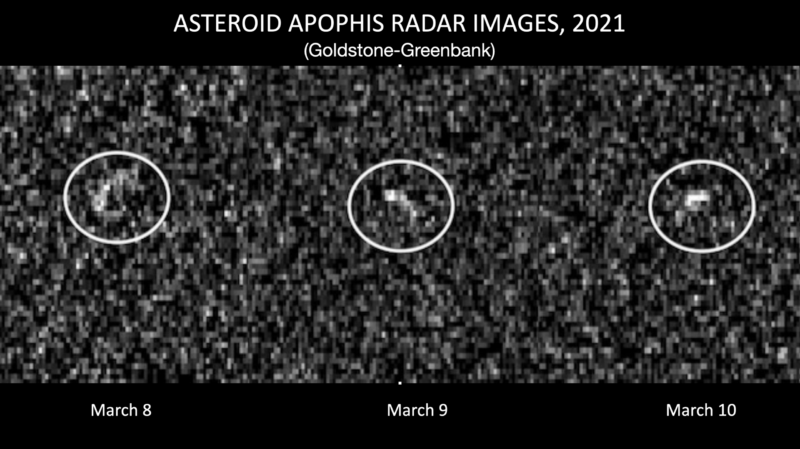
In early March of 2013, all eyes turned toward Apophis as the asteroid made a relatively close sweep (though not nearly as close as in 2029) to our planet on March 6. The Goldstone Deep Space Communications Complex tracked the asteroid for about two weeks around the closest approach. Researchers at the Green Bank Telescope took observations, coordinating with Goldstone because the use of these two telescopes together allows the data to be sharper. The coordination between the two telescopes meant that Goldstone was transmitting data while Green Bank was receiving, performing what is known as a bistatic experiment that doubled the strength of the received signal. Marina Brozovic of NASA’s Jet Propulsion Laboratory explained:
Apophis made a [close approach in 2013] with Earth. It was still nearly 10.6 million miles (17 million km) away. Even so, we were able to acquire incredibly precise information about its distance to an accuracy of about 490 feet (150 meters).
Later calculations enabled NASA scientists to announce on March 26, 2021, that Earth is safe from an impact with the relatively large asteroid for at least the next 100 years. Radar observations taken at NASA’s Goldstone Deep Space Communications Complex in California and the Green Bank Observatory in West Virginia have officially ruled out an impact in 2068, the only year out of the next 100 that previously showed a slight risk. Earlier observations had ruled out impacts during the upcoming 2029 and 2036 flybys.
Davide Farnocchia of NASA’s Center for Near-Earth Object Studies (CNEOS) said:
A 2068 impact is not in the realm of possibility anymore, and our calculations don’t show any impact risk for at least the next 100 years.
Apophis is no longer listed as a risk
This new analysis means that Apophis is no longer on the Sentry Impact Risk Table, which is a list of objects that pass so close by Earth that astronomers have not yet been able to rule out a possible strike.
This campaign not only helped us rule out any impact risk, but it also set us up for a wonderful science opportunity in 2029.
The images seen below are the product of the collaboration. Brozovic went on to describe the excellent quality achieved through the collaboration, which she called:
… a remarkable resolution, considering the asteroid was 10.6 million miles (17 million km) away, or about 44 times the Earth-moon distance. If we had binoculars as powerful as this radar, we would be able to sit in Los Angeles and read a dinner menu at a restaurant in New York.
From Aten to Apollo
Currently, Apophis belongs to the Aten group of near-Earth asteroids. Atens have orbits around the sun that are smaller in total width (semi-major axis) than Earth’s. But they still cross our orbital path.
When it executes its exceptionally close flyby on Friday, April 13, 2029, Earth’s gravitational pull will act as a slingshot on Apophis. This intense gravitational tug will alter and widen the asteroid’s path around the sun. Because its new orbit will have a total width greater than Earth’s, it will be reclassified into the Apollo group.
Apollos are a family of Earth-crossing asteroids with orbits wider than our own.
Apophis between now and then
Apophis is now in a part of the sky that is not observable from Earth. It will remain so until we see it again in 2029.
NASA’s OSIRIS-REx was a historic space mission which brought the first samples from asteroid Bennu back to Earth. The spacecraft remains in good condition and still has a quarter of its fuel left. So NASA has redirected the craft to a new destination. It’s now on its way to Apophis. After a long journey, the craft will reach Apophis in April 2029, just as the asteroid is sweeping past Earth.
And NASA has given the mission a new name. It’s now called OSIRIS-APEX, short for Origins, Spectral Interpretation, Resource Identification, and Security – Apophis Explorer.
Bottom line: In just three years, asteroid Apophis will zoom safely past Earth. This much-anticipated event is a must-see! Here’s how.
Read more: OSIRIS-APEX mission is headed to asteroid Apophis
Read more about the Yarkovsky effect: Pushing asteroids around with sunlight
Like what you read?
Subscribe and receive daily news delivered to your inbox.
More from
Editors of EarthSky


Comet Halley is parent of 2 meteor showers

Inferior conjunction — Venus! October 23-24, 2026
Mercury after sunset and great for Southern Hemisphere!
Meteor shower guide 2026: Up next … the Orionids