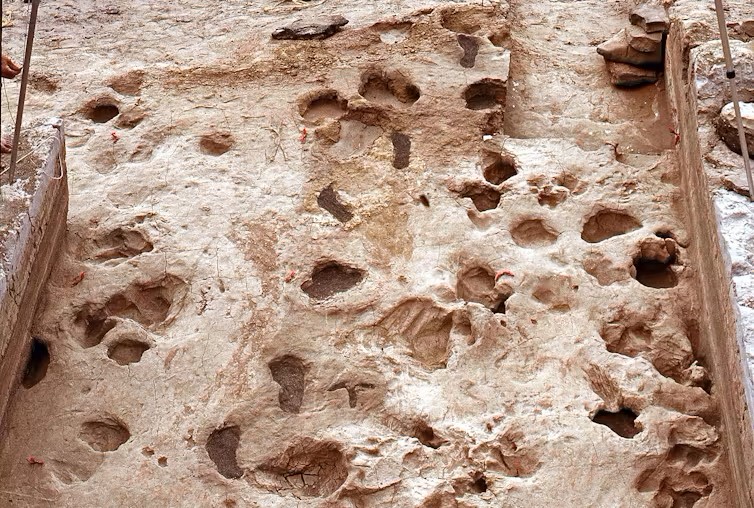
- Some 1.5 million years ago, two hominin species crossed paths. Scientists discovered their tracks fossilized on an ancient shoreline in modern-day Kenya.
- These trackways are etched into rock alongside the footprints of hippos, birds and other animals. The ancient humans might have been scavenging for food.
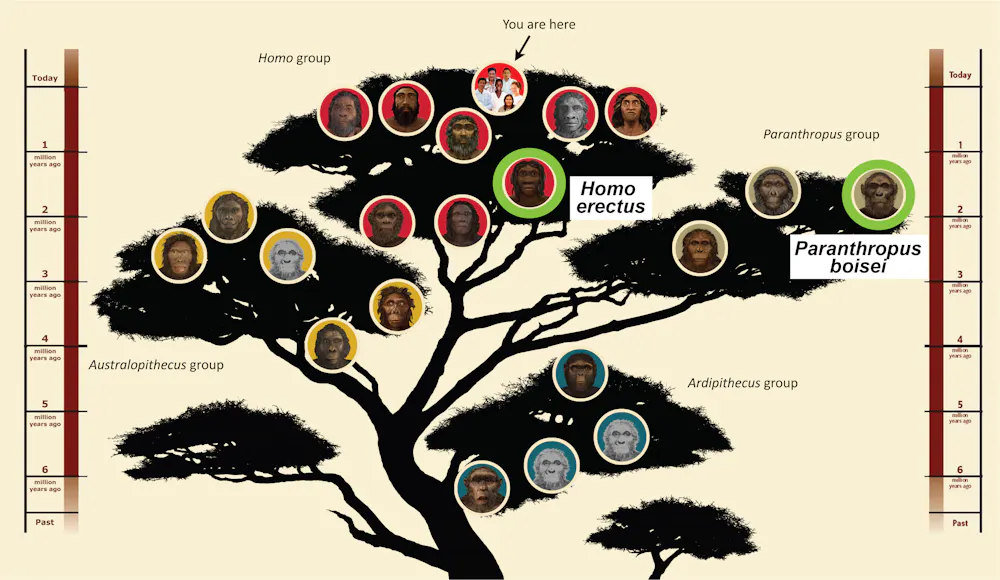
- For the first time, scientists can say these two species – Homo erectus (our likely ancestor) and Paranthropus boisei (a more distant relative) – coexisted at the same time and place.
By Anna K. Behrensmeyer, Smithsonian Institution; Kevin Hatala, Chatham University, and Purity Kiura, National Museums of Kenya
Discovery of two ancient human species footprints together
Human footprints stir the imagination. Indeed, they invite you to follow, to guess what someone was doing and where they were going. Fossilized footprints preserved in rock do the same: They record instants in the lives of many different extinct organisms, back to the earliest creatures that walked on four feet, 380 million years ago.
Now, discoveries in eastern Africa of tracks made by hominins – our ancient relatives – are telling paleontologists like ourselves about the behavior of hominin species that walked on two feet and resembled us but were not yet human like we are today. Our new research focuses on footprints that amazingly record two different species of hominins walking along the same Kenyan lakeshore at the same time, roughly 1.5 million years ago.
Studying ancient tracks like these fills in exciting pieces of the human evolution story. That’s because they provide evidence for hominin behavior and locomotion that scientists cannot learn from fossilized bones.
Finding first fossilized footprints in Kenya
The first discovery of tracks of early hominins in Kenya’s Lake Turkana region happened by chance in 1978. A team led by one of us (Behrensmeyer) and paleoecologist Léo Laporte was exploring the geology and fossils of the rich paleontological record of East Turkana. We focused on documenting the animals and environments represented in one “time slice” of widespread sediments deposited about 1.5 million years ago.
Hippo footprints and more
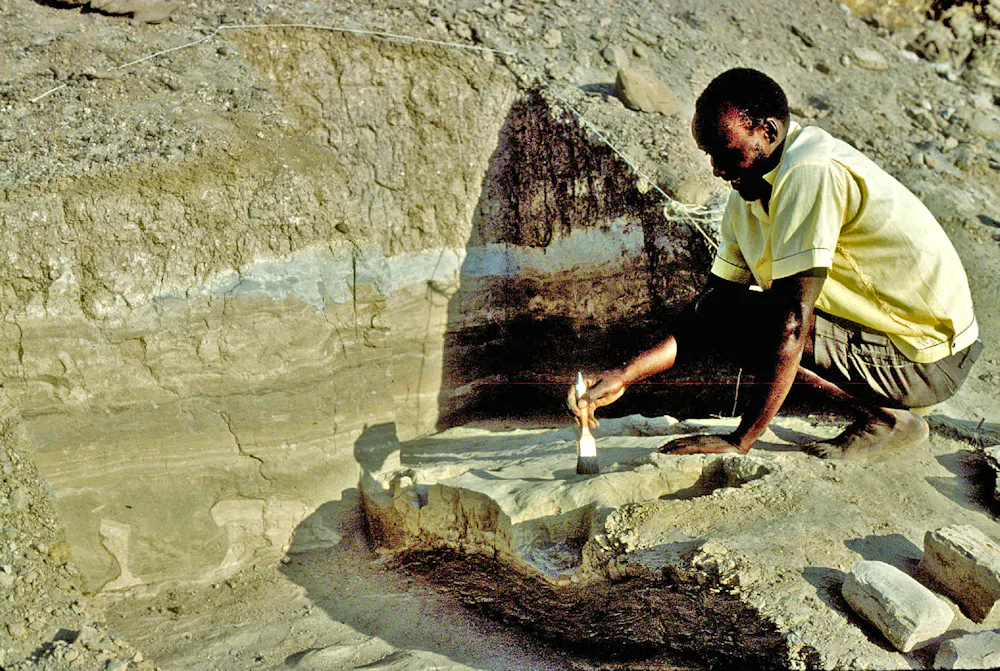
We collected fossils from the surface and dug geological step trenches to document the sediment layers that preserved the fossils. The back wall of one of the trenches showed deep depressions in a layer of solidified mud that we thought might be hippo tracks. We were curious about what they looked like from the top down, or what scientists call the “plan view.” So, we decided to expose one square meter of the footprint surface next to the trench.
Ancient human footprints
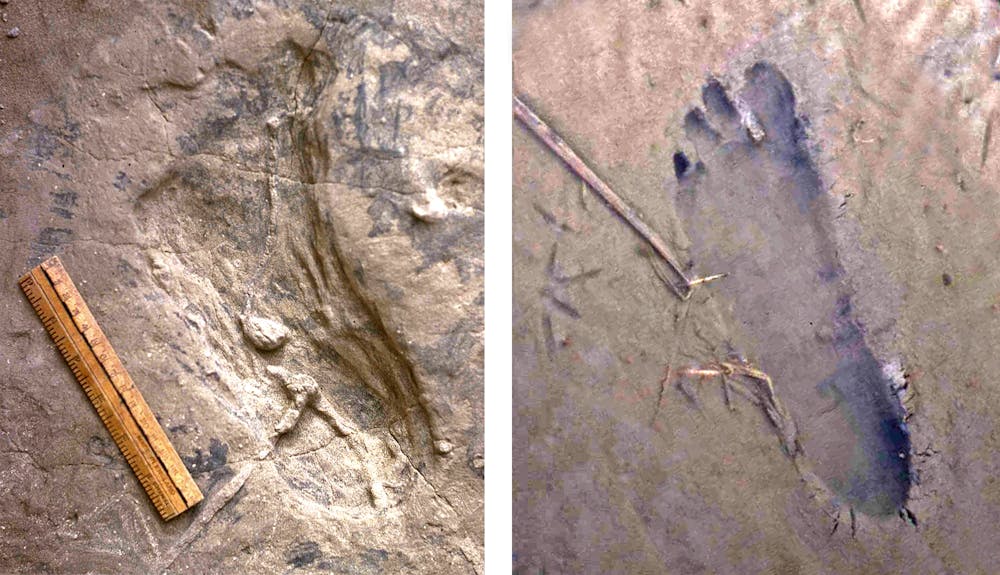
When I returned from more fossil bone surveys, Kimolo Mulwa, one of the expert Kenyan field assistants on the project, had carefully excavated the top of the mudstone layer. There was a broad smile on his face. He said, “Mutu!” – meaning “person” – and pointed to a shallow humanlike print in among the deep hippo tracks.
I could hardly believe it, but, yes, a humanlike footprint was clearly recognizable on the excavated surface. And, there were more hominin tracks, coming our way out of the strata. It was awe-inspiring to realize we were connecting with a moment in the life of a hominin that walked here 1½ million years ago.
We excavated more of the surface and eventually found seven footprints in a line, showing that the hominin had walked eastward out of softer mud onto a harder, likely shallower surface. At one point the individual’s left foot had slipped into a deep hippo print and the hominin caught itself on its right foot to avoid falling; we could see this clearly along the trackway.
Even today on the shore of modern Lake Turkana, it’s easy to slip into hippo prints, especially if the water is a bit cloudy. We joked about being sorry our hominin track-maker didn’t fall on its hands, or face, so we could have a record of those parts, too.
Another set of tracks
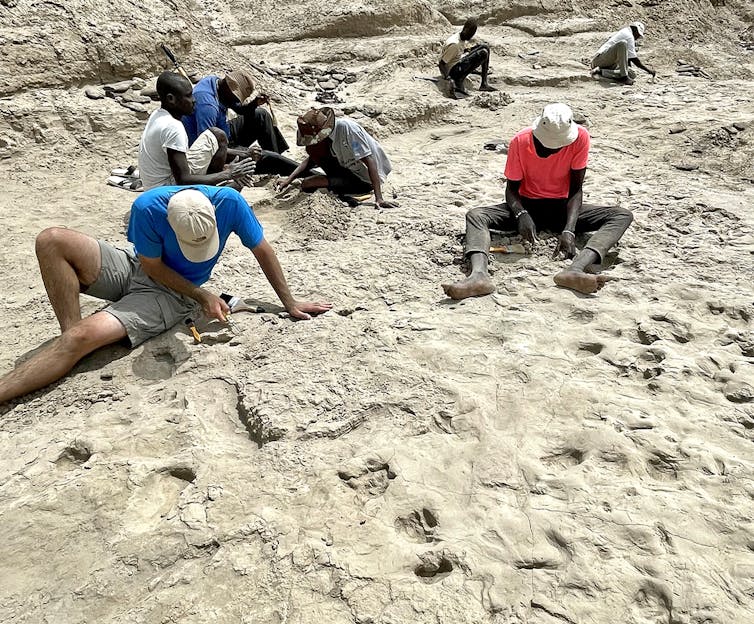
Over four decades later, in 2021, paleontologist Louise Leakey and her Kenyan research team were excavating hominin fossils discovered in the same area. That’s when team member Richard Loki uncovered a portion of another hominin trackway. Leakey invited one of us (Hatala) and paleoanthropologist Neil Roach to excavate and study the new trackway, because of our experience working on other hominin footprint sites.
The team, including 10 expert Kenyan field researchers led by Cyprian Nyete, excavated the surface and documented the tracks with photogrammetry, a method for 3D imaging. This is the best way to collect track surfaces, because the sediments are not hard enough – what geologists call lithified – to remove from the ground safely and take to a museum.

1.5-million-year-old ancient human tracks
The newly discovered tracks were made approximately 1.5 million years ago. They occur at an earlier stratigraphic level than the ones we found in 1978. And these tracks are about a hundred thousand years older, based on dating of volcanic deposits in the East Turkana strata.

Who was passing through?
These footprints are especially exciting. Careful anatomical and functional analysis of their shapes shows that two different kinds of hominins made tracks on the same lakeshore. In fact, they passed within hours to a few days of each other, possibly even within minutes!
We know the footprints were made very close together in time. That’s because experiments on the modern shoreline of Lake Turkana show that a muddy surface suitable for preserving clear tracks doesn’t last long before being destroyed by waves or cracked by exposure to the sun.
This is the first time ever that scientists have been able to say that Homo erectus (our likely ancestor) and Paranthropus boisei (a more distant relative) coexisted at the same time and place. Along with many different species of mammals, they were both members of the ancient community that inhabited the Turkana Basin.

A long-lasting coexistence
Not only that, but with the new tracks as references, our analyses suggest that other previously described hominin tracks in the same region indicate that these two hominins coexisted in this area of the Turkana Basin for at least 200,000 years. They repeatedly left their footprints in the shallow lake margin habitat.
In addition, other animals left tracks there as well. These include giant storks, smaller birds such as pelicans, antelope and zebra, hippos and elephants. But hominin tracks are surprisingly common for a land-based species. What were they doing, returning again and again to this habitat, when other primates, such as baboons, apparently did not visit the lakeshore and leave tracks there?
Reconstructing the past
These footprints provoke new thoughts and questions about our early relatives. Were they eating plants that grew on the lakeshore? Some paleontologists have proposed this possibility for the robust Paranthropus boisei. They theorize this because the chemistry of its teeth indicate a specific herbivorous diet of grasslike and reedlike plants. The same chemical tests on teeth of Homo erectus – the ancestral species to Homo sapiens – show a mixed diet that likely included animal protein as well as plants.
The lake margin habitat offered food in the form of reeds, freshwater bivalves, fish, birds and reptiles such as turtles and crocodiles. Though this food source could have been dangerous for bipedal primates 4 or 5 feet (1.2 to 1.5 meters) tall. Even today, crocodiles occasionally attack people living along the shore. And local hippos can be aggressive as well. So, whatever drew the hominins to the lakeshore must have been worth some risk.
For now, it’s impossible to know exactly how the two species interacted. Future excavations of more trackway surfaces could reveal new clues about their behavior. But it is fascinating to imagine these two hominin “cousins” being close neighbors for hundreds of thousands of years.
Ancient footprints you can visit
A project of the National Museums of Kenya is the development of a museum at earlier excavations of hominin trackways near a village called Ileret. This location is 25 miles (40 km) to the north of our new site. The public, the local Daasanach people, educational groups and tourists will be able to see a large number of 1.5-million-year-old hominin footprints on one excavated surface.
That layer preserves tracks of at least eight hominin individuals. And we now believe they represent members of both Homo erectus and Paranthropus boisei. Among these is a subset of individuals, all about the same adult size, who were moving in the same direction and appear to have been traveling as a group along the lake margin.
The design of the museum built over the track site will prevent erosion and protect it from seasonal rains. A community outreach and education center associated with the museum aims to engage local educational groups and young people in learning and teaching others about this exceptional record of human prehistory preserved in their backyard. The new site museum is scheduled to open in January 2025.

Anna K. Behrensmeyer, Smithsonian Institution; Kevin Hatala, Chatham University, and Purity Kiura, National Museums of Kenya
This article is republished from The Conversation under a Creative Commons license. Read the original article.
Bottom line: Scientists have discovered ancient human tracks of two different species, showing that they coexisted on the African shore.
Read more: World’s oldest human footprint identified in South Africa
Read more: Rare dinosaur tracks are longest continuous set of sauropod footprints
Like what you read?
Subscribe and receive daily news delivered to your inbox.
More from
EarthSky Voices


Olbers’ paradox asks ‘Why is the night sky dark?’

Why leaves change color in the autumn
How a helium leak in an exoplanet atmosphere hints at life
Would a Yellowstone supervolcano eruption end humanity now?