By Alan Dykes, Kingston University
Why the Pacific tsunami was smaller than expected
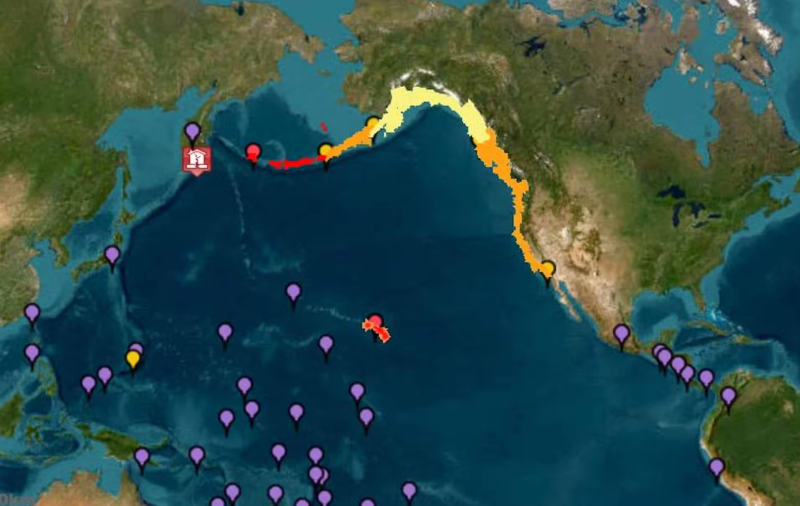
The earthquake near the east coast of the Kamchatka peninsula in Russia on July 30, 2025, generated tsunami waves that reached Hawaii and coastal areas of the U.S. mainland. The earthquake’s magnitude of 8.8 was significant, potentially making it one of the largest quakes ever recorded.
Countries around much of the Pacific, including in East Asia and North and South America, issued alerts and in some cases evacuation orders in anticipation of potentially devastating waves. Waves of up to 4 meters hit coastal towns in Kamchatka near where the earthquake struck, apparently causing severe damage in some areas. (For reference, a meter is about 39 inches, just over a yard.)
But in other places waves have been smaller than expected, including in Japan, which is much closer to Kamchatka than most of the Pacific rim. Many warnings were quickly lifted with relatively little damage. It seems that for the size of the earthquake, the tsunami was rather smaller than might have been the case. To understand why, we can look to geology.
Shifting plates
The earthquake was associated with the Pacific tectonic plate, one of several major pieces of the Earth’s crust. This pushes northwest against the part of the North American plate that extends west into Russia, and is forced downward beneath the Kamchatka peninsula in a process called subduction.
The United States Geological Survey (USGS) says the average rate of convergence – a measure of plate movement – is around 80 mm (3 inches) per year. This is one of the highest rates of relative movement at a plate boundary.
But this movement tends to take place as an occasional sudden movement of several meters. In any earthquake of this type and size, the displacement may occur over a contact area between the two tectonic plates of slightly less than 400 km by 150 km (about 250 by 90 miles), according to the USGS.
Tsunami waves arise from displaced water
The Earth’s crust is made of rock that is very hard and brittle at the small scale and near the surface. But over very large areas and depths, it can deform with slightly elastic behavior. As the subducting slab – the Pacific plate – pushes forward and descends, the depth of the ocean floor may suddenly change.
Nearer the coastline, the crust of the overlying plate may be pushed upward as the other pushed underneath, or – as was the case off Sumatra in 2004 – the outer edge of the overlying plate may be dragged down somewhat before springing back a few meters.
It is these near-instantaneous movements of the seabed that generate tsunami waves by displacing huge volumes of ocean water. For example, if the seabed rose just one meter across an area of 200 by 100 km (about 120 by 60 miles) where the water is 1 km (.6 mile) deep, then the volume of water displaced would fill Wembley Stadium to the roof 17.5 million times.
A 1-meter rise like this will then propagate away from the area of the uplift in all directions, interacting with normal wind-generated ocean waves, tides, and the shape of the sea floor to produce a series of tsunami waves. In the open ocean, the tsunami wave would not be noticed by boats and ships, which is why a cruise ship in Hawaii was quickly moved out to sea.
Depth is key
The tsunami waves travel across the deep ocean at up to 440 miles per hour (700 kph), so they may be expected to reach any Pacific Ocean coastline within 24 hours. However, some of their energy will dissipate as they cross the ocean, so they will usually be less hazardous at the farthest coastlines away from the earthquake.
The hazard arises from how the waves are modified as the seabed rises toward a shoreline. They will slow and, as a result, grow in height, creating a surge of water toward and then beyond the normal coastline.
So why did the Kamchatka earthquake not cause the devastation you might expect? The answer is that it was slightly deeper in the Earth’s crust (20.7 km or 13 miles) than the Sumatran earthquake of 2004 and the Japanese earthquake of 2011. This will have resulted in less vertical displacement of the seabed, which, as we’ve explored, means less water displacement.
Plus, the earthquake’s depth means the movement of the seabed will have been slightly less instantaneous, further weakening the displacement. This is why we saw tsunami warnings lifted some time before any tsunami waves would have arrived there.
Alan Dykes, Associate Professor in Engineering Geology, Kingston University
This article is republished from The Conversation under a Creative Commons license. Read the original article.
Bottom line: Despite being one of the strongest quakes ever recorded, the July 2025 Kamchatka earthquake didn’t cause tsunami waves as devastating as expected. The answer lies in the earthquake’s depth.
Like what you read?
Subscribe and receive daily news delivered to your inbox.
More from
EarthSky Voices


Olbers’ paradox asks ‘Why is the night sky dark?’

Why leaves change color in the autumn
How a helium leak in an exoplanet atmosphere hints at life
Would a Yellowstone supervolcano eruption end humanity now?