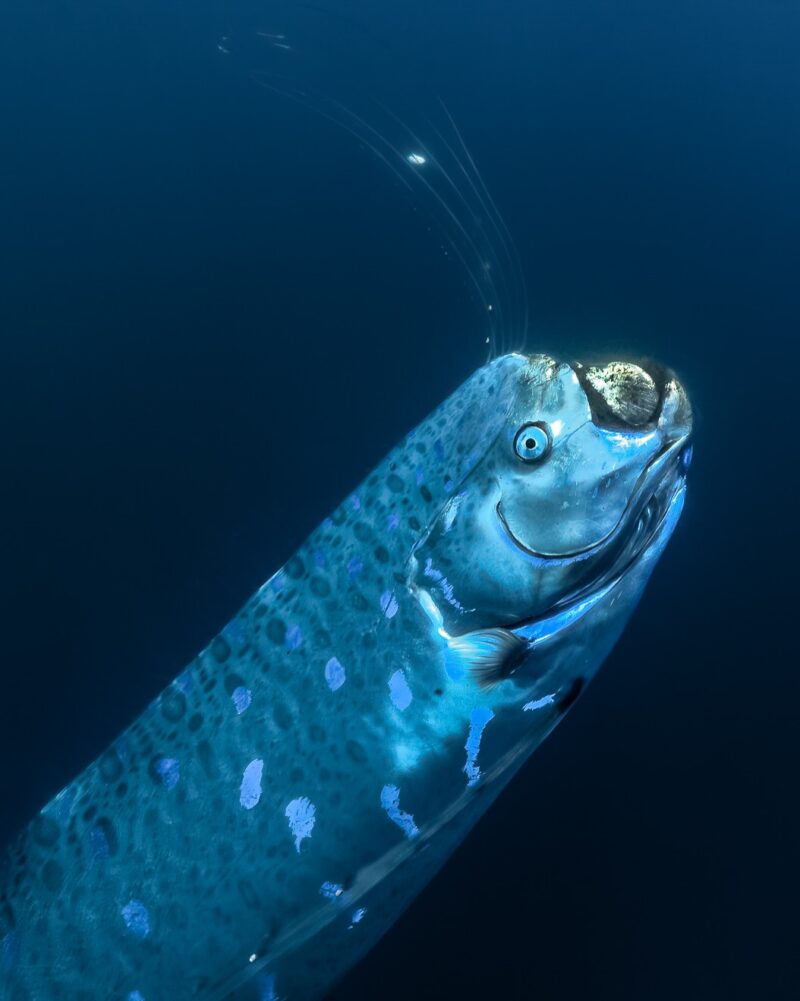
If you’re fascinated by extraordinary creatures like the Loch Ness Monster, get ready to meet a real-life giant. But forget about the Scottish lochs. The oarfish inhabits the ocean’s depths, a dark world where sunlight barely reaches.
Few people have been lucky enough to see this magnificent animal in its vast natural habitat, and even fewer have had the chance to study it in depth. But late last month, a team of scientists discovered something fascinating.
Could the oarfish’s remarkably efficient and stealthy swimming, powered by its long dorsal fin, hold the key to new advances in underwater robotics? Inspired by nature, these innovations could one day let us explore the ocean’s hidden wonders while leaving its inhabitants undisturbed.
The researchers published their study in the peer-reviewed journal BioOne on September 30, 2026.
The oarfish’s fin inspires underwater robotics
The giant oarfish can reach around 26 feet (8 meters) in length, making it a true ocean colossus. Its body is long and slender, with a ribbon-like shape that gradually tapers toward the rear. Just to give you an idea of how enormous it is, it took no fewer than 15 men to hold a specimen measuring a mere 23 feet (7 meters)!
But its appearance is just as striking. This creature has no scales; instead, its sides shimmer with a brilliant silvery sheen thanks to a covering that contains guanine, a substance responsible for its distinctive metallic appearance.
This smooth, gleaming surface contrasts with its vivid red and orange dorsal fin, which runs along almost the entire length of its back, from its head to the rear of its body. The first few fin rays are especially long, forming a striking crest above its head, as if the fish were wearing a crown of fire.
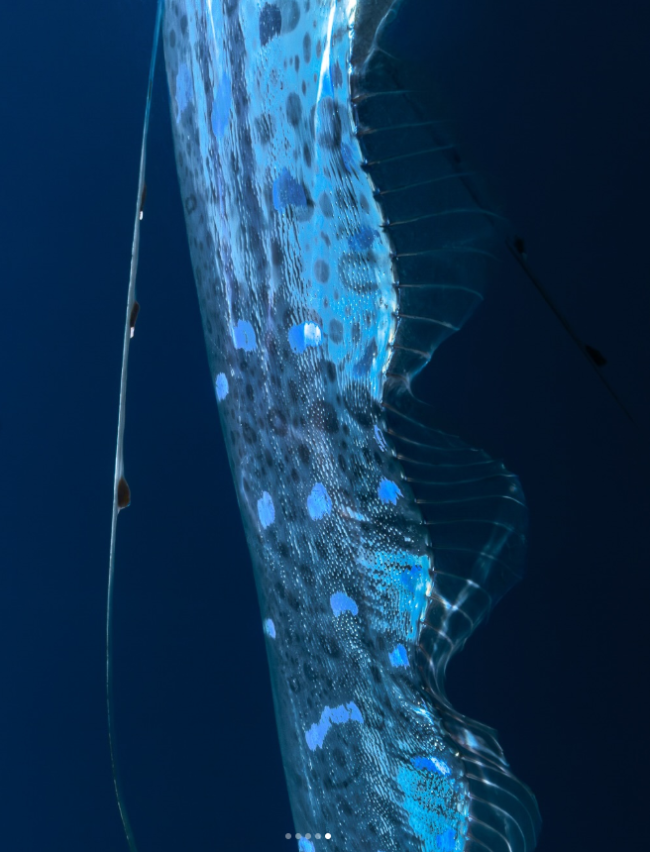
But its long dorsal fin is far more than decoration. It plays a major role in the fish’s movement, generating waves along the fin without requiring large side-to-side movements of the body.
This raises a fascinating question: how does the fish coordinate such a long structure, made up of numerous fin rays, to produce such fluid motion? To understand this, researchers must look beyond its striking silhouette and examine how the muscles, joints and skeletal elements of its fin are arranged.
This is where a research project begins to connect the biology of the fish with a very different field: underwater robotics.
Inspired by nature, designed to explore
Unlike many fish, the oarfish can propel itself by sending waves along its dorsal fin while keeping its body relatively steady. Although scientists already knew it swam this way, they still needed to understand how it controls such a long, complex structure with such precise coordination.
To investigate, a research team led by Gabriel Vinícius Felix Afonso, a Ph.D. student at the Virginia Institute of Marine Science, studied the anatomy of the dorsal fin in detail. By examining specimens, using imaging techniques and analyzing videos of oarfish in the wild, they studied how the muscles, joints and fin rays are arranged and how they work together to produce movement.
The findings revealed a surprising mechanism: each fin ray is controlled by a group of six muscles, which attach to it at twelve points. The joint also works much like a ball-and-socket joint, similar to the one in the human shoulder, allowing it to rotate in every direction through a full 360 degrees. Together, these muscles and joints help explain how the fish coordinates its fin movements to generate waves along its length.
Interestingly, the oarfish’s name does not come from its striking dorsal fin, but from its unusually long pelvic fins. Located beneath the front part of its body, each of these fins consists of a single ray that resembles a little oar. But despite inspiring the fish’s name, these pelvic fins are not primarily responsible for its distinctive swimming motion. That role belongs to the dorsal fin, whose precisely coordinated movements allow waves to travel along the fish’s body.
We asked Felix Afonso: “How did the oarfish inspire you to design an aquatic robot?” He said:
If you look at large species of fish that live in the open ocean, you will see fish with spindle-like shapes, such as tunas and billfish, as well as round shapes, such as sunfish and opahs. Unlike those species, the oarfish has an unusual body shape for an open-ocean fish. Interestingly, the oarfish does not swim by undulating its body like an eel. Instead, the oarfish keeps its body rigid while only its long dorsal fin undulates. This combination of an unusual body shape and an unexpected swimming mode attracted our attention, prompting us to study the oarfish’s functional morphology for future biomimetic robotic applications.

An inhabitant of the deep
Despite its unforgettable size, shimmering appearance, super long pelvic fins and hypnotic dorsal fin motion, the oarfish remains one of the lesser-known inhabitants of the deep ocean.
The oarfish is found throughout the world’s oceans, particularly in tropical and temperate waters. But it lives mainly in open water, far from shore and at depths where sunlight grows increasingly faint.
It is typically found hundreds of feet below the surface, with records reaching depths of around 3,280 feet (1,000 meters). There, in an environment that is difficult to observe directly, much of its life unfolds beyond our view, leaving researchers with many unanswered questions.
In addition, sightings near the surface are unusual and sometimes involve animals that are weakened or in distress. This makes their behavior difficult to study. Finding a stranded specimen or one close to shore allows scientists to examine its anatomy, but it is not the same as observing how it lives and behaves in its natural environment.
A giant that feeds on tiny prey
You might expect an animal this size to feed like a formidable predator, but the reality is quite different. The oarfish feeds mainly on small organisms, including krill and other planktonic crustaceans. Small fish and squid have also been reported among its possible prey.
Its head is relatively small compared with the length of its body and ends in a short, protrusible mouth that can extend forward to capture food. But it doesn’t need powerful jaws or an impressive set of teeth: its gill structures help trap tiny organisms as water passes through its mouth. Rather than chasing large prey, it makes use of much smaller food sources suspended in the water.
It’s remarkable that a fish capable of growing several feet long gets much of its nourishment from such tiny creatures. It’s also a reminder of just how diverse feeding strategies can be among marine animals.
The oarfish has also been observed swimming vertically, with its head pointing upward. Scientists believe this posture may help it spot prey silhouetted against the light filtering down from the surface. It may also make the fish less visible to predators looking down from above.
Nature’s lessons for safe ocean exploration
Over millions of years, animals have evolved remarkable ways to move, feed and adapt to their surroundings. Studying these abilities allows us to better understand the natural world, revealing just how much there is still to learn from the creatures with which we share our planet.
What we learn from them can also inspire new technologies. In the case of the oarfish, understanding how it swims could help researchers develop quieter underwater robots, opening up new ways to explore the ocean and observe marine life while causing as little disturbance as possible.
The more we learn about animals and the environments they depend on, the better we can protect them. By combining scientific discovery with more respectful ways of exploring, we can uncover some of the ocean’s secrets while helping preserve the remarkable life it sustains.
Bottom line: The giant oarfish has a remarkable fin that could inspire quieter underwater robots and open new possibilities for ocean exploration and conservation.
Read more:
Ocean sunfish are odd, gentle giants: Lifeform of the week
Anglerfish are our mysterious, deep-sea lifeform of the week
Like what you read?
Subscribe and receive daily news delivered to your inbox.
More from
Cristina Ortiz


New clues to how infectious fungus Candida auris resists antifungals

Amazon wildfires hide another threat to the rainforest
The Komodo dragon is the world’s largest living lizard
Scientists discover a new tiger cat hiding in plain sight